

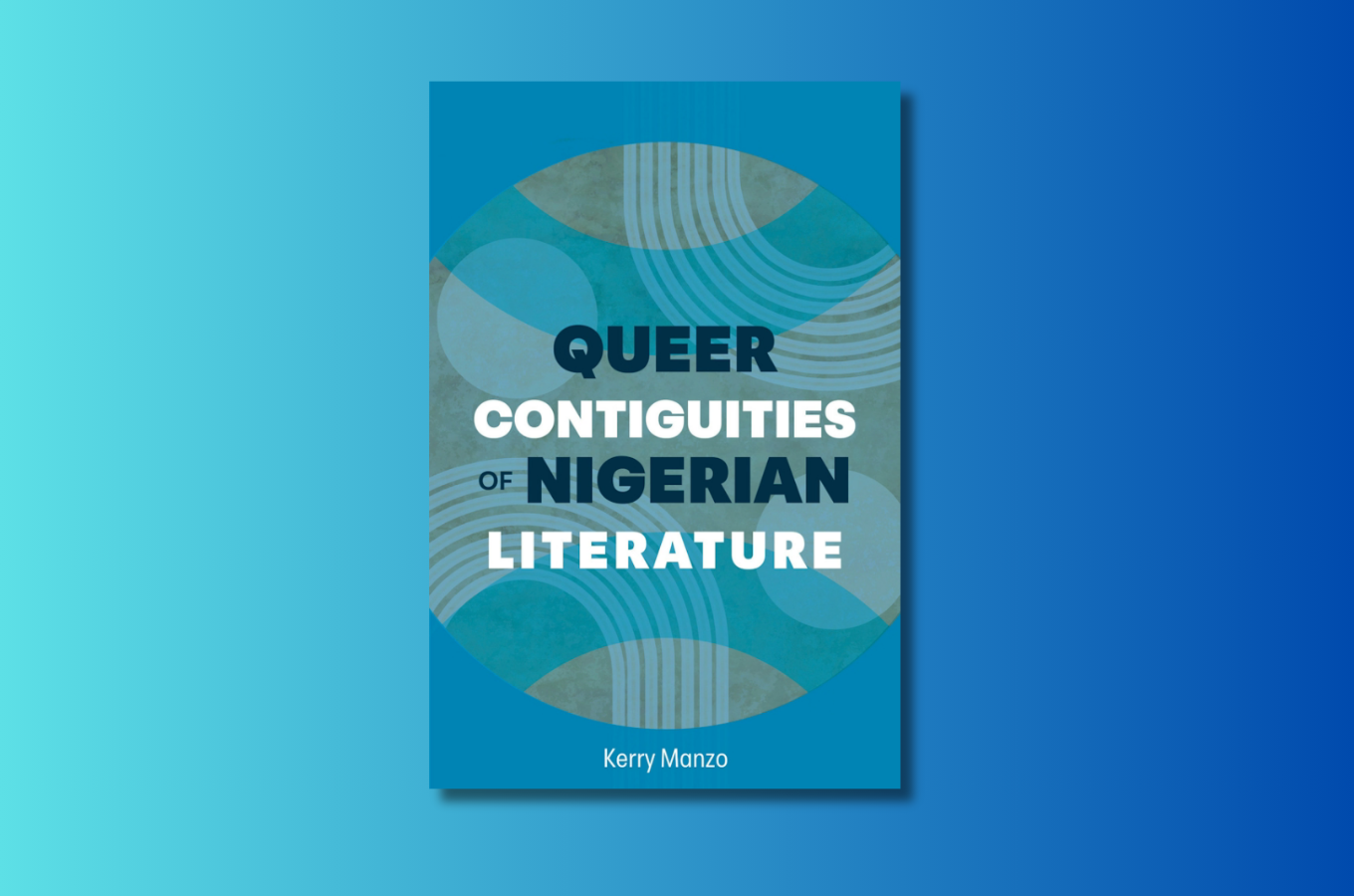
Published this month by Michigan State University Press, Queer Contiguities of Nigerian Literature by Kerry Manzo is a timely and rigorous intervention in how we read and understand Nigerian literature. The book’s central argument is both straightforward and consequential: that normative ideas about sex and gender have not been peripheral to the development of Nigerian letters, they have been foundational to it. By placing sexuality and gender at the centre of its critical framework, Manzo offers a way of reading the tradition that refuses to treat its exclusions as incidental.
The six chapters move deliberately through Nigerian literary history, opening with the gender politics of the Mbari movement, then turning to the sexual politics of Ibadan modernism as expressed in Black Orpheus. From there, the book attends to the rendering of queer bodies in fiction, the coloniality of gender and its transgender dimensions, the bio-logic of heterocoloniality as seen through woman-to-woman marriage, and finally, queer temporalities and epistemologies in contemporary writing. It is a coherent arc, each chapter building the conceptual architecture that gives the book its two most important contributions: the framework of “heterocolonial modernity” and the interpretive method of reading “contiguously”, attending to how different historically specific discourses move simultaneously alongside one another rather than in neat sequence, and how those contiguities reverberate through literary texts.
Drawing on archival research that includes institutional records, personal letters, small publications, and other ephemera, Manzo reconstructs the historical and material conditions that have constrained literary representation of women and sexual minorities, and shaped what he calls the national masculine tradition of letters.
The praise the book has already drawn speaks to how much it is needed. Brenna M. Munro, author of South Africa and the Dream of Love to Come, describes it as a vital intervention into global queer, trans, and feminist studies, one that offers a fresh account of Nigerian literary modernism by disentangling the operations of heteronormativity in both the history of the movement and the texts themselves. Terri Ochiagha, fellow at Harvard’s Hutchins Center and author of Achebe and Friends at Umuahia, calls it an intellectually daring work of literary history and an exciting milestone, one that disrupts what she names “the cloying orthodoxies of African literary history in rigorous, culturally nuanced ways.” Lindsey Green-Simms, author of Queer African Cinemas, writes that the study reshapes how we understand Nigerian literature altogether, revealing how colonialism, heterosexual normativity, and gendered power have shaped the conditions of literary emergence from Mbari to the present. Kanika Batra, author of Worlding Postcolonial Sexualities and co-editor of the Journal of African Cultural Studies, calls it a must-read for scholars and students in postcolonial, African, and Global South gender and sexuality studies, and a singular contribution to the field.
Manzo is an assistant professor of Global Studies at the State University of New York at Purchase College, and his work sits at the crossroads of decolonial method, queer and trans theory, Global South feminisms, and postcolonial criticism. His published articles have appeared in Research in African Literatures and African Literature Today, and he is a member of the Queer African Studies Association. This book, which draws on fellowship-supported dissertation research, is his first. For readers of Nigerian literature, whether scholars, students, or the curious, this is a book that will change what you notice when you read.
Queer Contiguities of Nigerian Literature is available in paperback, ePub, and PDF. Purchase your copy at msupress.org.




COMMENTS -
Reader Interactions