

Across the continent, African stories are reclaiming their voice through audio, technology, and a new wave of cultural builders.
***
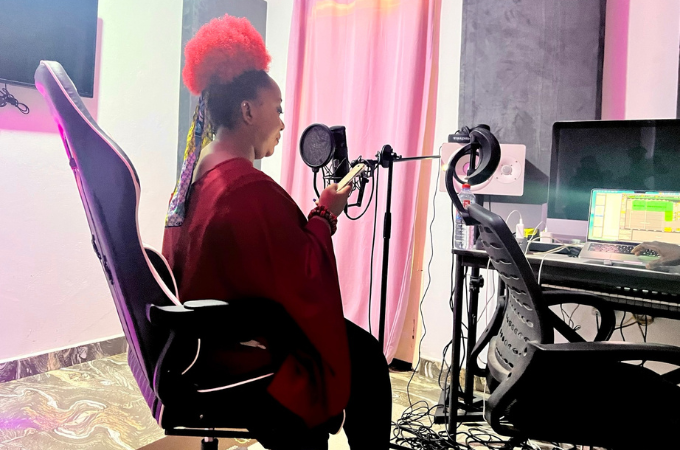
In a recording studio in Accra, a measured, lyrical, and unmistakably Ghanaian voice rises. This is where stories are no longer just written. They are heard.
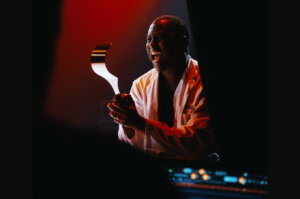
Across from me, Apiorkor Seyiram Ashong-Abbey, a poet, media practitioner, TED speaker, and one of the most compelling voices shaping contemporary African literary culture, leans into the microphone, phone in hand, shaping each sentence carefully, for meaning and nuance.
Apiorkor describes herself as a storyteller “in verse, in voice, and in vision.” Her work moves fluidly between poetry, journalism, activism, and performance, which she calls Verse Journalism. It’s an art form blending artistic expression with social commentary, and that resists boundaries.
She is not simply reading; she is performing and interpreting the words in front of her, returning to old traditions practiced long before the ancient Egyptians recorded African text. So that today, African stories are no longer just written but once again heard.
***
For me, the journey into audio is deeply personal and was shaped by my mother, a children’s book author who later lost her sight. I was confronted with a simple but profound question: what happens to stories when the people who need them most can no longer access them? Faced with the reality that many African stories were inaccessible, I began to imagine a future where African literature could be experienced through voice, not just text. It eventually became the foundation for AkooBooks Audio.
Across the continent, the lack of access to books remains one of the biggest barriers to building a reading culture. Books are expensive, and distribution is uneven, while payment systems don’t always work in ways that make buying books easy. But that is changing as we rethink beyond how Africans read and use listening as the gateway.
To many African audiences, audio is not just aesthetics; it is simply practical. Listeners can access stories on mobile-first platforms, like AkooBooks, designed to work seamlessly across African markets and the diaspora. Through subscription models, curated bundles, and telco integrations, we are beginning to reshape how African stories circulate all on our own African terms, which is why, to me, audio feels less like a shift and more like a homecoming.
My work doesn’t stop at the continent. I currently serve as the Audio Ambassador for the Frankfurt Book Fair (2025–2026). In this role, I work with publishers, platforms, and technology players across global markets, advocating for African stories in the rapidly expanding global audio economy. It is one of the most influential spaces where conversations about the future of publishing happen, in real time, especially around audio, access, and emerging technologies like AI. In those conversations, one thing is clear: the global audio market is expanding rapidly.
But the question remains—whose stories are being heard?
***
AkooBooks is not simply about platform or distribution; it is about creation.
Back inside the studio, the session continues. You will find a microphone, acoustic panels, and the quiet concentration of a narrator finding their rhythm and breath. It is not a seamless process. Lines are repeated, pauses, adjustments, and tiny decisions that turn text into something alive. What emerges is not just a recording, but an experience that carries the intimacy of oral storytelling into headphones, cars, classrooms, and cities far beyond where it began.
For artists like Apiorkor, whose work already exists in performance, audio is an extension of that and not simply an adaptation. Her poetry has travelled across global stages, from TED platforms to international festivals, blending music, movement, and spoken word into immersive experiences.
In the studio, her energy becomes something softer and more intimate. Audiobooks restore the essential tools of African storytelling: voice, cadence, and emotion, not simply as secondary or alternate formats, but the primary act.
My vision is taking shape in the growing catalogue of African audiobooks being produced and distributed on our platform, from contemporary works to iconic voices in African culture.
Recent titles include Mr. Music Man: The Journey, the life story of Ghanaian music legend Kojo Antwi, bringing one of Africa’s most celebrated artists into the audio space for both local and global audiences. AkooBooks Audio has grown into a movement reimagining how African stories are created, distributed, and heard.
African stories now travel beyond the page, through voice. And if you listen closely, you can hear the future of African literature, already in motion, too.



COMMENTS -
Reader Interactions