
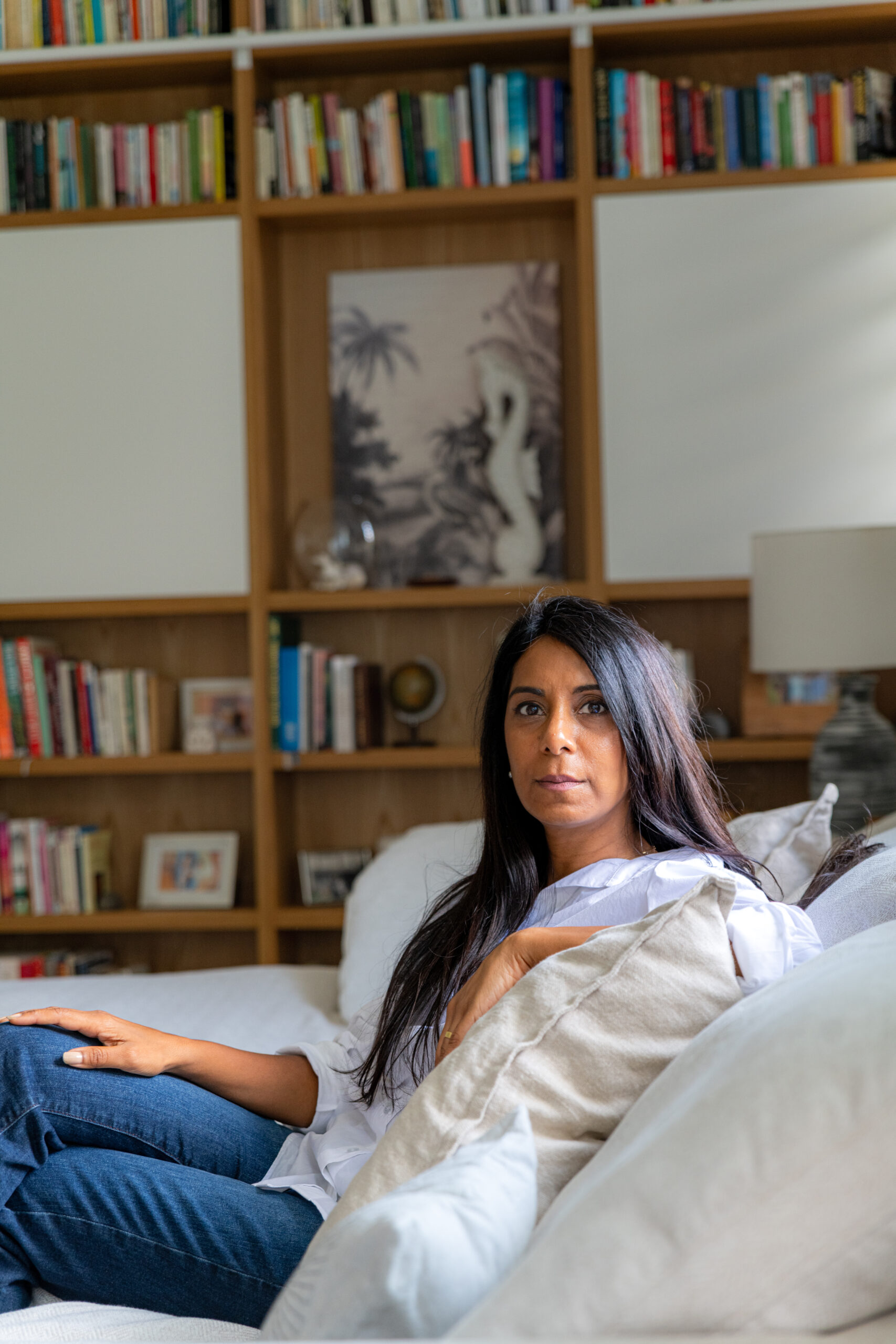
We are honored to feature Priya Hein in our ongoing celebration of contemporary voices shaping African and diasporic literature. Hein is a Mauritian author whose work explores the complexities of identity, belonging, and the legacies of colonialism. She is one of the emerging anglophone writers from Mauritius, contributing to a literary tradition long dominated by francophone voices. Her debut novel, Riambel, was written during the BLM movement in 2020, and her stories illuminate the lives often hidden behind the glossy tourist images of her island home.
Her second novel, Tamarin, is a haunting exploration of grief and homecoming. The story follows Anita Ram, a Mauritian woman who returns home from London after an unraveling experience, seeking solace in the sea and her mother’s care. The novel explores the weight of cultural expectations around motherhood, the complexities of women’s relationships, and how the body carries internalized trauma.
In this interview, we talk about the inspiration behind Anita’s story, writing the body as a site of healing and pain, and the literary landscape of Mauritius as a new generation of anglophone writers emerges.
***
Ainehi Edoro
Hi Priya. Congratulations on Tamarin! It is such a beautiful, haunting book. How are you feeling now to have book #2 out in the world?
Priya Hein
Thank you for reading my second novel and for your kind words, Prof Edoro! It feels exciting and yet daunting to have Tamarin out in the world.
Ainehi Edoro
Let’s start with Anita. What inspired her story?
Priya Hein
When my father passed away ten years ago, I was feeling overwhelmed and started to write a short story about grief. When I finished writing it, the main character, Anita Ram, kept haunting me. There was much more to be said so, over the years, I kept going back to the story and adding more pages until it finally turned into a novel.
Ainehi Edoro
That ending, though. I’m still reeling. What made you want to tell the story in this way, with that kind of tension and surprise?
Priya Hein
I don’t wish to give too much away here, but Tamarin was written in a more traditional way than my experimental novel, Riambel. As I rewrote Tamarin, I had a nagging feeling that something was missing and wanted to add a twist. In the end, I decided to try something different and play with anagnorisis (which I hope will also help keep my readers on their toes!).
Ainehi Edoro
Your writing about Mauritius is vivid. I could almost smell the sea and the sandalwood. But I could also sense you pushing against the version of Mauritius that’s often presented to the world as paradise, that glossy, tourist image of the island.
Priya Hein
Indeed, Mauritius is often showcased as paradise in glossy brochures that are used to lure tourists and expats to our island. In both Riambel and Tamarin I try to depict not only the other side of the postcard, but also the people behind these images. I try to portray other aspects of Mauritius and glimpses into the lives fragmented by the enduring legacy of slavery and indenture. In Riambel Noemi lives in a shanty town and in Tamarin Anita lives in Palma, which are places that tourists won’t necessarily visit. Sadly, there is another reality festering under the tyranny of the glossy brochures.
Ainehi Edoro
For many of our readers, Tamarin might be their first encounter with literature from Mauritius. What should people know about the literary scene there, and how do you see your work in that context?
Priya Hein
Mauritius has a very rich history of literature and lately Mauritian women authors have been garnering a lot of recognition on the global literary scene: Authors such as the prolific Ananda Devi who has won numerous accolades including the 2024 Neustadt International Prize for Literature, and Nathacha Appanah who has been shortlisted for several prestigious prizes including the Prix Goncourt for her latest novel La nuit au coeur. For a long time, the literary voices from Mauritius were predominantly francophone writers and I am one of the few exceptions. But the tide is now turning with a new wave of anglophone writers emerging from Mauritius.
Ainehi Edoro
Let’s talk about Anita’s body. So much of her story lives in physical feeling, the fatigue, the grief, the longing, the joy of swimming. How did you approach writing the body as a way of telling her story?
Priya Hein
As my new book is also about mental health and Anita’s internal struggles, I wanted to write about how the body reacts to internalized and repressed trauma. After her incident at university, we see how Anita neglects her appearance and stops nourishing her body because she blames herself and does not want to be objectified and seen as “exotic”. We also see the effects of stress as she leaves London and goes back to Mauritius and the quiet restorative power of coming home to the sea, which is deeply therapeutic and baptismal, and to her mother’s homecooked meals. We see the transformation in her as she heals and becomes stronger every day. Very often our body senses we’re unwell before our mind, which is something I also try to explore in my writing.
Ainehi Edoro
Fertility is such a charged theme. Anita clearly feels cultural pressure to become a mother, but she also genuinely wants it for herself. How did you navigate that tension between personal desire and social expectation?
Priya Hein
Although I wrote in the Mauritian context, women all over the world have to put up with this sort of pressure and are expected to conform to societal roles. We are told to be a ‘good’ girl, daughter, sister, wife, mother and when we don’t fit into neat moulds, or dare to be different, we are often ostracized. Anita truly wanted to be a mother and is devastated when she is unable to. We see how it leads to the collapse of her marriage: she feels like a failure as the social pressures from all sides weigh her down to the point of depression, themes that are still taboo in some communities.
Ainehi Edoro
I love how women’s relationships are at the center of the book: mothers, sisters, nieces, friends. The relationships are messy but feels real. I have two sisters, so I felt I could relate to some of the complexities you address. Did that web of feminine connections come from personal experience, or did it grow naturally as you were writing?
Priya Hein
I come from a big Mauritian family and grew up in a predominantly female household which influenced the family dynamics. Hence, I am used to tensed relationships and female rivalry. In Tamarin I wanted to revisit the complexities of some of these relationships and their long-lasting effects.
Ainehi Edoro
Your books are small in size but intense in feeling. Do you intentionally write short novels, or do stories just tell you when they’re done?
Priya Hein
Writing short novels is not intentional on my part, my characters tend to do their own things and let me know when they are done. I deliberately leave large gaps in Riambel that can be interpreted as the white silences of history of what is not being said. Silence is sometimes more effective than having to spell everything out.
Ainehi Edoro
I like to know what writers read. What are you reading these days?
Priya Hein
I was invited to The Macondo Literary Festival in Kenya, for the launch of Tamarin, where I met Yewande Omotoso whose book The Woman Next Door I am currently reading. I am absolutely loving her main character, her sharp prose and wittiness!
Ainehi Edoro
Second books come with their own kind of pressure. Did writing Tamarin feel easier, harder, or just different from your first book?
Priya Hein
Technically, Tamarin is my first book which I started writing in 2015. I put it aside to write Riambel which I felt compelled to write during the BLM movement in 2020. Riambel came from a strong feeling of anger and I wrote the first draft over one long weekend. The words just flowed out of me so in a sense it was easier and much faster. Whereas with Tamarin, since I had already written an early draft, I did not necessarily feel the pressure of having to write a new one from scratch. I took my time and as I gained experience as a writer and in life, I kept writing and going back to the manuscript which didn’t feel ready until recently.
Ainehi Edoro
Thanks for chatting with us. Congrats again on the book. All the very best from all of us at Brittle Paper.
Priya Hein
Thank you. It is always a pleasure!



COMMENTS -
Reader Interactions