
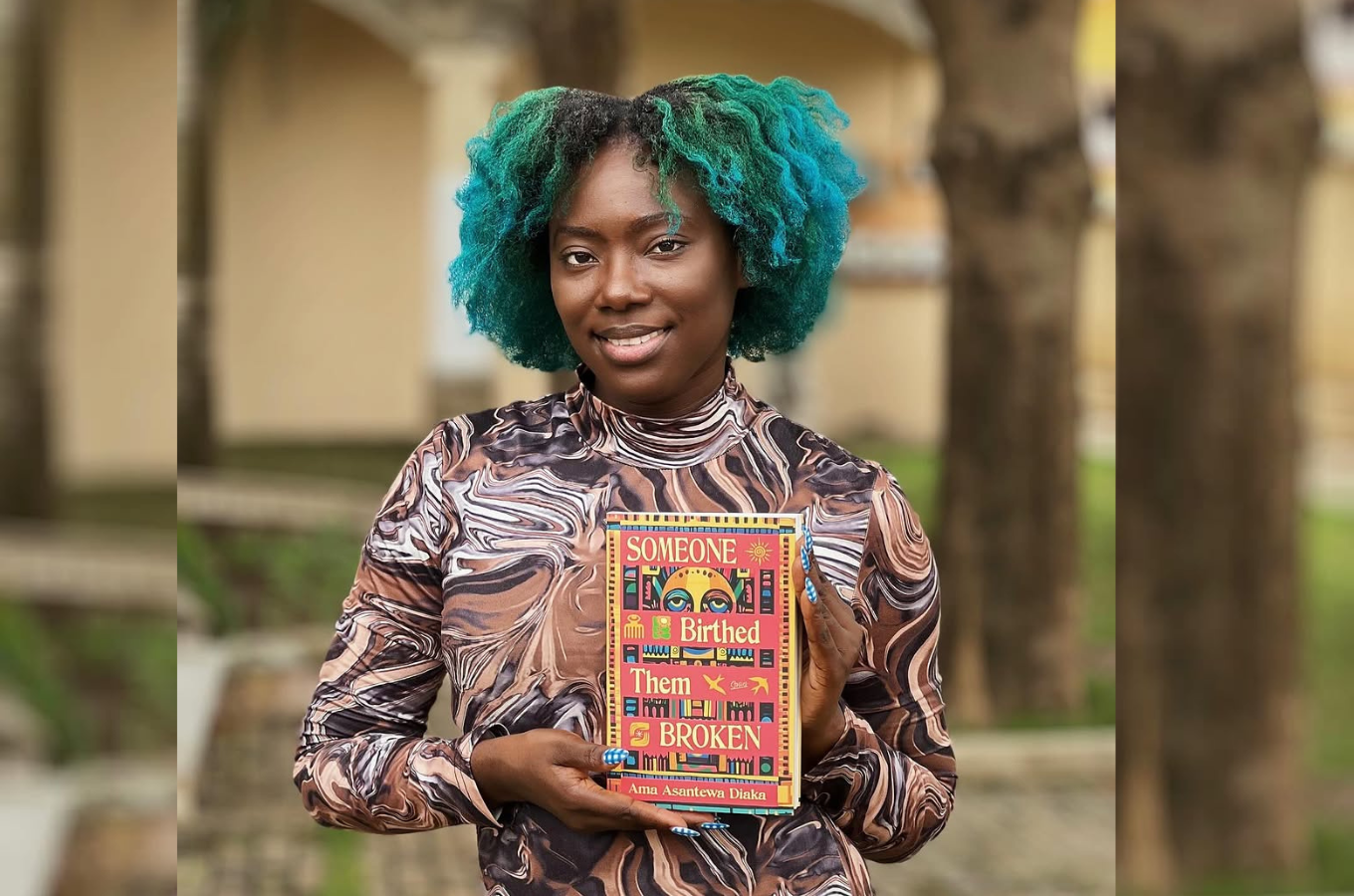
 Ama Asantewa Diaka’s debut short story collection, Someone Birthed Them Broken, arrives as a genre-defying work that refuses easy categorization. The Ghanaian writer, who published her poetry debut Woman Eat Me Whole in 2022, brings the same formal inventiveness to fiction, weaving together newspaper clippings, recipes, diary entries, hand-drawn illustrations, and prose to create what she calls a collection with “its own rules.” The stories center young Ghanaians navigating the contradictions of survival: the weight of maternal projection, the sanctuary and messiness of friendship, the failures that constitute their own revolutions. Diaka writes with an unfiltered directness that channels Ghanaian vernacular, deploying humor as what she calls “a really great lubricant” to make grief and reality easier to swallow. In this conversation with Tryphena Yeboah, she discusses the political dimensions of her writing practice, the silences that live in mother-daughter relationships, and why all her creative work returns to one central question: how do we survive ourselves and each other?
***
Tryphena
I want to start with a theme I simply could not get enough of: mothers and daughters. We see the dynamics between Boatemaa and her mother, and when Kekeli thinks she can love her mother better if she were a distant memory. What was most important to you in capturing this often beautiful yet complex relationship?
Ama
There’s already so much storytelling around mothers and sons, or fathers and daughters, but not nearly enough about mothers and daughters. So first, I wanted to create space for that relationship. Also, motherhood is often glamorized and sanctified, and I wanted to show its full range: the beauty, the nuance, and the ache that can exist all at once.
I think I discovered how much silence lives in that relationship—not just the things left unsaid, but the things we can’t say because we don’t have the language for them yet. I also realized how much of mothering is about projection: mothers projecting their dreams, their fears, their unfinished stories onto their daughters, and daughters either carrying that weight or trying to escape it. Writing these characters showed me that love and resentment can coexist, that you can desperately want your mother’s approval while also needing to break free from her expectations. It’s messier and more contradictory than I initially thought, and that complexity felt important to honor.
Tryphena
Friendship is another subject we encounter again and again in these pages, and I enjoyed how these companionships offered spaces for reprieve, confessions, healing even. In her email to Amoafoa, Deanna admits, “I know what it means to have no desire to persist, what it means to want to die.” When Victoria confides in Ayeley after a misunderstanding with her mother, Ayeley listens without interruption and validates Victoria’s emotions of anger and pain. And of course, they are not without its aches and messiness.
Ama
I am of the view that all relationships are a path to sanctification. But friendships hold such a special place in my heart because what are the odds that you met this person at this time, in this place, and there is an intersection of interest and awe and likeability enough to want to form a friendship? It feels almost miraculous. Friendships ask so much of us: how loving can we be, how sacrificial, how much of an extension of ourselves are we willing to offer? They can be heartbreaking and inconvenient, but also deeply fulfilling and healing. I wanted to write about all of it, the messiness and the beauty, the ways friends become witnesses to our lives, the way they hold our confessions and our silences. I wanted to show how friendship can be a space where we learn to persist, where we’re seen and validated even in our anger and pain.
Tryphena
“I used to be so full of ambition I wanted to save my country. Now I want to be saved from it. Nobody tells you failure is a kind of revolution too.” One reads these lines in “politicians all demma mordas,” where you offer sharp social commentary and criticism of Ghana’s failing leadership, economic hardships and religious blindness and deception. Can you think of a moment when writing felt the most political to you?
Ama
I can’t think of a moment when writing hasn’t felt political to me lol. The deliberate choice to pursue full-time writing over a 9-5 is an obvious political choice because it wields the ability to literally keep me alive. The choice to publish poetry first, to publish Ghanaian stories and topics, to work in ungovernable forms, to intentionally allocate time to building communities and platforms so my writing and the writing of others like me can survive now and after – all of it is political. Even the act of claiming space for our stories, for our language, for our failures and revolutions, feels like a political statement. Writing, for me, has always been inseparable from the question of survival and who gets to tell which stories.
Tryphena
There are so many parts in the stories that actually had me cackling to myself. There was something about the narrators’ informal and expletive tone that at once unsettled and disarmed me as a reader. I am thinking in particular of the descriptions of the female body and acts of intimacy. Kekeli’s breasts are described as “ripe fruits at Kaneshie market” and Eugene savages Coleen’s virginity like “a priced delicacy”. What informed the point of view on writing the female body and sexuality and what role do you think humor plays in treating these subjects?
Ama
Thank you so much for acknowledging how funny I am! . I think in another life I would be as good as Mrs. Maisel, and I’m really happy when people notice my humor. Humor is a really great lubricant, it makes it a little easier to swallow grief and reality, to stay long enough in our discomfort or ignorance to actually be aware of it. For me, culture informed my writing a lot. Some of these descriptions are variations of things I heard being spoken by teachers, friends, people in public transport or at the market. There’s a particular Ghanaian way of talking about the body – unfiltered, direct, sometimes crude but also strangely tender. I wanted to capture that voice, that intimacy. And when it comes to writing the female body and sexuality, humor felt like a way to disarm the shame or awkwardness that often surrounds those subjects, especially for women. It creates space for honesty.
Tryphena
Did you have any central questions and hopes that guided your writing of these stories? What was the most challenging part of your writing and revision process?
Ama
I think the central question for me was: how do we survive ourselves and each other? How do we (and the people after us) live with the weight of our choices, our grief, our desires, our failures? I wanted to explore what it means to be human in all its messiness – the contradictions, the longing, the ways we wound and heal each other, often at the same time. I also hoped to create space for young Ghanaians – their interiority, their complexity, their right to be flawed and still worthy of tenderness and attention.
The most challenging part was probably the revision process, knowing when to stop, when a story was truly finished. I’m someone who can endlessly tinker with language, and there were moments where I had to step back and trust that the story had said what it needed to say. Also, writing about pain and trauma while trying to avoid making it exploitative or performative was difficult. I wanted honesty without spectacle and finding that balance took time.
Tryphena
You published your debut poetry collection, Woman Eat me Whole, in 2022. You’ve also shared your wonderful illustrations through your greeting cards, Yobbings. It is incredible to see all these genres come together in someone birthed them broken. It feels like a mosaic of sorts—newspaper and recipe snippets, diary entries, drawings, email records, etc. Can you tell me about the creative process of weaving all these elements into the collection?
Ama
My multiplicity is my strength. I’ve been working with all these genres for the last two decades (poetry, fiction, nonfiction, drawing) so when I was working on this collection, I felt very drawn to experiment with form. In my poetry debut, I explored different forms – some poems were visually presented in tweet format, some as MRI scan results etc. I just couldn’t put together a fiction collection and not create its own rules as well, so this was my way of bringing it all together. I was guided by a simple question: what layered, cheeky, or funny image can complement this story? I used that as a guide to illustrate for each story. The newspaper clippings, the recipes, the diary entries – they’re not just decoration. They’re part of the storytelling, another layer of meaning and texture. Form, for me, is never separate from content. It’s all part of how the story breathes and moves and reveals itself.
Tryphena
What are some of your earliest memories of reading and writing?
Ama
For reading, I remember a box set of Peter Rabbit my mother’s friend gifted to us that I fell in love with so hard, I slept with the box for months and wouldn’t let it out of my sight. For writing, I remember my classmates in Class 4 – upon discovering I could write stories, giving me their empty exercise books to fill with stories and return to them. I felt SO important.
Tryphena
Over the years, what have you come to appreciate about the practice of reading and writing? How has literature shaped who you are today?
Ama
Writing has saved me over and over. Reading showed me how to inhabit other lives, other perspectives, other worlds. But writing taught me how to survive my own. It gave me a way to process grief, joy, confusion, rage etc. Over the years, I’ve come to appreciate both as acts of attention and care. Literature has shaped me into someone who believes stories matter, that they can be sites of resistance, healing, and transformation. It’s taught me that being human is about holding contradictions.
Tryphena
My only rule as a writer is…
Ama
To give myself permission to experiment and break forms, while still caring deeply about the work and the people in it.



COMMENTS -
Reader Interactions