

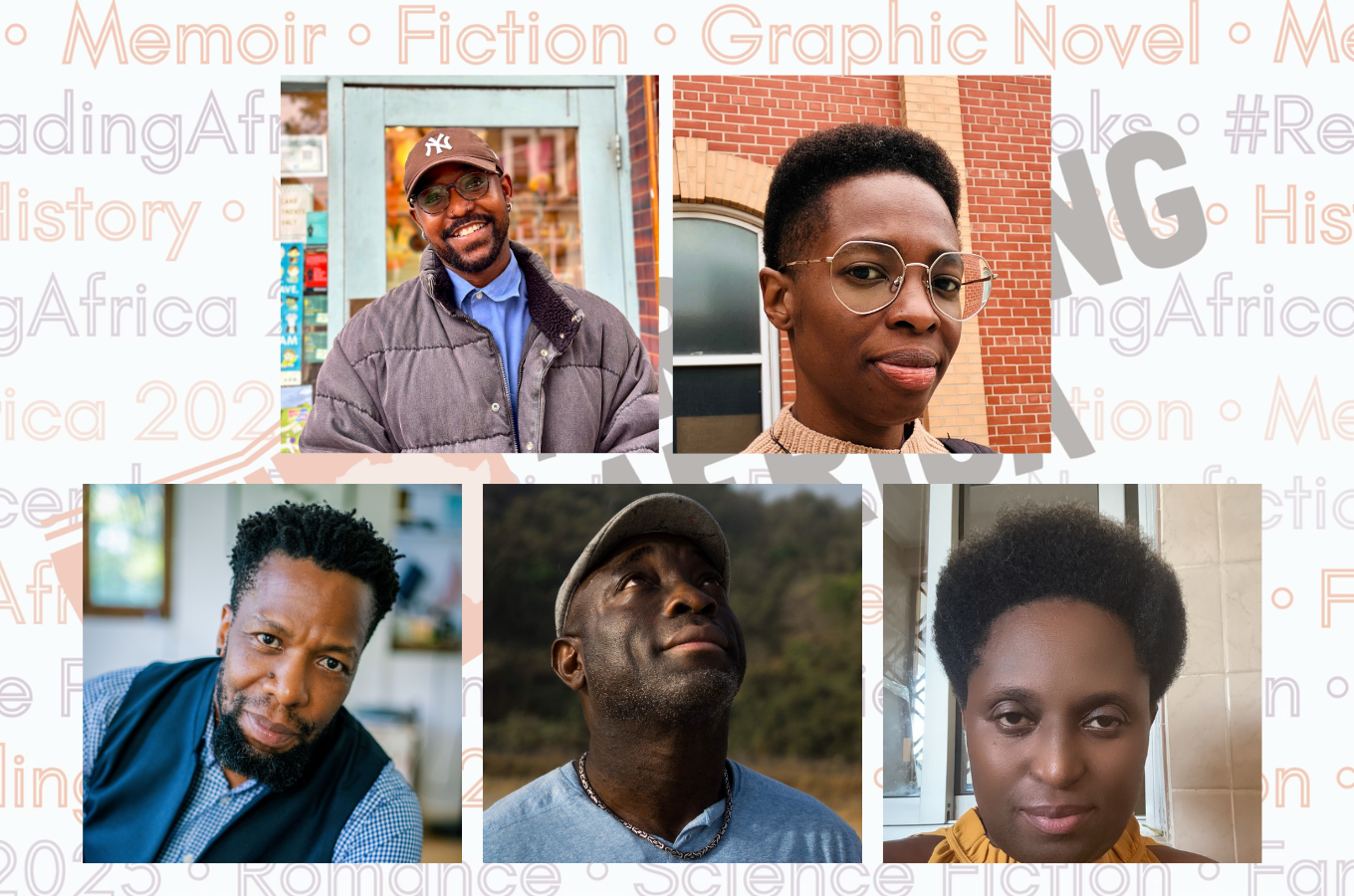
Welcome to this year’s #ReadingAfrica Week! This is the transcript of the Queer Africa Literary Panel, where we discussed queer literature, writing, and books from across the African continent. It has been edited for length and content.
Chinelo: Thank you so much, everyone, for being here this morning. From my perspective, as a Nigerian who’s living in Toronto, 2025 has seemed to be a tough year for the LGBTQ community in Africa. We’ve seen a lot of headlines about criminalization and violence, aimed at rolling back and eroding the gender and human rights of LGBTQ communities across the continent. The question I wanted to ask was how queer literature, whether reading or writing it, has helped.
Kevin: Good evening everybody from Kilifi, Kenya. It’s a pleasure to be here. I havereservations about that question. Yes, I recognize there have been rollbacks—what I call “reprioritization.” But having worked as a journalist and also as a writer, I strongly believe the way we look at queerness in Africa is very similar to how we look at being African, and how Africa is covered globally.
The story coming out of Africa is always one of doom and gloom. I was in Toronto in January, and I can’t remember the name of the main paper there, but it had a two-page spread about how queer Ugandan refugees are suffering on the continent. It didn’t mention that two other African nations had decriminalized homosexuality.
I’ve just come from South Africa, attending a conference called the Pan Africa ILGA. This was the seventh, and it was beautiful to see over 500 delegates from within and outside the continent coming together. There was representation from North Africa, increased Francophone representation, and there was a contingent from Madagascar for the first time. I met a trans individual from Eswatini talking about what they’re doing to make a difference on the continent. We saw disabled queer individuals at this conference.
We’re seeing queer African writers emerge from the continent talking about queer love. Solange is someone who’s opened my eyes to what it means to be queer through her work, and she’s doing it in French. It doesn’t make headlines because it doesn’t fall into the stereotype that being queer in Africa is sad. Being queer in Africa is not sad. We experience as much queer joy as anyone else, and we have writers to show for it.
Chinelo: Solange, you were mentioned just now. I’d love to hear your thoughts.
Lady S (Solange): I love to hear Kevin talk because he’s very positive, and honestly, I can hear him talking the whole day, the whole night, the whole year. And he has had the same kind of issues that I’ve been having for the last 25 years. But sometimes, when we enter into activism in Africa, our view changes. Because people are crying, people are suffering. And if you come and say, “Oh, don’t cry,” they will say, “Hey, you—you are lucky, you are Canadian. You can go back to Canada anytime. Your parents understand you. But we are not in the same situation. We are criminalized. I can’t get married.”
For example, I am a transgender woman, and Canada gave me “female” on my papers. That means even here in Africa, I can get married to the man I love because they look at the papers, they see feminine and masculine, so they can allow the marriage. That is a privilege I have because I have been in Canada.
So now I try now to understand that everything is not the same for everyone. Even though I can see real change from when we started 25 years ago: the young people, the energy in all countries represented here. I see doctors involved, writers, activists, singers. There is a transgender woman singing in Ghana. I can say we are no longer just a community; we are a movement.
But we cannot only focus on the good things going on or the impact we are creating. We also have to look at what is happening in the movement. People are fighting for resources, and when they see young[er] people coming, they think maybe these young people will take away the little resources they have. So, there is internal fighting, and we have to talk about it.
And when we go to donors, we cannot go and say, “Everything is good,” because then they will not give us anything. We have to cry so people can hear us, so thatmoney can come, so at least we can survive in the movement and live as people. And so we can support our families. Because when our families see that we have some economic means, they respect us more. These are realities we have to face.
So yes, I hear you, Kevin. I hear you 100%. Yes, we should not only talk about criminalization, but maybe we can talk about it when we are in strategic places. Let’s also understand those who cry, and give them the voice to cry.
Chinelo: Frankie and Zanta, do you think that literature is a way of making that balance between the joy that we feel and have access to in order to survive, as Kevin pointed out, and the reality that we are often second–class citizens in our own countries and we cannot be true to ourselves in our family systems?
Frankie: To be a queer person living in Africa is to be many different things. I can still feel very proud of my queerness in certain spaces in Nigeria, even though the laws on the books there are really strong. I also live in Ghana where the bludgeoning of LGBTQ people theoretically has been used to win elections. And yet queer people thrive here.
So yes, there is doom and gloom in the news. But what do we do with our writing? What do we do with our literature, what do we do with the things that we produce? We show the nuance. Because Africa is not one thing, right? And at least that’s the way I’ve looked at it.
One of the first African queer–themed stories that I did almost 30 years ago were about all of these out Africans in New York City making a life for themselves and being proud of it. And 30 years later, we’re still doing the same kinds of things: trying to find and shine a light on what is not doom and gloom for us. At the same time, I live in a country where, if you are gay-bashed, you can’t go to the police because nothing will happen.
So when you live in that reality, the only thing that I can do as a writer is to continue to put this nuance out there. It is a real thing that many of us in our countries are in trouble. But it’s also a real thing that many of us are thriving. Many of us believe that as queer Africans, wherever we are in the continent is our home and we’re not going to be driven out of here.
I’ve always believed that newspapers come and go. Stories and magazines come and go. But books? They stay in libraries forever. And I’m trying to produce work that will be in anthologies and in books, so that when people look back at this era, they can have a definitive moment of what queer life on the continent was. Not that what’s in the newspaper is not true. There’s just more to it.
Zanta: I think literature provides us the chance to exist in an affirming way. In literature, queerness can be anything. It’s not something we have to overcome. Instead, it becomes something we can use as a tool to propel ourselves forward.
With literature, we exist in many articulations. Queer people are flying in literature. Queer people are ghosts. Queer people are married and domestic. And I think these representations are critical in affirming a lot of our identities on the continent. If we are constantly bombarded with imagery that says my queerness only exists painfully, then stories that provide alternative queer existences become very important, because they give people hope. They give people possibility.
Growing up on the continent, in Eswatini, and being in the closet, stories were what gave me possibility. I felt possible because I was reading about queer lives from across the world. I think we also have to remember that these stories, and the way they exist, provide possibility for people who might feel there is no hope for them.
Chinelo: That’s such a great point, because I think for me, coming out of the closet has not been a one-step, two-step announcement. It’s been a long journey of discovery and rediscovery, and seeing myself reflected in stories helped me see ways that I could take on stories for myself.
And I think that takes me into my next question, which is: when we see ourselves reflected in mainstream media, we are either villainous tempters trying to lure the morally upright into sin, or we are sidekicks who are only interested in sex. What kind of intentionality do you bring to your writing so that you can stray out of thosestereotyped boxes that have been established for us?
Zanta: I think for me, I have been very interested in writing queer characters who exist outside of exceptional trauma. I tend to avoid writing about the closet, not because I’m denying anyone else’s experience – I have also been in the closet, of course – but because I felt my calling in writing was to avoid those stories. I felt there were already enough stories about closet trauma about African people.
I’ve been more interested in domestic representations of queerness, emotional universes that feel normal, where queerness was seen as boring. I think adapting my writing to focus on a “boring” queer life allows me to centre narratives that are less about queerness as an identifying factor, and more about it being just one part of someone’s life. There’s so much more to their existence than just being queer, and that has helped me explore other themes. Of course, having a queer character is still an act of representation.
Trying to avoid stories of exceptional pain has been an interesting practice for me. People just don’t recognize those stories. I remember in a writing program, a tutor asked me, “Why isn’t the father mad that his son is gay?” And I just thought, That’s not the story I’m writing.
Kevin: I come from a place of imagining what love looks like in our African context. For me, that’s the important thing: to imagine what queer African love exists, where it is so normalized it could happen on a trotro or a matatu, or even at a kiosk.
I wrote a short story called “Salt in the Desert,” set in Djibouti. It was about two guys—one was a migrant crossing over to Yemen bumping into a tourist—and the attraction between them. My premise was to show that queer love can happen anywhere on the continent. I have to mention Rob Kimutai, who introduced me to imagining what queer love looks like in our context. His short story, “Man on the Bridge,” is so beautifully written. It’s about two guys in the closet who meet on a bridge, a cruising area. And I think that is the reality for many people—it really happens.
I’m doing research for another book, and someone was telling me that in Uganda, gay guys go to football matches so they can end up hooking up in the bathrooms. It’s that normalization of our queerness that is so invisible, yet visible at the same time. I want to show people that our love is normal, our love is real, and it could happen when you’re just going to buy tomatoes from the lady at the market. For me, that’s where I love centring my characters: on normal folk going about their business—falling in love, falling out of love—just like anybody else.
Lady S: I want to jump in on what Kevin has said. I like it. We all love love. We all want to be loved and to be in love. But I think that, as queer people, we have the opportunity to oppose the normativity of love—the way it is normalized in our society.We can bring our own way of loving.
Because when we hear African stories, it’s often: a man marries a woman, they have many children, and that’s considered the “normal” life of love. But is that how we want it? Do we want to live that kind of normalized life? I think no. And that’s what I try to write in my books. Maybe the character changes partners, and that’s fine—it’s love too. Love can be multiple, and we have to recognize that.
I also think we can take the prejudices society puts on us, grab them, and play with them. We don’t have to enter into this normalizing love to show that we are laughing, living, and being loved the way others are loved. No! I want to be special. I am special. My character is a transgender woman navigating Africa, meeting men in patriarchal situations, but living her life, enjoying sex, exploring her sexuality in African countries, and playing with some of these African ways of seeing things. And I think that’s okay.
So, if society insults us—saying we are this or that—we can say, “Yes, we are that.” That’s another way of responding, instead of being on defensive all the time.
Frankie: I think that I’m always leaning into joy. That’s what I look for in the work that I do. I’m looking for joy and I’m looking for nuance. Now how do I put that on the page? I put that on the page in a way that just makes it as normal as anything else.
When I’m leaning into joy, I’m looking at people who are finding their happiness. So queer people in Ghana and Nigeria and many parts of our continent cannot legally get married, right? But that doesn’t stop them from having full-blown, full-bodiedrelationships where they commit to each other after maybe years of flirting. That doesn’t also stop them from having a side piece on the side, just the same way everybody else does.
I come from a place of non–judgment. I think if you find love, go for it. But if you are in a situation where you have to do something else, do it. When I was younger, I used to be very judgmental about that, as an older person I’m not so much because I understand that the [idea of] marriage in Africa, about two people falling in love, is the real fallacy. There are all sorts of reasons why people get married, it’s not because they found their soulmate. But when you find your soulmate, that is the joy that I want to write about, especially among us.
Zanta: It’s making me think about how a lot of the time queer characters aren’t allowed complexity. It’s as if our queerness is the only thing that can be “deviant,” right? So if you are a queer character, you can’t be messy, get drunk, fall apart in the street, or cry, because everything else about yourself has to be exceptional in order to appease family.
I grew up feeling that way. I knew that my queerness was considered “wrong,” so everything else about me had to be exceptional. I had to be good in school, I had to be respectful. I had to be useful to the heterosexual family dynamic so they wouldn’t ostracize me.
I think a lot of queer characters haven’t been given that complexity. Once you’re queer, that’s the only thing that can be “wrong” with your character, which is obviously not true. The more we lean into writing complex queer characters, the more we serve the movement. I agree with what Lady S said: We need to write messy queer characters. I think that’s something we really need to consider when we lean into characterization.
Kevin: Zanta, just to add onto that, we’ve been given the liberty to explore what queer identities and narratives look like. But when you said, it made me think: traditionally, who are people writing for? Are they writing for the queer community, or have we been writing for mainstream audiences—people who might not even like us so why should they be reading our literature? I think it’s about us taking ownership of our stories and not being ashamed to say, “I’m just writing for queer folk, and I don’t care about anybody else. I’m just writing for queer freakin’ folk. I’m writing for a queer audience.”
Frankie: That’s not something I would do, because I’m writing for Africans—whether you’re queer or not. If I want to move the needle and get you to understand, respect, and take a step back to think clearly about how you treat your brother or sister, then I have to show you us in the fullness of us, and not in the caricatures.
I want all Africans to read my work. If I write only for queer people, while that validates us and allows us to see ourselves on the page, it doesn’t have as much effect in moving the needle for me. I know heterosexual people who have read my work and met me, and they’ve said, “You made me think differently about my actions.” That’s where the journalism in me comes out: yes, I want to tell our stories, but I also want people who aren’t us to read and understand that we are their brothers, their sisters, their children. We cannot be reduced only to our sexuality, with people treating us any which way, because then it becomes an academic exercise. So yes, of course we should write for ourselves. But personally, I want to write for all Africans, because we cannot change unless we all understand each other.
Lady S: Sometimes I think, “all Africa is queer.” Because when you say writing for queer people, or writing not for queer, I think everybody is queer.
As a transgender woman, I meet people and I ask: are my partners heterosexual? Are they queer? So when we say we should write for queer people, who is queer, who is not? Sometimes, I think we are the majority. So, let’s write.
I remember in Senegal, in every novel I was reading, there was a queer character. If a queer character was missing, the book didn’t have meaning. Even in homophobic contexts, writers are including queer characters. So then, was that book about a queer person? Was it not?
It wasn’t about judgment. It was about our world being wide, being diverse, being a rainbow. When we talk about queer women, trans people, men, and the mix of all of that, that’s what makes the beauty of our literature.
Zanta: I’m just thinking about what Frankie said about writing for everyone, and I’m thinking of how there’s this school of thought that fiction is an empathy-building exercise. The idea is that fiction really allows you to put yourself in someone else’s shoes. Whether I believe that or not, I do see the validity in it. Fiction puts you in a character’s mind and lets you experience their world, and I can see how that builds empathy. So when we do write, we’re writing for ourselves, but also to teach the world about our existence in a way.
Chinelo: I think that’s a good point. In my writing, I’ve experienced both sides. Queer readers have sometimes told me my work doesn’t feel queer enough—that I kind of hold back, while others have pointed out that it feels too queer because I write speculative fiction. That can be a complicated thing.
Frankie: I’m sorry, what does it mean when someone says what you’ve written about queer people isn’t queer enough?
Chinelo: I think for that particular person, it was a sense that I had pulled some punches. There was a sex scene that sort of faded to black instead of going deep into the details. So I think that particular criticism was made half in jest but also half in seriousness, in the sense that, why stop? Which audience was I trying to appease by not getting into the details of this particular encounter? And it does lead to the question of when we are writing for ourselves, are we writing for or are we writing against? And I think Lady S’s response in that it’s more complicated and nuanced than just the queer and the non–queers in terms of our audience might be something for me to think about.
Zanta: Wait, so this person was upset that you didn’t finish a sex scene?
Chinelo: Yes, essentially.
Zanta: So for them, I guess queerness is attached to sexual activity? Or that for it to be a full queer story, it must have full queer sex?
Chinelo: I think—especially because of the way it was written—I think what she waschallenging me on is that I had written it in a way that was either/or, maybe/maybe not. By not going into the details, by not pushing the narrative, I left it a little tooambiguous. And I think she had a point. I was trying to play it safe so that if I were “accused,” I would say, well, did you see any sex there? Did you see it? She was calling me out, rightfully so, for not committing to something that I started.
Frankie: I say this with a grain of salt, but sex cannot be the determining factor of our queerness. We can have relationships, descriptions, and many different things of our lives without the titillating-ness that people expect. When I hear things like that, I think of someone trying to reduce us to what we do in the bedroom, versus the fullness of our lives, and falling in love with people we cannot have, and all the rest.
That makes me even more interested in doing work that shows our other experiences, that are joyous, without that sex scene in there. We can be very queer in our presentation without the sex. People have to get used to that. They cannot expect a queer character to fuck in every story. We don’t expect that from other characters, so why should queer characters always have to have sex for it to be a properly queer story?
It’s just as bad as any other thing that is riddled with stereotypes, like queer men have to be effeminate. All of those things are bad, and all of those things are just a morsel of the truth. There is such a diversity of us that we have to be able to say: you can write a story and express all the queerness, and it be “queer enough” without the titillating part that some folks expect.
Kevin: But isn’t that why we’re in this space altogether, where we’re all writing different genres? I think giving each other the liberty and the freedom to express our queerness or our writing is the most exciting thing. For me, it’s exciting to see how where African writers are growing. There’s a space for those who want to write about titillating and queer sex. There are those who want to write about offering a different nuance to that.
I’m just really excited that we can do that as Africans now—that we can represent our queerness in in all colours of the rainbow. If you wanna write messy, sis, write messy.
Frankie: But that’s not really the issue. I mean, I agree with all of that, but somebody telling a writer that “you didn’t go far enough because you don’t have queer sex,” that “that’s not queer enough,” is where I have an issue. I think that queer people have all kinds of stories whether we’re banging or we’re not. And so one reader should not define what is queer writing to a writer, and tell a writer, “You didn’t go far enough.”
Chinelo: In defense of the person, the question was whether I was willing to commit to putting down my queerness on the page more fully, and I think that was where they were coming from rather than “this isn’t queer because there’s no sex.” I think they recognized a certain holding back that I was doing in my own writing, and they rightfully called that out. Lady S, I saw your heart.
Lady S: People don’t understand us the way we are and some people require us more than we want to give. I think we have to understand them. For example, a person might ask a transgender person if they’ve had surgery, or if they want to do it, and if you don’t do it, you’re no longer “really” trans. I met a man dressing as a woman who identifies as transgender, and that’s valid. We are all trans in our own ways. That’s where we are. We need to meet people where they are, without fighting them, and continue our work. That’s why I put that heart.
Chinelo: What is the piece of queer literature that is giving you life right now, or has given you life in the past? I would love it to be African-specific; I’d like to be pointed toward more voices and stories that I may not know about.
Kevin: I read this book. It’s called Someone Birthed Then Broken by a Ghanaian writer [Ama Asantewa Diaka]. It’s a collection of short stories and I really liked the fact that she lived in queerness. It was different characters, all different experiences, but she was able to establish a common thread throughout the book. I had stopped reading short stories for a while, but I really enjoyed this in terms of African queerliterature that I sunk my teeth into.
Frankie: I’m really enjoying the discovery that I’m making in the characters that permeate Eloghosa Osunde’s two books. One is called Necessary Fiction, and the other one is called Vagabonds. Not to put them in the category of queer literature, but it is always a joy to bump into the unexpected. I’ve been going back and forth and looking at the two books and the discovery of non-regular hetero characters in the pages has been fun.
Zanta: Growing up, The Quiet Violence of Dreams [by K. Sello Duiker], as a southern African queer person, is the first book we all start off reading. It was just so influential in terms of queer writing. I’m also thinking of La Bastarda [by Trifonia Melibea Obono] from Equatorial Guinea, and the Moroccan queer writer, Abdellah Taïa. I read a lot of queer Asian writing as well. I find it quite similar in its non-western identity politics.
Lady S: When I started reading, I could not find any queer writers in French. And I thought, Wow, why doesn’t this exist? In my activism, I’ve often been a pioneer, starting things that didn’t exist before.
I know one writer, Karim, who wrote a book in Senegal called I’m Waiting for My Husband. That book was really an inspiration because so many people in Francophone Africa had never had a book in French talking about queer love. There is also Emma Onekekou, who wrote For Women Who Love Women in Africa. It’s in French as well.
Another writer wrote a book I saw two years ago called Me and Three Women in My Life. He was talking about his mother, his wife, and his daughter, but he was gay. His mother pushed him into marriage because she didn’t want people to know he was gay. The book describes what he went through with religion, spirituality, everything. It’s a very sad book, but we shouldn’t just stay on the surface level. Please, read it. Yes, it gives joy. It gives energy.
Chinelo: My recommendations would be Womb City by Tlotlo Tamaase, which won the Nommo Awards just last month. And if you can get hold of anything by AdaNandi, she’s a Nigerian queer writer who writes speculative fiction featuring queer characters –great writing.
Thank you everyone so much for your time, and thank you for this amazing conversation. I had so many more questions. We could talk all day, but I’ll let you guys go back to your lives.
BIOS:
Moderator:
Chinelo Onwualu is a Nigerian writer, editor and recovering journalist. She is former co-editor of Anathema magazine a magazine of queer speculative fiction, the co-founder of Omenana, a magazine of African speculative fiction, and former chief spokesperson for the African Speculative Fiction Society. She’s a 2014 graduate of the Clarion West Writers Workshop, which she attended as the recipient of the Octavia E. Butler Scholarship. Her short stories have been featured in several magazines and anthologies, including the award-winning Africa Risen: A New Era of Speculative Fiction, The Saga Anthology of Science Fiction 2020, and 2021’s Best of World SF Vol.1. She’s been nominated for the Locus Award, the Nommo Award for African Speculative Fiction and the British Science Fiction Awards. Ex Marginalia, her debut anthology of essays by speculative fiction writers of colour, is available now through Hydra House Books.
Panelists:
Lady S (Solange) is a writer and international speaker specializing in Afro-Queer issues. She co-founded Arc-en–ciel d’Afrique in Montreal in 2004 and launched the Massimadi Festival in 2008, which later evolved into the Massimadi Foundation celebrating now its 17th edition. In 2016, she relocated to West Africa, where she continues her activism through the Maison de la Culture des Diversités Humaines and the Queer African Youth Network (QAYN) and published two books “Les bayas de Kibibi” and “Les murmures.” Together with Cameroonian exegete André Kamo, she is currently leading a QAYN-commissioned study on the history of queer identities in Africa and the evolution of discriminations faced by Queer people on the continent.
Kevin Mwachiro is a Kenyan writer, podcaster, queer activist, and journalist whose media and communications career spans more than two decades. His debut book, Invisible – Stories from Kenya’s Queer Community, was the first of its kind in the country, breaking ground in documenting queer narratives.He later led the editorial team for the publications We’ve Been Here, a moving collection that shares the stories of LGBTQI Kenyans over 50, and the anthology Rainbow Childhoods. Kevin was also part of the team behind Boldly Queer – African Perspectives on Same-Sex Sexuality and Gender Diversity. In 2017, Kevin launched Nipe Story, a storytelling podcast that brings African short fiction to life through audio. Nipe Story was one of 13 African podcasts that were recipients of the initial African Podcast Fund initiative that was setup by Spotify in 2022. He is also the co-founder of the Out Film Festival, East Africa’s first LGBTQI film festival. Kevin holds a degree from Daystar University in Kenya and an MA in Radio Production from Bournemouth University in the UK. He is also an alumnus of The Rockefeller Foundation’sBellagio Centre residency program.
Zanta Nkumane is a writer and journalist from Eswatini. His work has appeared in the Mail & Guardian, OkayAfrica, This Is Africa, Lolwe, Racebaitr, The Johannesburg Review of Books, Kalahari Review, The Republic & Michigan Quarterly Review. He has contributed essays to anthologies: We’re f*****g here! An African Queer Collection (Iwalewa Books, 2020) & TOUCH: Sex, Sexuality & Sensuality edited by Tiffany Kagure & Kim Windvogel (NB Publishers, 2021), Flow edited by Mehita Iqani (African Minds, 2023) and his short stories appear in Now Now: Short Stories from Namibia, South Africa, Zambia and Zimbabwe edited by Remy Ngamije (2023) and Captive: New Short Fiction from Africa edited by Rachel Zadok and Hellen Moffett (Catalyst Press, 2024). Zanta was the 2022/23 UEA Booker Prize Foundation Scholar in the MA in Creative Writing, University of East Anglia. He is co-editor at Translator Magand non-fiction editor at Doek! Literary Magazine.
Chiké Frankie Edozien is the Director of New York University, Accra. He’s also the curator of the Labone Dialogues series of public conversations. He directed the NYU Arthur L. Carter Journalism Institute’s Ghana-based ‘Reporting Africa’ program from 2008 to 2019. Edozien was awarded New York University’s Martin Luther King, Jr Faculty Award in 2017. Edozien is a journalist whose work has appeared in Vibe magazine, Time Magazine, Transitions Magazine, Out Traveler, The Advocate, Quartz, the New York Times, Jalada, Atlas Obscura and more. In 2001, he co-founded the AFRican Magazine and served as the editor-in-chief. He is a 2008 Kaiser Foundation fellow for Global Health Reporting.
He is the author of the 2017 book, Lives of Great Men, a Lambda Literary Award winner. His short story “Shea Prince” was shortlisted for the 2018 Gerald Kraak Human Rights Award and his “Last Night in Asaba” was shortlisted in 2019 for the same award. It was part of the book ‘As You Like It’ which earned him a second Lambda Award in 2019. His latest piece of fiction was published in Lolwe Magazine in 2025. Edozien holds a BA from NYU’s journalism school and a selection of his broadcast, print and media appearances work is available on www.edozien.net.
***
Panel Transcript provided by Catalyst Press for Reading Africa Week


COMMENTS -
Reader Interactions