

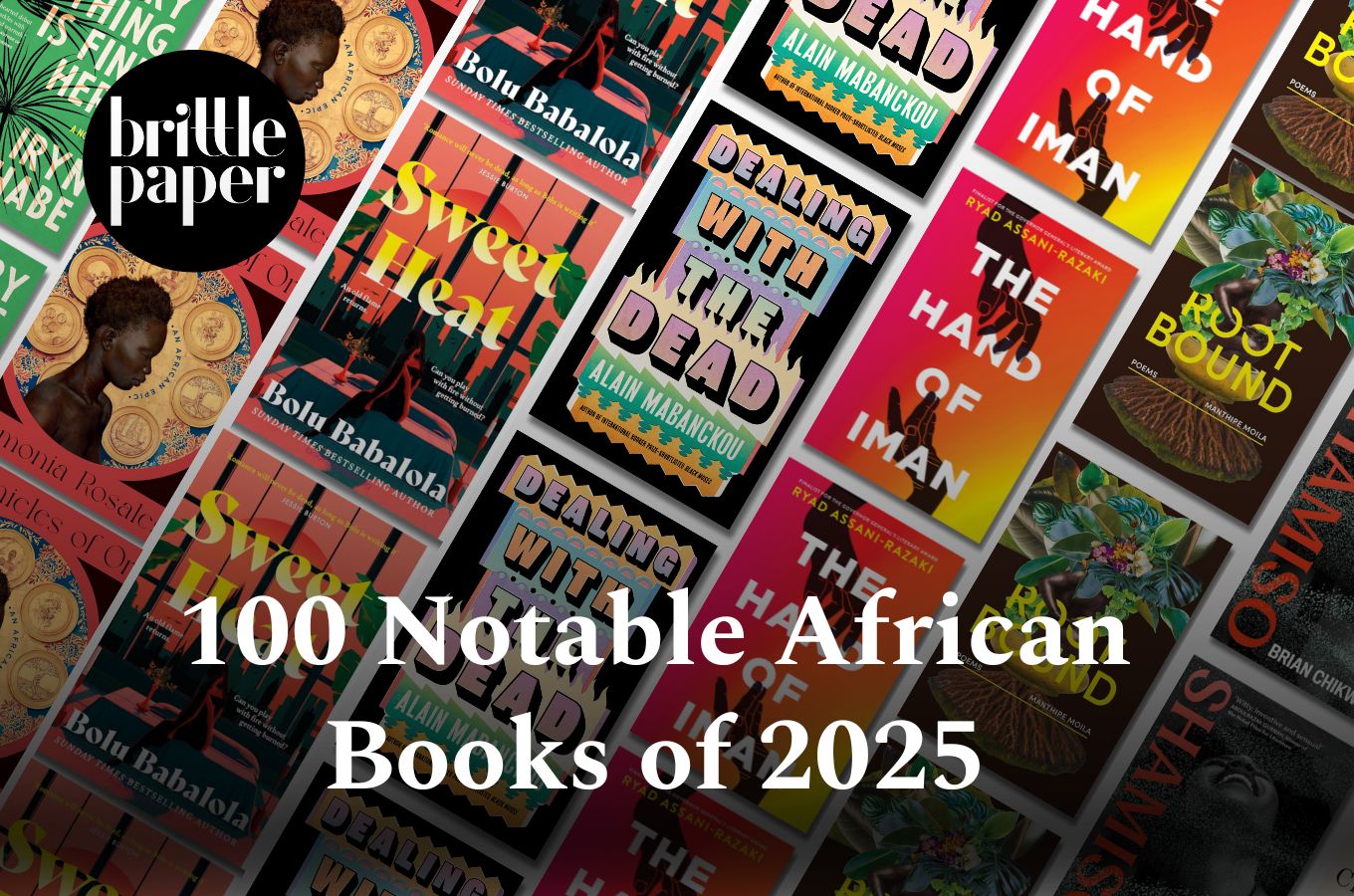
Year-end lists carry two kinds of information. There is what the books say, and then there is what the list signals about the ecosystem that produced them. Although Brittle Paper’s 100 Notable Books of 2025 is a small sample of the books published by African writers in a single year, the depth of research and metadata-driven curation behind the list makes it a useful lens for big-picture analysis. We consider close to 400 books in the process of coming up with the list. Here are a few things that stood out to us in the process of creating the list.
1. Nonfiction is no longer secondary.
We saw more nonfiction titles than in any other years, ranging in topic from space travel to disability. This shows the growing role of memoir, history, essays, and hybrid forms in African writing, a welcome shift in a literary culture that has historically been overwhelmingly oriented to fiction.
2. Poetry had a strong year.
Nearly a fifth of the list is poetry, spanning debuts, anthologies, and small-press titles, with presses like uHlanga and the University of Nebraska Press continuing to anchor the genre.
3. Island Nations. A subtle but very exciting trend is the growing visibility of island nation literatures in the Anglophone space. Increased translation (see Trend # 7) has made writing from countries such as Comoros, São Tomé and Príncipe, Madagascar, Cape Verde and Mauritius more accessible to English-language readers. While still marginal in scale, this expanded circulation is a good sign.
4. Women writers increasingly central to African literature. We do not currently track author gender as a data category, so this observation is based on editorial experience. That said, research conducted for this list suggests the continuation of shift that has been taking place for a while now. Many of the most visible African writers today are women. While visibility does not necessarily correspond to overall publishing volume, it could signal that women writers are playing a more influential role in defining the global reception of 21st-century African literature.
5. Romance is growing faster than it’s being recognized.
While few romance titles appear on the list, during research for the list, we saw a clear expansion in romance publishing. We also saw presses like Masobe Books expanding their romance fiction catalogue for local and digital readerships. Same trend in South Africa as well. Sweet Heat, by Bolu Babalola and published by William Morrow, is a sequel to Honey and Spice, which was optioned in 2025 for a major UK film production, a small indication of the growing international reach of contemporary African romance.
6. Speculative fiction has gone mainstream. Roughly half of the fiction titles use speculative, science fiction, or other non-realist modes, continuing a broader 21st century move in African fiction away from realism as the default.
7. Horror is a Genre to Watch. We also want to point to early signals suggesting that horror may be a genre to watch. If speculative fiction has moved from the margins to the mainstream, horror may be following a similar trajectory. There are still relatively few African writers working explicitly in the genre, but the growing influence of Nuzo Onoh, often described as a leading voice in African horror, suggests that something is beginning to stir in that space.
8. Translation is growing. Roughly a third of the books on the list are translations, making cross-language movement a structural feature of contemporary African writing. The source languages are also wide-ranging. The list include language such as Arabic, French, Portuguese, Amharic, Shona, Malagasy, Swedish, Italian, and other languages. This points to multiple literary lineages feeding the Anglophone African space.
9. Debuts signal growth. There is a strong representation of first books, pointing to a steady inflow of new voices and suggesting that African literary production is expanding. Debut authors are one of the clearest indicators of growth.
10. Longevity. The presence of mid-career and long-established writers shows that literary careers are being sustained over time. We saw publications from the likes Chimamanda Adichie, Abdulrazak Gurnah, Nnedi Okorafor, Alain Mabanckou, Leila Lalami and more. This makes it possible for writers to continue to build backlists and grow audiences over time.
11. Nigeria. The data also reinforces a familiar pattern in African publishing: Nigerian writers feature heavily among African authors published in Western markets. Even as Nigeria’s local publishing industry continues to struggle, Nigerian writers appear to be the most widely published Africans outside the continent, particularly in the US and UK. This is a trend worth studying more.
12. South Africa. The data also points to contrasting publishing dynamics across countries. While Nigerian writers are highly visible in Western markets, South African publishing appears more domestically anchored, with a local ecosystem capable of sustaining writers and books within national circuits. These differences show that African literary circulation operates through multiple, uneven models rather than a single continental pathway.
13. The Big Five no longer set the center of gravity.
Multinational publishers in the US and the UK are still some of the biggest publishers of African books, but they account for well under half of the list, and no single corporate group determines visibility or taste across the field. About 62 percent of the list comes from independent and African-based publishers, including Masobe Books, Jacana Media, Modjaji Books, Uhlanga, Editora Trinta Zero Nove, Cassava Republic Press, and Narrative Landscape Press, as well as mission-driven and boutique houses in the west such as Seagull Books, Transit Books, Soho Press, and Graywolf Press, alongside university presses like the University of Nebraska Press.






COMMENTS -
Reader Interactions