

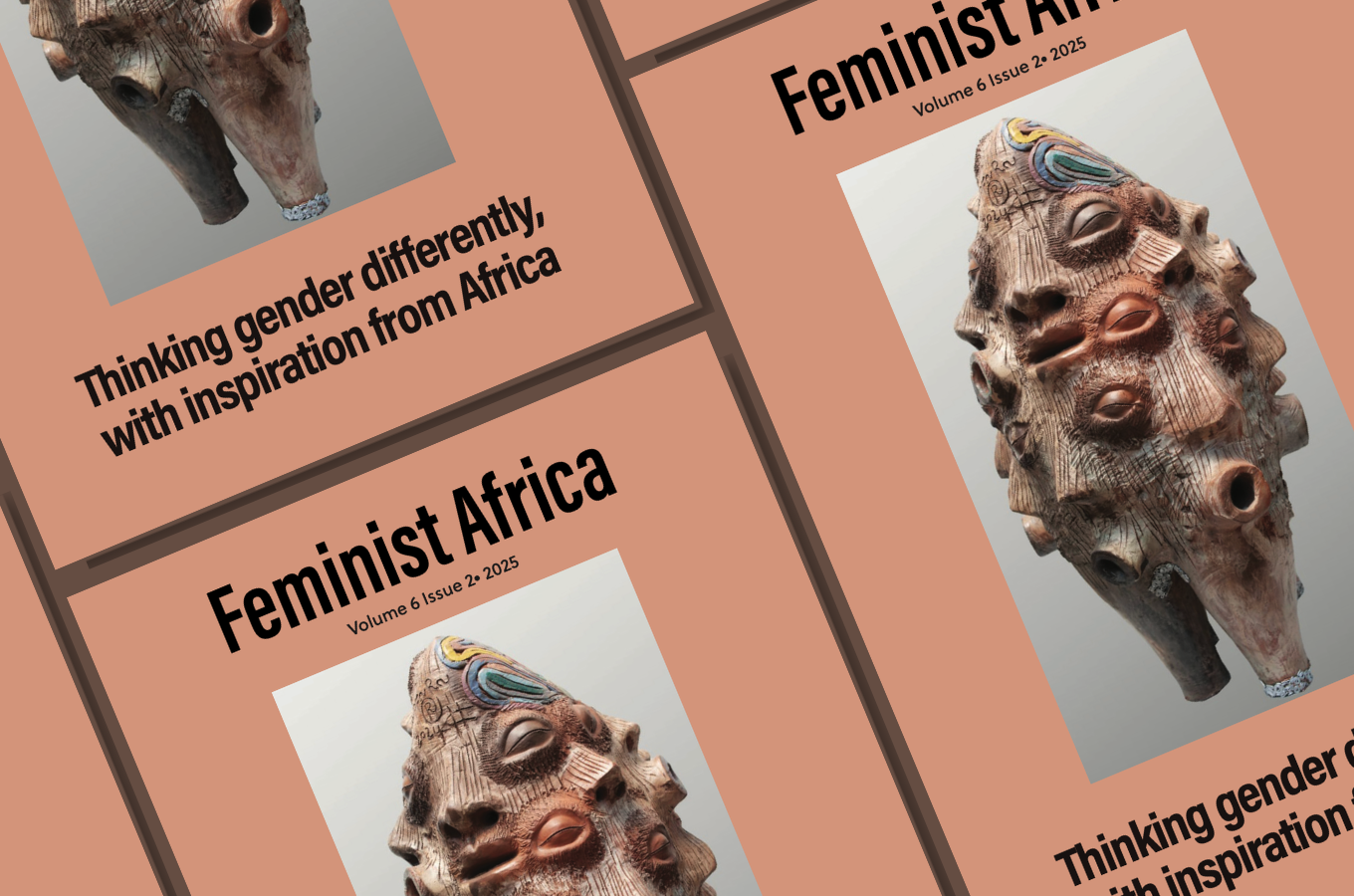
The latest issue of Feminist Africa, Volume 6, Issue 2, published in August 2025 by the Institute of African Studies at the University of Ghana, arrives with a provocation in its title: “Thinking Gender Differently, with Inspiration from Africa.” The phrase is careful. It does not say thinking gender better. It says differently, and what unfolds across more than 160 pages is a sustained, rigorous argument that the very concept of gender, as it has been theorised and deployed in global feminist discourse, may be fundamentally inadequate for much of African life.
The issue was born at the 2022 World Women’s Conference in Maputo, where issue editors Carmeliza Rosário and Signe Arnfred convened a panel on contextualising gender from African perspectives. Sandra Manuel joined the project through that extended engagement, and together the three have assembled a collection that spans ethnography, conceptual analysis, standpoint writing, oral testimony, and collaborative review, all united by a refusal to treat Western feminist epistemology as the measure of African feminist thought. The editorial collective, led by Managing Editor Dzodzi Tsikata, includes Asanda Benya, Akosua Keseboa Darkwah, Lyn Ossome, Charmaine Pereira, and Coumba Touré. The journal remains available free on open access at feministafrica.net.
The issue opens with Rosário’s editorial, which frames the stakes with precision: the concept of gender, however emancipatory its intentions, carries stubborn Eurocentric preoccupations that fail to reflect the lived experiences of much of humanity. As the Yoruba philosopher Oyèrónkẹ́ Oyěwùmí argued in 1997, there were no “women” in Yorubaland prior to colonisation, the fundamental category that anchors Western gender discourse simply did not exist. Rosário and her co-editors take this provocation seriously. They ask, what organising principles existed before gender was imposed? And what might they still offer?
Signe Arnfred’s feature article, “Reconceptualising Gender: Critical Investigations into Assumptions of ‘Modernity’,” is the issue’s deepest excavation of this question. Drawing on decades of fieldwork in northern Mozambique, Arnfred revisits the tension between Frelimo’s post-independence campaigns against female initiation rituals and the rural women who quietly refused to comply. What strikes Arnfred, looking back, is how thoroughly her own feminist assumptions had been shaped by the same Eurocentric modernity she was meant to be critiquing. The women were not victims of tradition, they were custodians of a knowledge system that Frelimo, the solidarity workers, and Western feminism alike conspired to erase. Arnfred situates this in a longer argument about the origins of Western gender concepts in early capitalism, drawing on Maria Mies and Silvia Federici, and in dialogue with Latin American decolonial thinkers like Lorena Cabnal to articulate what a feminist framework rooted in African cosmologies might actually look like.
Sandra Manuel’s contribution, “Gender as a Development Tool: Depoliticisation, Crisis Discourse, and Academic Constraints,” shifts the terrain from the village to the university. Using Mozambique’s Universidade Eduardo Mondlane as a case study, Manuel tracks how donor-driven development agendas have reduced gender to a technical framework, a measurable variable, a policy lever, stripping it of its transformative potential and actively constraining the kind of theoretical work that African feminist scholars want to do. The result is an epistemological dependency that flatters Africa while silencing it. Manuel advocates instead for a research practice grounded in local realities and knowledge systems, one that draws on principles like matrifocality and seniority rather than importing Western constructs wholesale.
Janine Häbel’s ethnographic article, “The Rise of Breadwinner Femininity in Urban Northern Tanzania,” brings the argument into the market and the household. Based on long-term fieldwork, Häbel examines the lives of breadwinning women, often single, separated, or in long-distance partnerships, who elude patriarchal control by cultivating alternative forms of authority grounded in motherhood, relational embeddedness, and economic provision. Häbel terms this “breadwinner femininity,” and argues that it challenges rigid gender binaries while pointing toward more plural, African-affirming models of feminine power and social legitimacy. In a context where motherhood frequently matters more than marriage as a marker of adulthood, these women’s economic strength becomes a source of moral authority, not a masculinised deviation.
Rosário’s second feature, “Here, I Am His Mother: Unqueering Gender Relations and Identities through African Kinship Etymologies,” makes perhaps the most striking theoretical move in the issue. Drawing on archival and ethnographic data from Zambezia, Mozambique, including cases of male “wives” of Karanga kings and a female ruler who inherited a putative male position, Rosário argues that concepts like gender fluidity and performativity, as developed by Judith Butler and dominant in queer theory, are inadequate for understanding non-sexual, non-queer, heteronormative socialities in much of Africa. The title comes from a moment at a family ceremony where a man introduced himself simply as his nephew’s mother, as the genuinely occupied relational position. For Rosário, this points to a gender fluidity understood through kinship and social role rather than through identity and sexuality, one that Western frameworks are ill-equipped to name.
The issue’s two standpoints deepen the argument from different angles. Emidio Gune’s piece, “Putting Gender Where It Belongs: Reimagining Social Organisation and Categories from Mozambique,” examines seniority, in this case, gained through age and accumulated expertise recognised by a community, as the organising principle that gender in many African societies overlays, rather than replaces. Gune argues that even gender might be theorised under seniority, reframing it as contextual and earned rather than fixed and binary. Serena Owusua Dankwa’s standpoint, “Horizons of Touch,” opens in the dim hall of a house in Accra and moves outward from there into a reflection on erotic knowledge, fieldwork, and intimacy as feminist method. In her decades of research into female same-sex culture in Ghana, Dankwa has come to understand touch, the peck at the end of an interview, the staying in contact across years, as the actual substance of knowledge production.
The issue’s conversation section features a transcript of Nyanchama Okemwa’s presentation at the 2022 Maputo conference: a meditation on Abagusii women as custodians of the hearth and producers of ancestral knowledge. Okemwa, a decolonial expert and human rights defender who returned to her PhD in philosophy after a 27-year break, tells the story of abandoning anthropology because it could not recognise the Abagusii women she knew, women whose knowledge, authority, and personhood were invisible to a discipline shaped by the masculine gaze. Philosophy, she found, offered a way to abstract and honour what anthropology could not.
The reviews section is equally substantial. Signe Arnfred, Sandra Manuel, and Carmeliza Rosário offer a collective reading of Minna Salami’s Sensuous Knowledge, a genuinely unusual form for an academic journal, born from the discomfort of a young African feminist scholar who declined to review the book because she could not endorse it. The three editors engage Salami’s work from contrasting positions (European, continental African, African-in-Europe) and the friction between their readings is productive. They acknowledge the book’s accessibility and its important critique of Europatriarchal knowledge, while pressing on its frequent returns to Western philosophical frameworks and its reproduction of the myth that African cultures are inherently patriarchal. The second review, by Sihle Tshangela Mazibu, offers a deeply personal reading of Nana Darkoa Sekyiamah’s The Sex Lives of African Women, weaving in Mazibu’s own experience as a queer, polyamorous, and pansexual African woman. That the issue closes with two reviews of books by African feminist bloggers, one diaspora-based, one continent-based, is, as the editors note, coincidental but telling.
Feminist Africa Volume 6, Issue 2 is available free at feministafrica.net.



COMMENTS -
Reader Interactions