

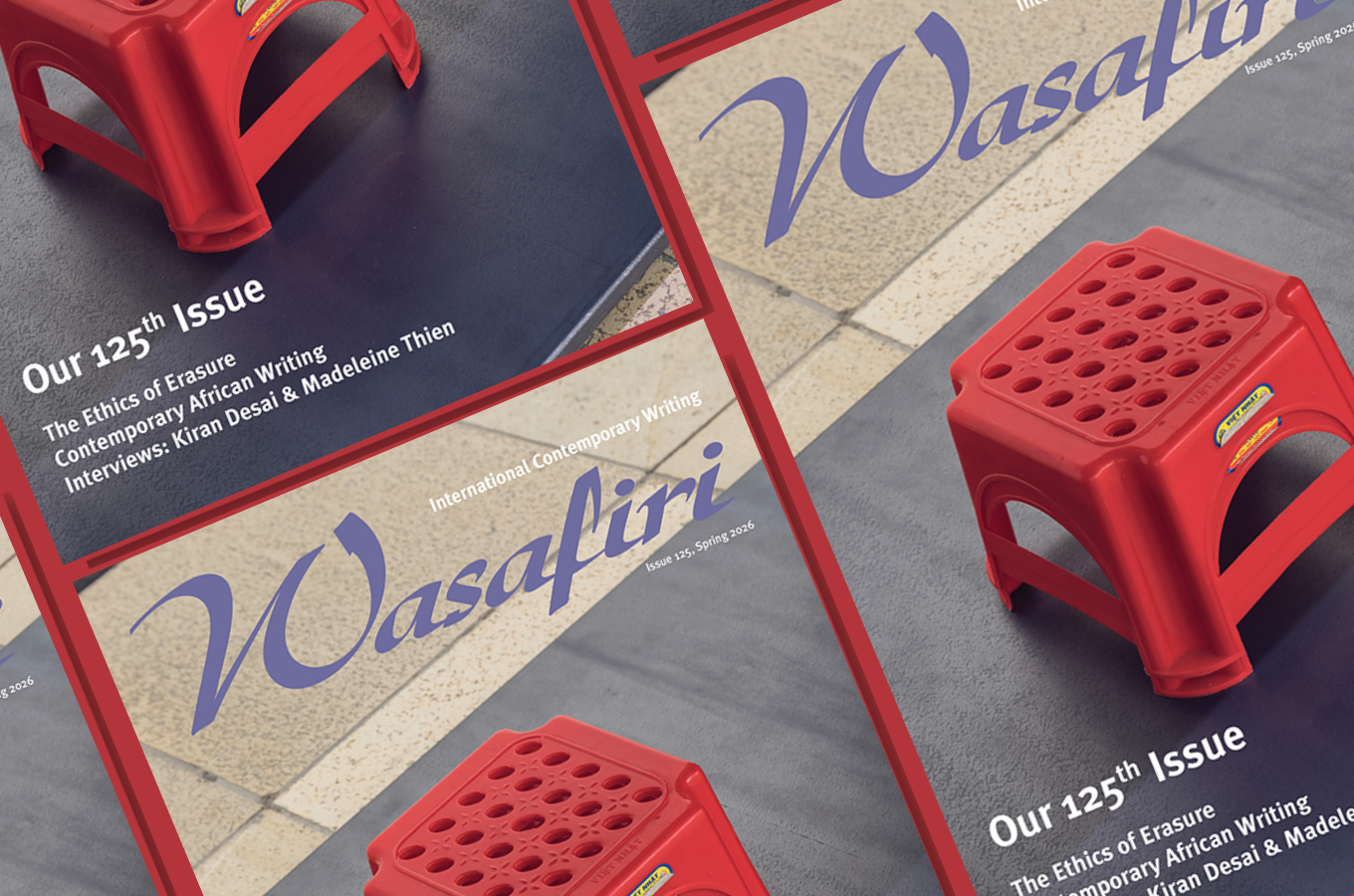
Since 1984, Wasafiri has been one of the most important literary spaces for international writing that refuses the narrowness of established canons, a magazine built on the conviction that the best way to challenge borders is to publish across them. Volume 41, Issue 1, the magazine’s 125th issue, arrives under the editorial stewardship of Vamika Sinha, and it is anchored by a term Sinha encountered at a public lecture by Sri Lankan artist Abdul Halik Azeez: melancholony. Coined to describe the erosion of Colombo’s history under the pressure of capitalist development, the word captured something larger for Sinha, not a temporal description like “postcolonial” or “neocolonial,” but an experiential one. A description of feeling. “Whatever our positionalities,” she writes in her editor’s note, “this stain touches all of us.” The 125th issue does not wring its hands over the world ending. It steeps itself in the crumbling asking, simply and urgently: what is it like to live here?
The African continent has a commanding presence in this issue, and not incidentally. Sinha notes that Issue 125 carries writing from countries and languages never previously featured in Wasafiri, including Botswana, where she herself grew up. Tawanda Mulalu, born in Gaborone and the author of Please make me pretty, I don’t want to die (Princeton UP, 2022), winner of the 2023 Glenna Luschei Prize for African Poetry, contributes “Tlokweng” a poem named after a settlement in Botswana’s capital, threading personal distance and continental longing through the formal architecture of the sonnet. Nigerian poet Onyekachi Iloh, whose honours include the Quarterly West Prize and the Oxford Brookes Prize for Poetry, offers “Long Exposure,” a devastating phone call between a son abroad and his mother in Nsukka, in which news of death and emigration arrives between bursts of static: “The void between the two departures fills with the grainy screech of static and the / tireless dancing of trees.” ML Kejera, the Gambian writer shortlisted for the Commonwealth Short Story Prize and recipient of a Miles Morland Foundation Writing Scholarship, contributes “Anciens Combattants,” a hybrid work that braids English and French, the two colonial languages of West Africa, to tell a distinctly West African story: a man remembers his home as “bush where fruit, game, and gods were bountiful before Messieurs’ maps terraformed it into a dark and ever-shrinking continent.” And Farah Ahamed’s fiction follows an Ugandan woman radicalised by the forced state censorship of The Vagina Monologues, who must re-examine who she is between victim and perpetrator and what she truly desires.
The issue also carries Beth Hickling-Moore’s English translation of a short story by Mozambican writer Lília Momplé, herself a landmark figure, winner of the José Craveirinha Literary Prize in 2011, and the author of the seminal collections Nobody Killed Suhura (1988) and The Eyes of the Green Snake (1996). Hickling-Moore, who is currently translating Paulina Chiziane’s The Seventh Oath for Archipelago Books and was the recipient of the 2025 PEN Grant for the English Translation of Italian Literature, brings Momplé’s prose into English with care and precision. Sinha describes the African fiction in this issue as “scattered with various remnants of colonial presence, reckoning with the trauma of subjugation through characters that behave unexpectedly, sometimes violently, because of the insistence of their pain.” The violence she describes is structural, ungovernable, a direct consequence of misgovernance that refuses to stay contained on the page.
The essay that will perhaps linger longest is Deepa Bhasthi’s “Language is a Fuse Waiting to Be Lit”, a piece of life writing that is as much memoir as it is literary-political manifesto. Bhasthi, whose English translation of Banu Mushtaq’s Heart Lamp won the 2025 International Booker Prize, writes from inside the experience of being formed by a Macaulayan education system in India, one designed to make English the aspirational tongue and render every other language secondary. Drawing on Ngũgĩ wa Thiong’o’s Decolonising the Mind and The Language of Languages, she argues that language is never merely functional: it is “a repository of memories, histories, food practices, rituals, cultural hierarchies, geography, weather, self-awareness.” Her translator’s credo is stated with full conviction: “I want to take pieces of my language into other linguistic cultures — in order to do so, I must keep them untranslated in some sense.” The piece closes with a journal entry written “in the heavy fog of a translation project”: “After you translate something, let the text rest. You need to rest, as do the words. You both, remember, have been through a violent phenomenon of wrestling between two cultures.” It is a sentence that feels written for this entire issue.
Elsewhere, the 125th issue features an interview with Beata Umubyeyi Mairesse, a survivor of the 1994 Rwandan genocide against the Tutsi, whose work covers the loneliness of the genocide survivor “when their experience isn’t heard”, a loneliness she connects directly to the ongoing genocide in Gaza. Madeleine Thien speaks with Jeremy Tiang about the impetuses and afterlives of her stories. Thomas Glave writes in remembrance of the Guadeloupan writer Maryse Condé, who passed away in 2024, in a piece that is less tribute than personal reckoning, with his own ignorance, his own prejudices, and the role of Western imperialism in entrenching divisions across the Caribbean. Rivers Solomon, Vanessa Kisuule, and Sarah Lasoye discuss fugitivity from Black feminist perspectives as a framework for what comes next: “Fugitivity is a practice. You have to practise rebellion, practise imagining otherwise.” And the issue carries the three winning pieces of the 2025 Queen Mary Wasafiri New Writing Prize, including Jo Bardsley’s extraordinary historical fiction “Iko of Benin, King’s Diver,” narrated by a diver from Benin contracted to salvage the Mary Rose in 1546, a story that does something rare: it puts an African body at the centre of a canonical English historical event and refuses to let the reader look away.
The melancholony, as Sinha frames it, has not taken our languages. It has not erased our capacity to write, to record, to feel, to fight. Wasafiri’s 125th issue is both evidence and argument for that claim — a gathering of voices from across the African continent and its diaspora, from South Asia, the Caribbean, Southeast Asia, and beyond, insisting on their full humanity in language that is unafraid of difficulty and unafraid of beauty. It is one of the strongest issues the magazine has published. Read it in full here.
As a Brittle Paperian, you have an exclusive discount code to purchase the issue. The code is BRITTLEPAPER10 and will be valid for 10% off from now until the end of April. It can be used on Wasafiri 125, as well as on Wasafiri’s African Writing bundle which includes this issue plus three others from across their over 40-year archive on African and Afro-diasporic writing.


COMMENTS -
Reader Interactions