

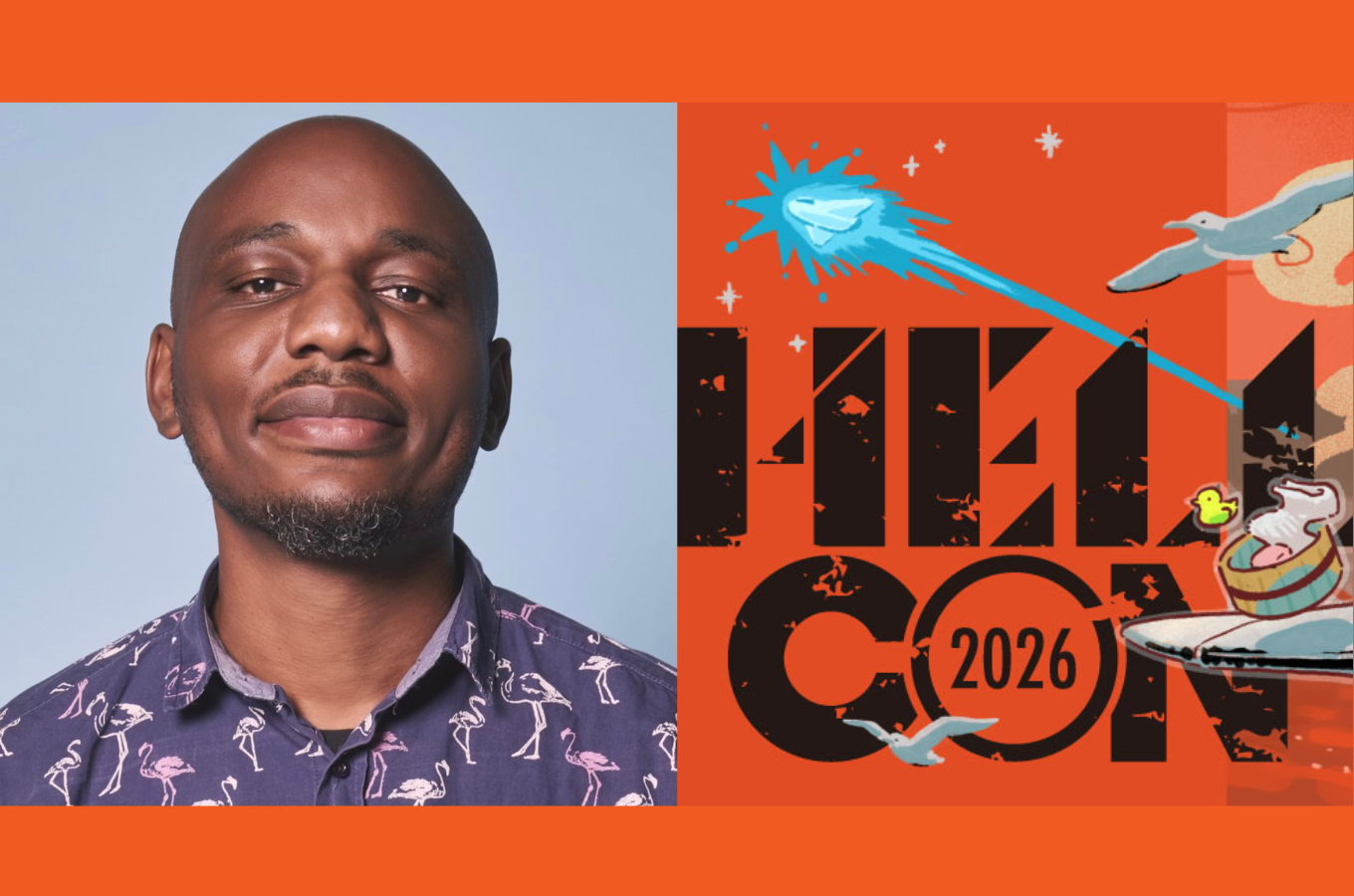
Wole Talabi is having a year! His novella Descent is a 2026 Nebula Awards finalist. His second novel, The Fist of Memory, arrives in October from DAW Books and Gollancz. And now, a short story he published three years ago has found its way onto the shortlist for one of Japan’s most prestigious speculative fiction honours.
The nominees for the 57th Seiun Awards were announced on March 16, and among the six finalists for Best Translated Short Story is Blowout by Wole Talabi, translated into Japanese by Masato Naruniwa and published in Hayakawa SFin December 2025. The winners will be announced in early June, with the awards ceremony held at Hellcon, the 64th Japan Science Fiction Convention, in Oita Prefecture on July 11–12, 2026.
The Seiun Awards are the Japanese equivalent of the Hugo Awards, voted on by attendees of the Japan Science Fiction Convention and considered the most significant recognition a work of speculative fiction can receive within Japanese SF fandom. They have been awarded since 1970, and the categories for translated works are fiercely contested, reflecting Japan’s robust culture of SF translation and readership. To appear on that shortlist is to have captured the imagination of one of the world’s most devoted science fiction communities.
The other finalists in the Best Translated Short Story category include Hémisphères by Tristan Garcia, Two Truths and a Lie by Sarah Pinsker, After Zero by Greg Egan, Five Views of the Planet Tartarus by Rachael K. Jones, and The Terror of the Gaze by Han Song. It is, by any measure, a formidable list.
Blowout was first published in Analog Science Fiction and Fact in July 2023, and it went on to win the Analog Analytical Laboratory Award for Best Short Story, an award voted on by the magazine’s readers. It later appeared in Talabi’s acclaimed collection Convergence Problems (DAW Books, 2024).
The story follows a woman racing against time, and against a previously undocumented geological phenomenon, to save her brother on the surface of Mars. The title carries a double weight: it describes the physical catastrophe unfolding on the Martian surface (an uncontrolled, explosive flow of underground fluids during drilling), and it names the rupture happening between the two central characters, siblings named Femi and Folake, whose relationship bears the strain of shared grief and divergent paths. In a Q&A with Analog, Talabi explained that the emotional core of the story traces back to an abandoned 2012 novella about traumatized children of inventors who die young, a story whose fragments have woven their way into several of his works over the years.
Talabi’s work has now been translated into ten languages, a range that reflects both the universality of his themes and the specificity of his craft. His stories, which often centre on African cultures, myths, and philosophies, have clearly found readers and translators willing to carry them across languages without flattening what makes them distinctive.
The Seiun nomination for the Japanese translation of Blowout is a reminder that African speculative fiction is not only being written and recognised in Anglophone spaces, it is crossing into other literary traditions entirely, being claimed by communities of readers with their own rigorous standards and their own deep investment in the genre.
African speculative fiction has global reach. Wole Talabi keeps proving it.







COMMENTS -
Reader Interactions