

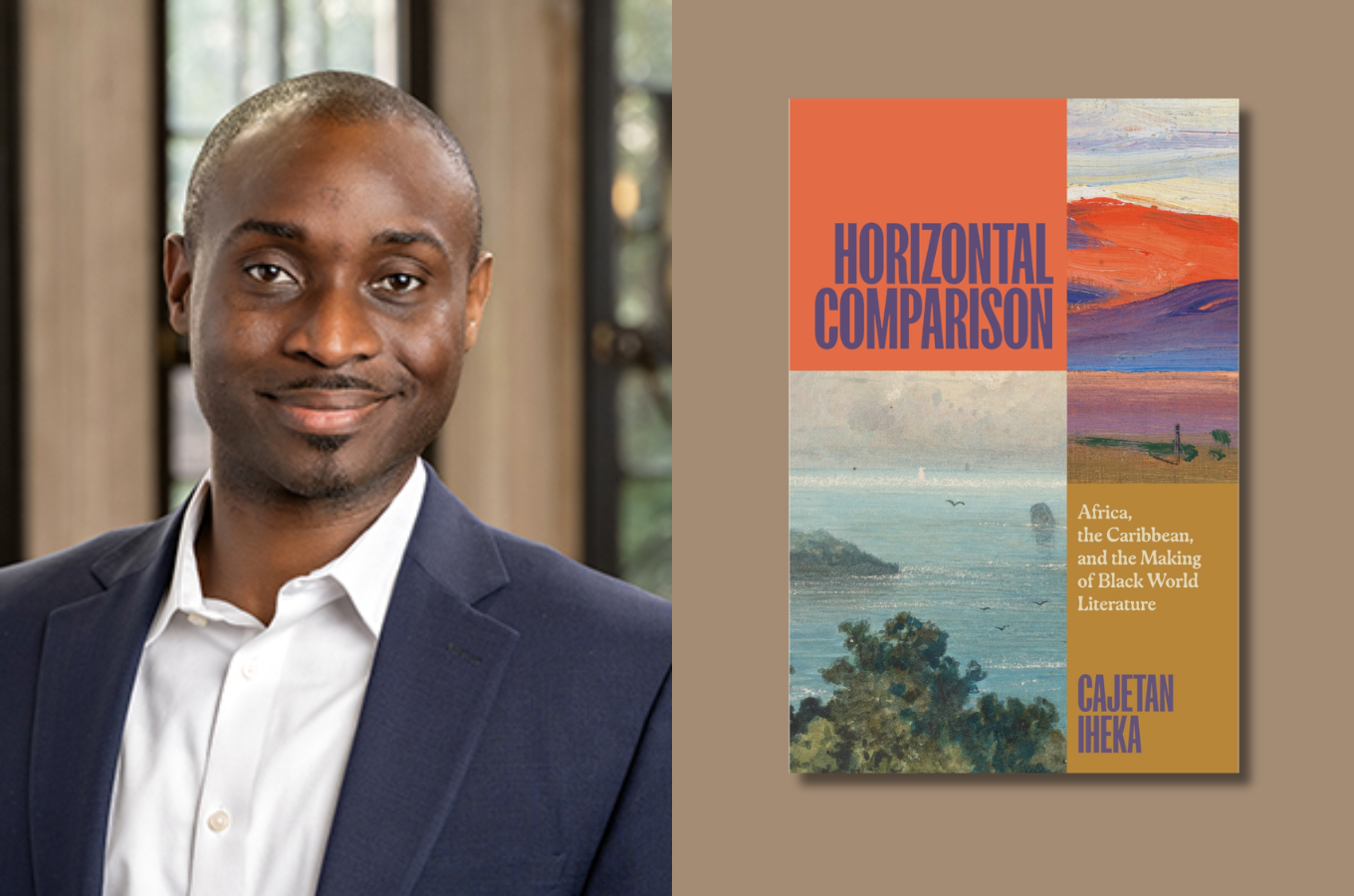
What happens when African and Caribbean literature is read alongside itself, rather than continually measured against Europe and the United States?
That is the question at the heart of Horizontal Comparison: Africa, the Caribbean, and the Making of Black World Literature, Cajetan Iheka’s forthcoming book from the University of Chicago Press. In it, Iheka argues that comparative literature and Black Atlantic studies continue to carry what he calls an “Africa problem”: even after decades of attempts to decenter Western frameworks, the United States and Europe remain their primary points of reference.
Horizontal Comparison proposes a different way of reading. Rather than arranging literary cultures along a hierarchy that places the West at the center, Iheka turns toward a South-South model, tracing the connections between African and Caribbean writing and asking what becomes visible when those traditions are placed in conversation with one another.
The book follows the literary work and life trajectories of writers including Peter Abrahams, Chimamanda Ngozi Adichie, Maryse Condé, Buchi Emecheta, Jamaica Kincaid, Claude McKay, Dinaw Mengestu, Ferdinand Oyono, Taiye Selasi, and Sam Selvon. Across these pairings, Iheka examines how African and Caribbean texts have long been in conversation, informing and reshaping one another outside the familiar routes through Western literary canons.
The result is not simply another call to diversify the canon. Iheka uses these African-Caribbean encounters to question the methods through which comparative literature itself has traditionally produced relationships between texts. The book’s chapters move through questions of Black world literature, the Black Atlantic, reading, trauma, and character, asking how literature is “worlded” and who gets to determine what constitutes a literary world.
The book’s five central chapters bring different sets of writers into these lateral conversations. Sam Selvon and Jamaica Kincaid appear alongside Adichie’s Americanah in a chapter on the Black Atlantic; Claude McKay and Dinaw Mengestu become the basis for a discussion of blackness and queerness; Ferdinand Oyono and Maryse Condé are brought together around trauma; and Buchi Emecheta, Kincaid, and Taiye Selasi anchor a chapter on character and individualism.
For Iheka, this approach is also part of a longer scholarly project concerned with moving Africa from the margins of literary and cultural debates toward the center of how those debates are constructed.
A Professor of English at Yale University, Iheka directs the Whitney Humanities Center and chairs the Council on African Studies. He is also editor-in-chief of African Studies Review, the flagship journal of the African Studies Association.
Horizontal Comparison is his third monograph. His first, Naturalizing Africa: Ecological Violence, Agency, and Postcolonial Resistance in African Literature (2018), won the 2019 Ecocriticism Book Award from the Association for the Study of Literature and Environment and the 2020 First Book Prize from the African Literature Association.
His second, African Ecomedia: Network Forms, Planetary Politics (2021), examined the relationship between media, materiality, infrastructure, and ecological politics in Africa. The book received six prizes, including the 2022 African Studies Association Best Book Prize, the Ecocriticism Book Award, and the Harold and Margaret Sprout Award from the International Studies Association.
With Horizontal Comparison, Iheka moves from questions of ecological and media relations toward a broader question of literary relations: what happens when Africa and the Caribbean are allowed to constitute one another as intellectual and aesthetic reference points?
The University of Chicago Press describes the project as an attempt to articulate new forms of “transoceanic solidarity.” For Iheka, the point is not simply to add African and Caribbean texts to an existing map of world literature, but to reconsider the map itself.
Horizontal Comparison: Africa, the Caribbean, and the Making of Black World Literature will be published by the University of Chicago Press on November 9, 2026, in hardcover and paperback. Preorder here.



COMMENTS -
Reader Interactions