

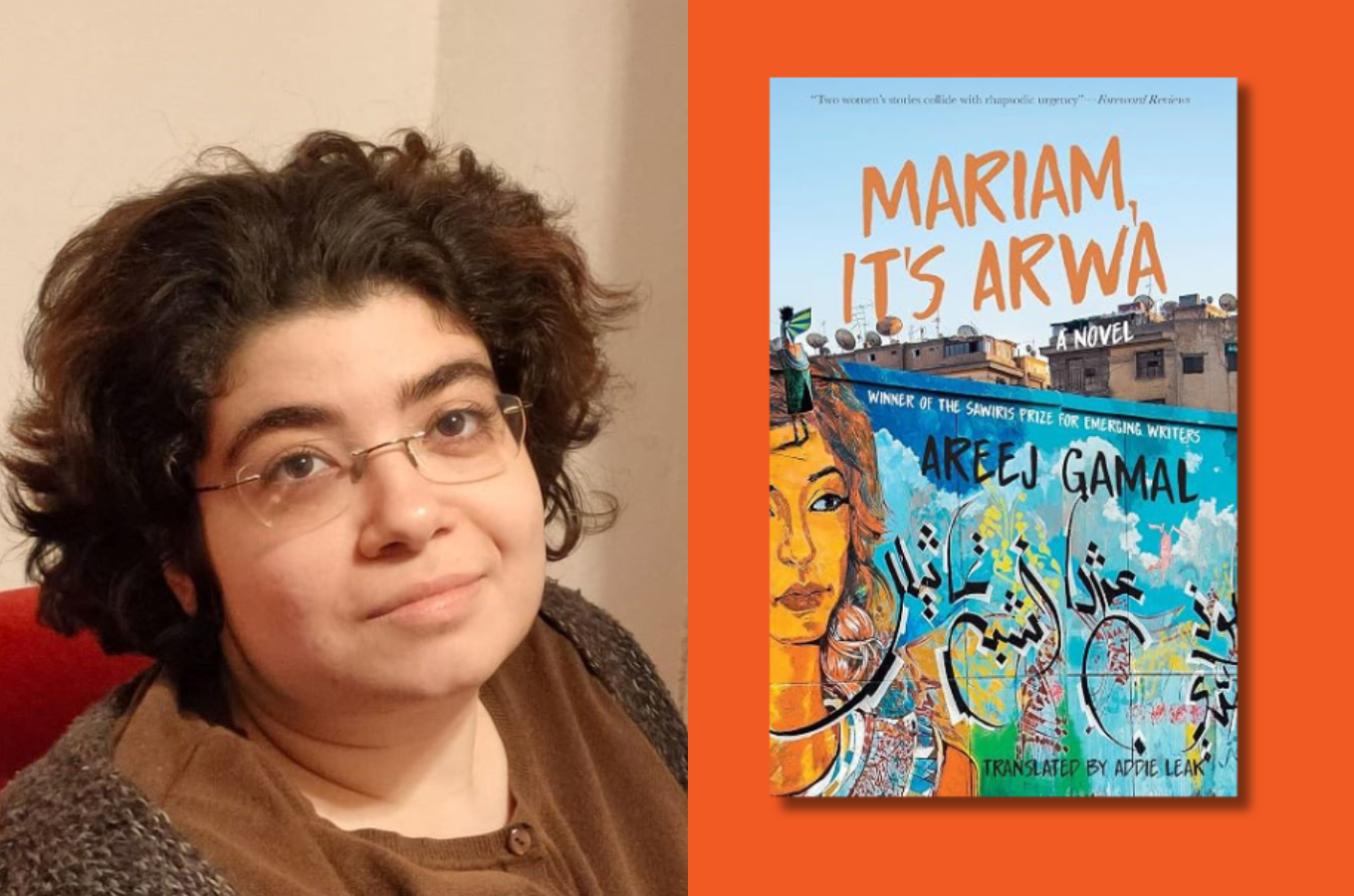
During the 2011 Egyptian Revolution, as Cairo fills with protests and uncertainty, two women meet in a subway station near Cairo University. One has returned from Germany searching for a home; the other is carrying the grief of losing her parents. Their encounter becomes the beginning of a love story shaped as much by memory and loss as by desire.
Areej Gamal’s Mariam, It’s Arwa, translated from Arabic by Addie Leak, follows Mariam and Arwa as they reveal the stories that have shaped them. Mariam grew up in Riyadh before returning to Egypt after her parents’ deaths, while Arwa comes back from Germany carrying the complicated history of her family and her mother’s past. Their relationship unfolds against a city in political upheaval, where the revolution outside mirrors the emotional upheaval taking place between them.
At the centre of the novel is the question of what it means to find home after displacement. Arwa’s apartment on Champollion Street, once occupied by her parents, becomes a space where inherited stories and new possibilities collide. Music also binds the women together: Arwa, an oboist, brings a freedom and vitality that draws Mariam out of her loneliness. Their connection allows both women to confront the past while imagining a life beyond it.
First published in Arabic, Mariam, It’s Arwa won the Sawiris Cultural Award for Young Writers in 2021. The English edition, published by the American University in Cairo Press in March 2026, marks Gamal’s first novel and her first book translated into English. Gamal is an Egyptian writer, translator, and film critic who has also published three collections of short stories.
Dreamlike and intimate, Mariam, It’s Arwa places a tender love story against a turbulent historical moment, asking how two people can make something new from the fragments of what came before.
Here’s the synopsis:
Mariam, It’s Arwa follows two young Egyptian women who meet during the 2011 Egyptian Revolution and find love, comfort, and hope in one another. Arwa has returned from Germany to participate in the protests, while Mariam, born in Saudi Arabia, has come to Egypt following the deaths of her parents. As they share stories about their mothers, grandmothers, families, and the experiences that shaped them, their unexpected relationship becomes a path toward healing and self-discovery.
The novel moves between past and present, exploring grief, family, displacement, and the possibility of salvation through human connection. At its heart is a recognition of the women whose lives and choices came before Mariam and Arwa and how their histories continue to shape the lives of those who follow.




COMMENTS -
Reader Interactions