
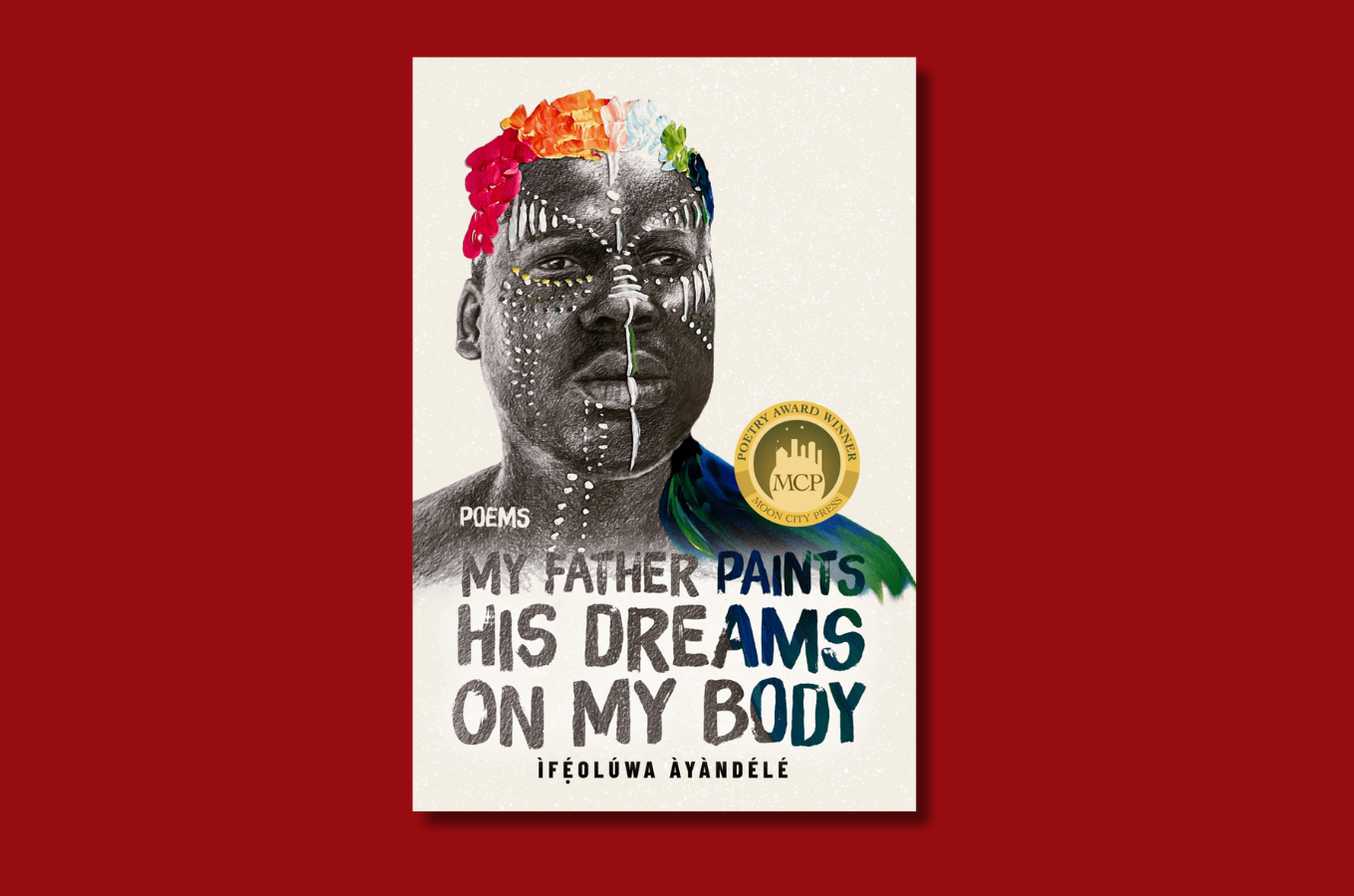
Years after the Nigerian Civil War, Ìfẹ́olúwa Ayandele’s grandfather was still carrying the weight of what he had lost. He had served as a soldier, returned home, and later travelled to Lagos to collect a pension that never came. His story became one of the threads behind My Father Paints His Dreams on My Body, Ayandele’s debut poetry collection about inheritance, grief, ancestry, and the memories that refuse to stay in the past.
At the heart of the collection is Àyàndélé’s relationship with his father and grandfather. The collection is also deeply concerned with the body. In a conversation with AfricanWriter, Àyàndélé describes the Black body as an “archival site”, carrying cultural and historical memory alongside the experiences of individual lives. Across the poems, the body becomes a place where family history, childhood, displacement, and the memory of home can be stored.
That idea of home is complicated by distance. Àyàndélé was born in Ago Are, grew up in Lagos, and is from Tede, Nigeria; he now lives and studies in the United States. He has said that writing about places such as Tede and Ago Are was a way of remaining faithful to the people and places that shaped him, rather than writing toward an imagined audience or literary expectation.
The collection’s poems move through the Nigerian-Biafran War, family, grief, animals, prayer, rivers, forests, and the ache of being away from home. Its manuscript won the 2024 Moon City Poetry Award before being published by Moon City Press in January 2026. Àyàndélé has since also won the 2026 Pink Poetry Prize from Great River Review.
In My Father Paints His Dreams on My Body, memory is not passive. It moves through generations, settles in the body, and changes shape as it is carried forward. The collection asks what we do with the dreams we inherit and what it means to make them our own.
Here’s the synopsis:
How do our ancestors inhabit the world that they have abandoned? What is the place of our family in our hearts? In this stunning debut collection, Ìfẹ́olúwa Àyàndélé reveals this interior world in which the past sings its lament in the present moment. The father is Àyàndélé’s connection to the deep past and his ancestors, who move through love and the Nigerian-Biafran War, but also through the luxuriant landscape of rivers and forests.
How does one person balance the past and the present? Animals can show us the way of nature. Prayer can form a river of the soul as it chants, praises, and reveres the terrible beauty of this world.
Buy My Father Paints His Dreams on My Body here



COMMENTS -
Reader Interactions