

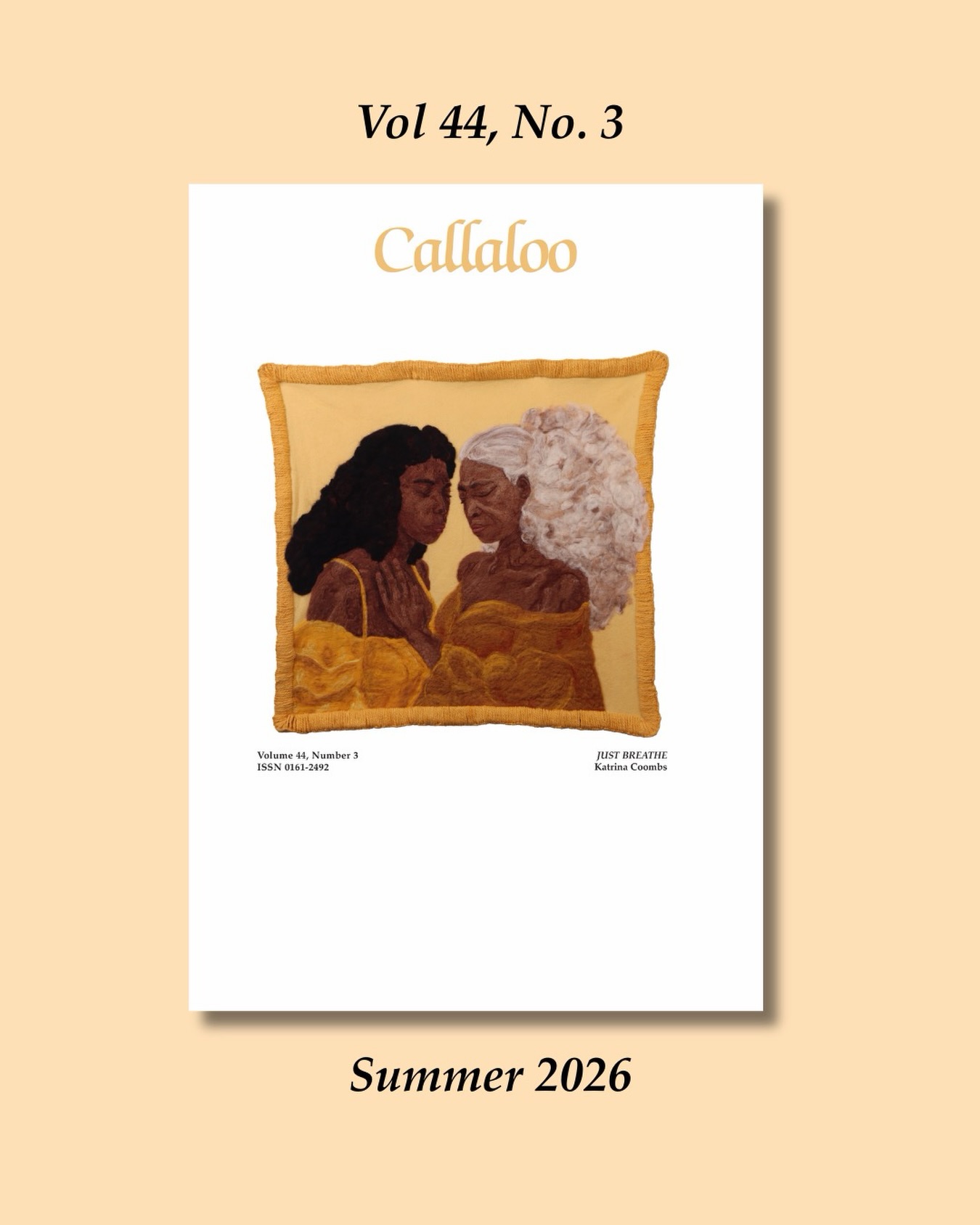
Callaloo, the premier journal of literature, art, and culture of the African Diaspora, has released a new issue, Volume 44, Number 3, Summer 2026, bringing together fiction, poetry, visual art, criticism, interviews, and scholarship on Black history, memory, culture, and survival.
At the heart of the issue is a meditation on complexity. In the editor’s note, Kyla Kupferstein Torres draws on James Baldwin’s reflections on the difficulty of making sense of Black life in America without reducing its contradictions. Baldwin cautions against the temptation to simplify complex realities, arguing instead for the difficult work of confronting them in their fullness.
Torres takes up that challenge in reflecting on the United States and its history, acknowledging both the violence and oppression that have shaped Black life and the flourishing, achievement, and survival that have emerged alongside them. For Black people, she writes, reckoning with the country’s history is not simply about cataloguing its failures. It is also about recognizing “the power we refuse to relinquish” and the everyday resilience through which Black communities continue to create and endure.
Many of the contributions in the issue take up this tension between historical violence and creative survival.
The issue opens with a conversation with photographer and scholar Leigh Raiford, whose work engages questions of photography, memory, and the Black archive. Fiction and poetry throughout the volume similarly explore questions of identity, place, history, family, and belonging, creating a wide-ranging portrait of Black life across different geographies and generations.
The issue’s geographical reach extends well beyond the United States. Contributions engage histories and cultures across Africa and the Caribbean, including Philip Chijioke Abonyi’s “Igbo” and Afia Ansong’s Hye Wo Nhye, and: Answers: Anomabo, Cape Coast. A substantial section turns to Jamaica, with contributions exploring Jamaican cultural history and the role of literature in making sense of the island’s past and present.
A special section on deep listening in Jamaica brings together several perspectives on Jamaican cultural life, followed by a conversation with Jamaican poet Ishion Hutchinson. The issue also features work engaging the writing of Olive Senior and scholarship on the relationship between Caribbean literature, colonialism, and history.
Elsewhere, a critical essay examines Kei Miller’s Augustown, Miller’s acclaimed novel about memory, violence, colonialism, and resistance in Jamaica. Another conversation turns to Nicholas Boggs’s scholarship on James Baldwin, extending the issue’s interest in literary archives and the recovery of Black intellectual and cultural histories.
The issue also looks beyond literature to other forms of cultural memory. One contribution examines Kingston’s defunct movie theaters, considering what these disappearing spaces reveal about the city’s cultural history. Visual art and photography throughout the issue further expand its investigation of how Black histories are recorded, represented, and remembered.
The contributions demonstrate the expansive terrain of contemporary Black literary and cultural scholarship. The issue moves between the United States, Africa, Jamaica, and the wider Caribbean, underscoring the connections between histories that are often studied separately but have long been linked through migration, colonialism, slavery, cultural exchange, and the movement of ideas.
This diasporic perspective is central to Callaloo’s longstanding mission. The journal publishes original work by and about writers and visual artists of African descent worldwide, bringing together creative and critical work that crosses national, disciplinary, and geographic boundaries.
The new issue continues that tradition while asking readers to sit with the contradictions that shape Black life: grief alongside beauty, historical violence alongside achievement, and rage alongside the persistence of hope and creative possibility.
Rather than attempting to resolve these tensions, Callaloo gives them room to exist together and in doing so, offers a portrait of Black life defined not only by what has been endured, but also by what has been created, preserved, and carried forward.
Access the issue here

COMMENTS -
Reader Interactions