

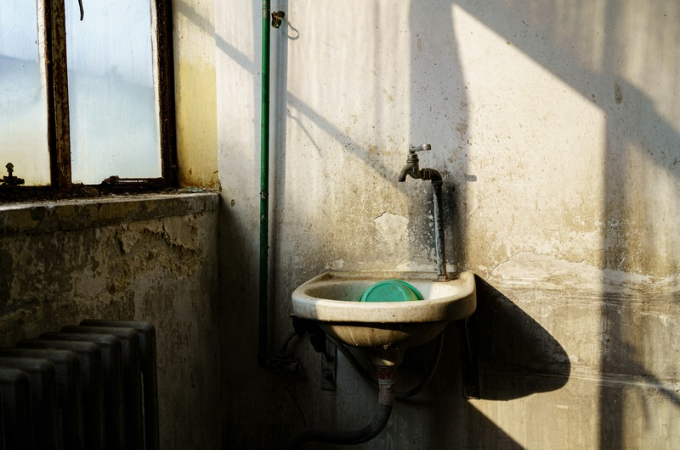
Thula turned the knob without hope to excite him. The tap, as expected, belched out hunger, its pipes drier than his oesophagus. They were now going into the tenth week without water. No water tank to placate their suffering. No community meetings to explain the deprivation. No lies of burst pipes or malfunctioning engines. Nothing but disregard. Just the ward councillor hiding behind his thumb, telling his kids to deny his presence when neighbours confirmed it.
On the third week, when they had decided enough was enough, they had gathered on the main road, by the taxi rank, before sunrise. In the blue hour they had gathered, a throbbing mist of figures breaking open the day. Young and old, they came in numbers to lament their suffering. To stretch their voice hoarse from fruitless enquiries, to give it the weight and strength of unity, to anchor on the road their rage like a flag. They burnt tyres for incense and watched as the smoke rose heavenward; to say let the dark cloud of privation lift. In song they cried for freedom to lift from the pages of the constitution and manifest in their lives. They cried for dignity that acknowledged their worth, for the humility of those in power, for the righteous force of justice.
But they cried to deaf ears. Ears waxed thick by the contentions of water tank wars and political deceptions. Opposing parties crouched out of nightly shadows to destroy the water station and sabotage the ruling party, while the ruling party cut off water to benefit its friends. It was a loosely kept secret that each political party had its own water tank goons. Such were the relations between the mayor and Mr Mngadi; a friendship enriched by water cuts. The mayor’s pockets were stuffed full by the Mngadi’s. In turn, the mayor would routinely cut off the water supply, citing fictional problems, so Mngadi could tender out his water tanks.
It was a ruse. A political trick, poorly executed, constructed by a mind trapped in its arrogance and folly, masquerading as sly intelligence. A mind that blinds itself believing it blinds another. Like a child attempting invisibility by covering his eyes. At first, the community, seeing it as a small thing, had played along. They had played the adult, and as any adult in a child’s game, they had feigned ignorance, forgetting that tooth decay begins as a tiny black spot. Before the cavity. Before utter rot eats the enamel to the gum. It begins as a small thing. Almost inconsequential. A thing small enough to weave into the pattern of living.
A day or two without tap water wasn’t so bad. They would even joke, as they stood at the water tank line, that one must gather as much water as one can so as to have the likes of Mngadi earn their pay. Besides, it didn’t happen that often, perhaps once in three months, so they had shrugged their shoulders and said, “Ah, what is it to fight over?” Until two days turned into two weeks. Then six. Then ten. Who is to say it would not reach fifteen? That it would not become the new normal?
That is the danger in giving leeway to wickedness. The danger in thinking that there is such a thing as a harmless evil when, in truth, evil is a dumdum bullet that expands on impact. Turning a blind eye to corruption gouges out the other. Like rust, like cancer, like poison, corruption corrodes the host.
Thula went back inside and turned on the radio. They were discussing the looming local government elections, urging the public to go out and vote.
“Your vote is your voice,” the radio DJ said.
“True, Slash,” his co-host supported, “It is sad how voting numbers have plummeted in the recent years, especially among the youth. Young people, let your voices be heard, go out and vote. This is a right generations before you fought for.”
Thula switched it off. He wondered what lies the campaigners would dish up this time and what fool would eat it up. He wondered if they would do door-to-door. He had a good mind to set the dogs on them.
His stomach growled. He raided the cupboards and found a lone slice of bread which he plastered thick with margarine, then spat out after a couple of bites as the breath of the toilet sneaked in to snatch it from his hand. The house stank of shit, urine, and strangely, rotten eggs. The toilet, having drunk only wash water for nine weeks, screamed its intolerance.
His phone rang. He knew who it was and what they wanted, so he did not answer. He changed quickly, then headed out. Today they will do a water heist. For the first time, the burst pipe excuse would be no excuse, and the community will have water.
When we turn a blind eye to corruption, it gouges out the other.





COMMENTS -
Reader Interactions