


They Dream in Gold by Mai Sennaar is a novel about sound. Music runs through the story. The two main characters, Bonnie and Mansour, are bound to music in different ways. Bonnie is a Black American woman who grew up in Paris with a mother who lined their apartment with records: Sarah Vaughan, Ella Fitzgerald, Nat King Cole. Food lived next to albums, and sometimes even in the bathtub, because the music always came first. She learned to feel life through songs.
One of my favorite thoughts in the novel, repeated a few times, is the idea that “everybody has a sound.” Another one is “some of us are helpless before melodies, our great plans for our lives escalated or abandoned with a singer’s choice to wail or wait.” I love the idea that we carry a tonal life within us, that experiences can be anchored on sound, how we make our own sounds but also how we carry memory in the music that fill our spaces.
Mansour is a musician, but his relationship to music began in childhood in Saint-Louis, Senegal. Mansour grew up as a talibé in Saint‑Louis (a boy studying the Quran under a marabout, often moving through the streets to beg for alms) where he first discovered his own sound in the rhythms of street life. He learned to hear sound in his own body, high notes lifting his spirit, low notes filling him up like food. That deep connection to music threads through the novel, giving the story a texture that feels like listening as much as reading.
The novel moves across countries and decades. The present-day story is set in Switzerland, where Bonnie is living with Mansour’s mother, Mama, who runs a Senegalese restaurant. Bonnie is pregnant, and Mansour is away on tour in Spain, or at least he was supposed to be. Weeks pass with no word. He misses a television appearance she arranged for him, and eventually, a TV announcement about an unidentified dead man makes Bonnie fear the worst. She refuses to believe he’s gone, but the question hangs over the book: where is Mansour, and what happened to him?
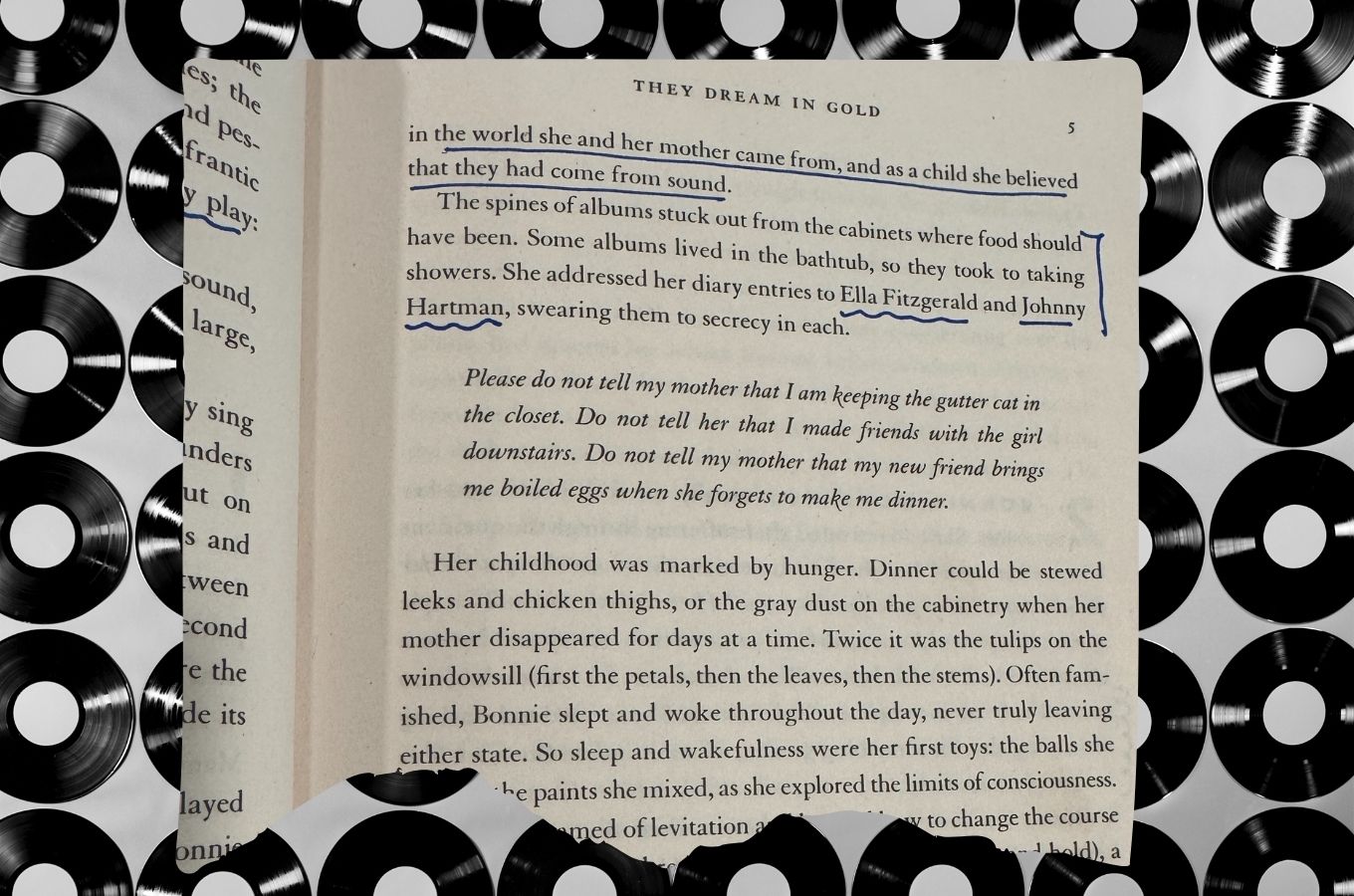
From there, the novel travels back in time, moving through their shared history and the people around them. We see Mansour in New York during the 1960s, trying to break into the music industry with his Irish friend Liam while the city electrifies with jazz and the energy of the civil rights era. We see Bonnie’s childhood in Paris, her imagined conversations with musicians in her journal, her deep attachment to Black music that feels like home even when she struggles with questions of heritage. Along the way, the book introduces a sprawling cast of characters. There are family members, friends, lovers, and mentors whose stories all touch music in some way. The plot about Mansour’s disappearance gives the novel its hook, but the book spends as much time in the past as in the present, trailing music into kitchens, rehearsal rooms, and city streets.
The heart of They Dream in Gold is its cultural richness. It moves between Senegal, France, Switzerland, and the United States, carrying with it histories of migration, music, and diaspora. There are scenes of Mama’s Senegalese kitchen in Switzerland, where the smell of cassava and the blare of Afro-Cuban horns fill the air. There are moments in Saint-Louis that capture the rhythms of West African life and the complexities of mourning and sisterhood. In New York, Bonnie and Mansour begin their epic love story lived in jazz clubs and record studios.
I really love this book. Sennar’s writing is a conjuring. It is spare and unassuming, with just the right touch of poetry to make it work like a spell on the reader. I read the novel, underlining musicians, albums, and songs mentioned, and even made a playlist that I played for my family on a Sunday morning drive to a nearby Wisconsin town. This is a book that feels both real and beautiful.
What didn’t work for me was the use of Mansour’s disappearance as a mystery. It felt like a device to string the reader along, while the true heart of the novel lies in its meandering portraits of the characters’ lives. I don’t mind the fragments, the long detours into backstories, or the ensemble-character feel of the book. I actually enjoy that kind of storytelling. What I struggled with was feeling like the novel kept me dangling on the question of Mansour’s fate, without fully developing it into a mystery or letting the other lives stand entirely on their own. The structure left me wanting a bit more momentum.
But that isn’t really the point. They Dream in Gold is less about answers and more about pulling the reader into a world where music carries a lot of narrative and emotional power.
If you are drawn to novels that give you more than a story, you have try this one. I went in for a story, and felt like I got way much more. I experienced a guided playlist layered onto careful and tender world-building. Like Caleb Azumah Nelson’s Small Worlds, They Dream in Gold reminds you that sometimes, to understand a life, you have to listen for its sound.





Adejumobi Oluwatomiloba September 16, 2025 01:07
Beautiful review!