

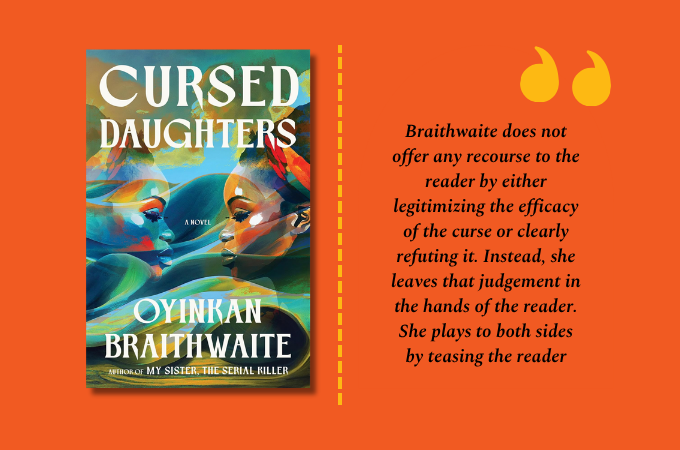
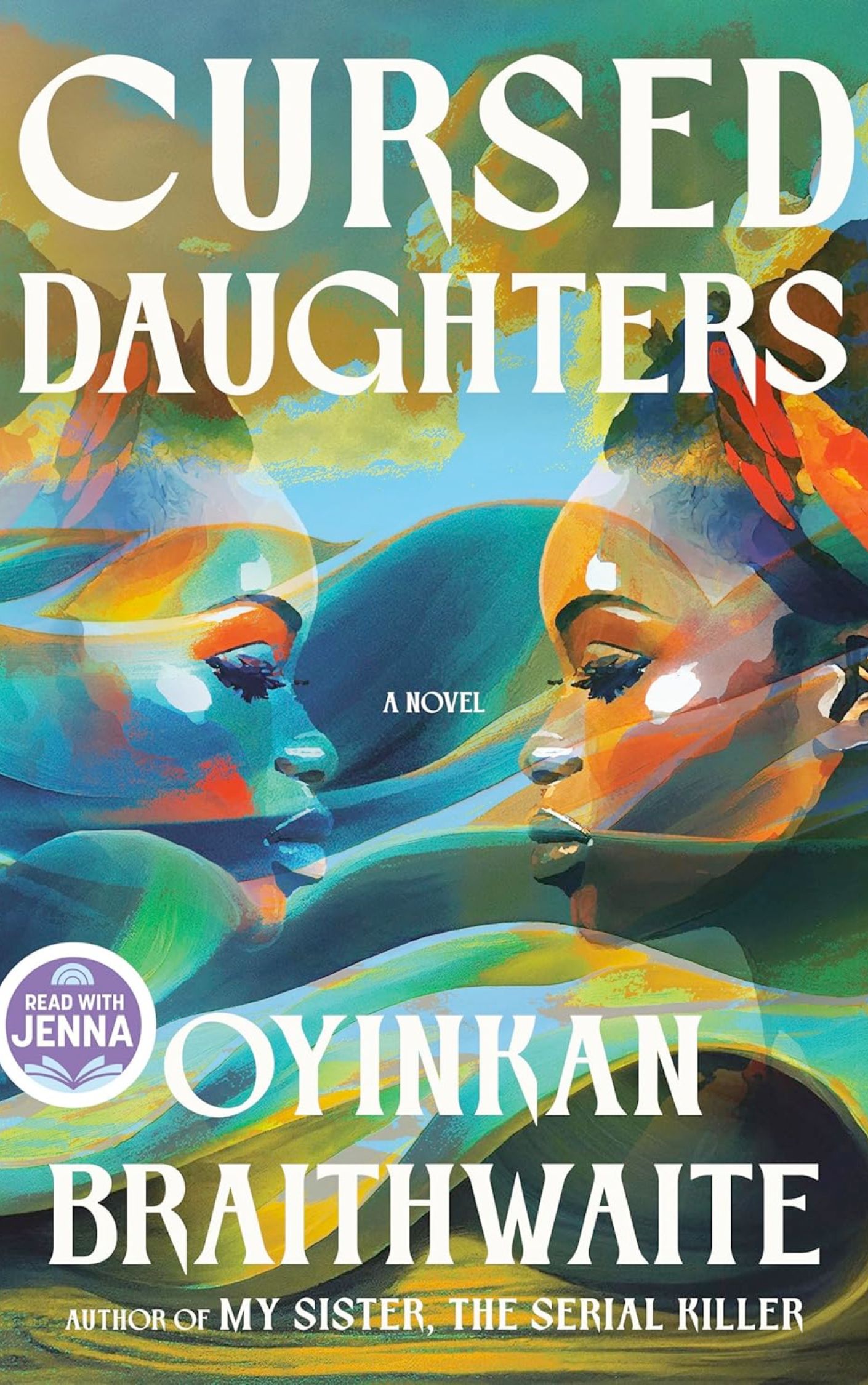
Oyinkan Braithwaite’s Cursed Daughters is a decisive turn away from the dark humour of her critically acclaimed debut, My Sister, The Serial Killer.
Focalized through three women, the cousins Monife and Ebun, as well as Ebun’s daughter, Eniiyi, Cursed Daughters chronicles generations of Falodun women and their inability to be successful in matrimony due to a curse laid on their ancestor, Feranmi Falodun, by a blindsided first wife.
It all begins when Feranmi Falodun seduces and eventually marries the unnamed stranger visiting the village from the city to bury his father, a man who lacks the courage to tell his first wife what he has done. Instead, during a trip to the village, which the first wife assumes is to see the house that would be her children’s inheritance, he claims need to go pay obeisance to the village chief and leaves both women to get acquainted. They immediately get locked into combat, and soon, it is only neighbours who can separate them. Embittered, the first wife curses Feranmi Falodun:
It will not be well with you. No man will call your house home. And if they try, they will not have peace. Your daughters are cursed – they will pursue men, but the men will be like water in their palms. Your granddaughters will love in vain. Your great-granddaughters will labour for acknowledgement, but they will all fall short of other women. Your daughters, your daughters’ daughters and all the women will come to suffer for man’s sake. Ko ni dafun e.
And perhaps to make the curse all the more potent and binding, she “wipe[s] the blood from one of her many wounds and smear[s] it on the ground.”
Even though the curse is pedestalized in the lives of the five Falodun women we encounter in the novel—the sisters Bunmi and Kemi, their daughters Monife and Ebun, and Ebun’s daughter Eniiyi—Braithwaite does not offer any recourse to the reader by either legitimizing the efficacy of the curse or clearly refuting it. Instead, she leaves that judgement in the hands of the reader. She plays to both sides by teasing the reader with Monife’s haunting words that one might not believe in the curse, but “what if the curse believes in you?” and with Eniiyi’s conjecture that:
[w]hat if the trauma of losing the love, stability and social standing that came with marriage had left epigenetic markers on generation after generation of Falodun women? What if the neurons in their brains were triggering her mother, grandmother and grand-aunt to select the wrong partner, and that was the ‘curse’?
These questions—Monife’s and Eniiyi’s—begird the lives of the Falodun women, keeping them, and, by extension, the reader entrapped and unable to move on. The underpinnings of the novel’s preoccupation with the curse are demonstrative of the average Nigerian’s tenuous relationship with superstition. The novel holds a mirror to society in the sense that due to Nigeria’s status as a postcolony and the resultant Christian and Islamic permeation in everyday life, like Bunmi, many Nigerians outwardly profess fidelity to monotheistic faiths while privately maintaining a furtive, often pragmatic, engagement with indigenous spiritual systems when shit hits the fan. This doubleness reflects a layered cosmology in which modernity does not so much replace tradition as uneasily coexist with it. The curse, then, functions not only as a supernatural device but also, as a narrative articulation of this unresolved tension: a burden that thrives in the interstices between faith and fear.
And perhaps, one might surmise that the real curse is the Falodun women’s obsession with men, whether, like Monife, they are trying desperately to keep him or, like Ebun, they are trying desperately to keep him away. In both instances, male presence, or the looming threat of its absence, becomes the axis around which the Falodun women’s emotional and existential lives revolve, suggesting that what is transmitted across generations is not simply a metaphysical affliction but a deeply internalized script of relational dependency. The tragedy of the Falodun lineage, therefore, lies not only in the possibility of supernatural retribution but in the more insidious inheritance of desire itself: a cycle in which love is inextricable from fear.
Braithwaite’s use of music accentuates the story’s sense of time and place. Songs like Pliers’ “Murder She Wrote” and Snoop Dogg’s “Gin and Juice,” and even “Brandy’s crooning” situates one in the early 90s. Shooting to the mid 2020s, the music turns to such hits as Burna Boy’s “Last Last” and “Gbona,” Teni’s “Case,” Lojay’s “Monalisa,” and Ayra Starr’s “Bloody Samaritan.” The grounding effect of the music also serves to show the evolution of the mainstream musical palette and the rise of afrobeats within the Nigerian (and even international) soundscape. From the American import blasting from radios in the 90’s, to the more afrocentric distribution in the mid 2020’s, Braithwaite charts the course of musical evolution in Nigeria. The transition period between the late 2000’s and mid 2010’s lends credence to this evolution, featuring a mix between import and domestic music with songs like Janet Jackson’s “Doesn’t Really Matter” and Lagbaja’s “Coolu Temper” playing simultaneously in that era.
Yet, despite the evolution of music to show the changing times, Braithwaite deftly portrays the staticity of the Nigerian socio-economic scene. In the time between Monife’s 1994 and Eniiyi’s 2025, amenities such as stable electricity and responsive emergency services are still a mirage. Several times, Monife experiences the lights going off and the air-conditioning unit rattling to a stop due to NEPA power cuts that were “arbitrary and […] becoming more and more frequent.” This status quo remains even until Eniiyi’s adulthood in 2024/25 where she is “hot and irritable” inside the house due to the lack of electricity.
But even more than this glaring lack of basic amenity, Braithwaite highlights the dwindling state of affairs in the country and the current political climate, noting that Eniiyi and friends “fell to talking about the presidency – the disappointment that was the president’s run thus far; the seemingly arbitrary decision to change the national anthem whilst his citizens faced economic crisis; the lack of hope in the political process.” Braithwaite uses Zubby’s drowning scene, not only to orchestrate his and Eniiyi’s first encounter, but also to comment on the flabbergasting lack of emergency policy in the most popular beach in Lagos state, a microcosm for the general state of affairs in the country: “It dawned on her that they should call an ambulance, but she had no idea what the number was for that or if there was even a number to call.” This commentary on the living conditions in the country over a thirty-year span does not serve merely for worldbuilding, it foregrounds the nation’s decrepitude from bad leadership.
Cursed Daughters might be praised for a lot of things such as its evocative prose and adroit exploration of interiority—and it rightly should—but one of those things is certainly not its portraiture of Pidgin. The use of Nigerian Pidgin within the text is unconvincing at best, and frequently disrupts the otherwise seamless absorption of the novel. This flavour of English, often used by the Priestess and Mamalawo, Mama G, of whom Bunmi, Monife’s mother, is a patron, often feels out of place and inauthentic—oddly reminiscent of IJGB’s trying to fit in with their Nigerian relatives when they come home for Christmas. Early on in the text when Monife tries to get a refund from her, Mama G argues, “I cannot resell am,” instead of the more natural ‘I no go fit sell am give another pesin’ that a more natural Pidgin speaker would use.
There are other smatterings of her poor Pidgin littered through the novel, such as “E don happen in the spirit world” and “No be small matter at all; but I can start to beg the gods for her sake.” Rather than grounding the reader in a culturally and linguistically specific milieu, Mama G’s utterances read as strained approximations. The cadence is inconsistent, the syntax occasionally overdetermined, and the tonal register betrays a lack of intimacy with the fluid nature of Nigerian Pidgin. What is lost, consequently, is not merely linguistic credibility but also a deeper sense of character interiority; and Mama G, who might otherwise emerge as a complex spiritual intermediary, is flattened into a stylized figure whose voice never quite settles into authenticity.
In a novel so attentive to the textures and contours of the Nigerian experience, this dissonance is particularly jarring, calling attention to itself in moments that should recede into the immersive fabric of the narrative.
Despite its lack of an authentic portraiture of Nigerian Pidgin, Cursed Daughters confirms Braithwaite as a writer deeply attuned to the psychological complexities of family and the cultural pressures shaping women’s lives. Through its exploration of filial bonds and interior consciousness, the novel paints a portrait of daughters struggling to escape a curse, and ironically re-enforcing their entrapment by their own efforts towards freedom. The result is a narrative that is both haunting and defiantly triumphant. Through the imagery in the epilogue, with Monife deep in the belly of the ocean wrestling the beastly curse, and Eniiyi in the belly of a plane untethering herself from its clutches, the novel affirms that even the most deeply entrenched cycles can be broken and, crucially, survived.



COMMENTS -
Reader Interactions