

A mother of the nation in the tradition of Nehanda, the heroine of our story is a late veteran of Zimbabwe’s liberation war. But the voice that rises from her coffin, messes around the smoky hut, and bonds chest to chest during her funeral wake is nothing like the singular and defiant: “My bones will rise again!” With those famous last words, Nehanda seeded the spirit of revolution beyond the reach of death. The story before us similarly circles around the last words of a warrior-prophetess. But her parting memo gives off a whimper rather than a bang. If it’s a message of liberation, at least, its willed resignation throws listening posts off the scent.
“In the middle of the night,” Zimbabwean novelist Tsitsi Nomsa Ngwenya tells us in her latest short story, “someone had heard the dead heroine’s voice from the coffin saying, ‘let it die.’” What these mourners are called on to give over to death – to abandon from their burden of care – we are not told. We can, at least, assume that this giving over does not amount to internal injury. The women affirm to themselves that they will not die, even as they accept the chilling words to “let it die.” “The women were not frightened by the voice,” Ngwenya tells us, “instead they echoed it. They embraced it.’”
“Let It Die” appears in Strides of a Woman (2025). Edited by veteran poet and novelist, Eresina Hwede, the latest short story collection from Zimbabwe Women Writers Association (ZWWA) puts experience in conversation with a blast of rising power. Appearing in the collection alongside two other pieces by Ngwenya, “Aunt Lena’s House” and “I am Happy,” “Let It Die” marks the novelist’s return to the short form, following her critically acclaimed, The Fifty Rand Note and Other Short Stories (Carnelian Heart Publishing, 2023).
With a counterintuitive command on how to live is to “let it die,” Ngwenya takes a second look at the wisdom of the fallen. We are not here in a grain-of-wheat territory where you throw your life away to harvest the bitter-sweet passionfruit called liberty. “Let It Die” marks the remit, in no uncertain terms, of its women’s stoical divestment from the way things are. “There were things the men would die for,” we are told, “but not the women; they would not die.” These are not militants throwing stones and raising their voices. If there is an emancipatory endgame, we got to keep up and wrap our heads around the command. Let’s hear what they got to say.
Voices without Bodies
“Let It Die” strikes one as Ngwenya’s most poetically inclined work so far, with the possible exception of A Portrait of Emlanjeni (2023). Where Portrait works out the idyllic plausibility of how beautiful a place can be away from the rot and rote of madhuna – modernity – the lyrical swing of “Let It Die” is doing metaphysical work.
The opening sequence, with women walking “as if they carried dawn in their arms and earth in their armpits” and “…moving as if they carried the memories, sounds, and the smell of the earth they walked on…” is a little more than a flourish. It is positioning women in a civilizational pre-dawn, and placing them under an anonymous burden of care. The novelist, one might suggest, is confronting the problem of her story in this opening sequence.
“The heroine’s voice had continued its song from the roof of the hut,” Ngwenya tells us. We may be, here, forgiven for suspecting an Yvonne Vera-esque appetite for abstract expression. But the kernel of the matter might just be caught in the flourish. “Her voice was not part of her body,” the narrator continues. “It was part of her soul.” From coffin to roof, we want to really consider our main character as a woman’s voice disembodied and dissociated from its wasted host.
Many great women of legend have made this passage from beauty – and especially from scandal – to disembodied voice (see Ruramisai Charumbira, Imagining a Nation: History and Memory in Making Zimbabwe, for a related treatment of the Nehanda Nyamhita legend). Our heroine might find her mythological equivalent in Echo, the scorned lover of Narcissus who pined for his attention until the fool’s errand wore down her beauty to a voice among the rocks.
In the Greek legend, Echo’s vivacious chatter never quite resolves into meaning until she is famished by the curse of an angry goddess into a voice among the rocks. A mythic equivalent of speech prior to signification, and perhaps emotion prior to reason, origin prior to history, Orient prior to Occident, and so on.
In Neil Gaiman’s Sandman – Preludes and Nocturnes, the parents of the Endless, Mother Night and Father Time, are modelled after a well-worn formulation. Mother Night is origin and prehistory, libidinal charge and undifferentiated mass. Father Time corresponds with the intervention of law, totem, taboo, history, signification, representation, and so on.
The great Nigerian novelist, Chinua Achebe, paid the highest homage to womankind in Things Fall Apart, but he found himself out of his depth each time he wrote women in the post-colony. The women of No Longer at Ease and A Man of the People are a little more than agents of downfall for the men of destiny, if they have any agency to talk about in the first place. For his fifth and final novel, Achebe pens an apology to womankind, hiding behind the character of Ikem Osodi, the journalist-poet whose simplistic ideas about women are the only chink in his armor.
The apology lands, not least because one of Achebe’s most rounded character, Beatrice, a senior civil servant and priestess of Idemili who never quite divines her spiritual office. Beatrice becomes for Ikem, a mirror that reflects that one chink in his armor. His letter of repentance, a love letter, as he calls it, outsources his guilt to great traditions that raised him all wrong. In every story of origin, Ikem tells us, woman is either subordinated or “kicked upstairs” to a ceremonial pedestal where she is safely outside the affairs of consequence.
Ikem faults the biblical treatment of Eve as the world’s first taste of sin, as well as a corresponding Igbo cosmology where heaven used to be within arm’s reach, until Woman started to rub her hands against God’s habitation after washing dishes. American rapper Nas channels the same energy in “America” (2008), where he spits, “Y’all played her with a Bible and an apron, like, ‘Bring me my dinner, dear.’”
But his protégé Kendrick Lamar is closer to the Ulyssean method of Anthills of the Savannah. In the 2024 song, “Reincarnation,” Lamar’s shape-shifting persona concludes, “I rewrote the devil story just to take our power back.” Both Achebe and Lamar approximate the story of the Fall in their respective works. Beatrice receives a “love letter” and has an “anything but” moment of passion with her lover’s best friend. But the paradigm in which this happens means it can be read without gendered attribution of guilt and its civilizational implications.
However, Achebe is not simply taking a second look at the charge sheet against Eve, but also of the beatification of Mary:
So the idea came to Man to turn his spouse into the very Mother of God, to pick her up from right under his foot where she’d been since Creation and carry her reverently to a nice, corner pedestal. Up there, her feet completely off the ground she will be just as irrelevant to the practical decisions of running the world as she was in her bad old days (Achebe, Anthills of the Savannah, 1987).
Ngwenya’s Women Speak Agamben
Uniquely among her animal kin, the human being can deactivate her captivation from vital practice. She can disconnect her words and her actions from a given field of meaning, and this inoperativity is what renders her relationship with her world one of pure potentiality. This idea comes from the Italian philosopher, Giorgio Agamben, who is critical, for the same reason, of the leftist tradition’s privileging of labor as the defining character of the human being.
Ngwenya’s “Let It Die” curves the Marxian-Fanonian undertones of revolutionary violence, settling on Agamben as the novelist’s philosophical kinsman. Agamben has applied the idea of inoperativity to language and being. His political formulation of the idea is the “theory of destituent power.”
if revolutions and insurrections correspond to constituent power, that is, a violence that establishes and constitutes the new law, in order to think a destituent power we have to imagine completely other strategies, whose definition is the task of the coming politics (Agamben, “What Is a Destituent Power”, 2015).
Just as Ngwenya’s women are about deactivating a broken system they anonymously underwrite, Agamben’s theory of destituent power divests rather than repurposes the political. Anarchy and revolutionary violence fail because they re-enact their pre-emptive capture in the system they fight.
The law is already anarchical as it is based on the possibility of its setting aside by the sovereign. Constituted power already represents the people which it includes in order to exclude. As Agamben coldly puts it, “a people that must be represented is by definition absent.” The endless dialectic between constituent power – that is, revolutionary violence which makes the law – and constituted power – the institutional violence that preserves it, never seems to resolve the essential absence of the represented.
In letting it die, the problem Ngwenya’s women grapple with is not simply subordination but pedastalization, as Achebe notes in the Anthills of the Savannah passage cited earlier. At base, Agamben explains, power constitutes itself by dividing, excluding and rejecting elements at the bottom. These excluded elements go on to be the foundation of the structure. If women – the storied origin of humankind, same as mother continent, national matriarchs, native peoples and other benign designations – graduate from subordination straight to pedastalization, they might really be without place in the choices made for them in-between. Ngwenya’s answer is not burning the structure but deactivating it through symbolic divestment.
Representative Fictions of Revolutionary Emergency
“Let It Die” works with instances of penury and ademy – Agamben’s term for a people who are represented because they are absent, in the first place – from Ngwenya’s previous books. Abuse of women, underemployment, inflation, marginalization, and exploitation of locals by foreign businesses have come across strongly in previous works which equally find the novelist’s soul breaking apart. We pick up her older correspondence with Agamben in her 2023 autofiction book, The Fifty Rand Note and Other Short Stories.
In “Yesterday Morning,” one of the key stories of this collection, a minibus crew writes its own road rules, black jokes and change tokens found in each random turn of the journey. Passengers complain about being paired for change and dropped before their destinations. But the conductor doubles down on his dark arts: “People of Zimbabwe, since when have you ever questioned anything unfair done to you?” Soon enough, one suspects the minibus in the short story collection is not just carnival feedback to, but also miniaturization of Zimbabwe’s ruling class.
The conductor reminds his Zimbabwean compatriots: “You welcome harrasment and intimidation from those who sit at the top, burning your money and decency to ashes.” Have they suddenly found their voices on his bus? They will find that their tour boss – the minibus conductor – does not really condemn but rather embodies the dark arts of the national rulers.
The minibus affair continues the endless cycle of the many outnumbered by the few. Among philosophers who have taken up the problem, Agamben will find that “people of Zimbabwe” – as encountered above – means both the sovereign state and the poor who are politically excluded from that state. According to the Italian philosopher, in European languages, “people” always refers to “the poor, the disinherited and the excluded” – peuple in French, popolo in Italian, pueblo in Spanish, and so on. One might add, the majestic plural “We” in ancient regimes suggests the king is the state, while its expansion to “We the People” in constitutional democracies is, as Agamben would put it, the same gesture of sovereign power speaking in the name of the bare life it includes in order to exclude.
In Southern Africa, bantu (in Zulu, batho in Sotho, vanhu in Shona, watu in Swahili) is an ethically qualified ontology which grounds being in terms of the other (a person is defined through people; I am because we are). The name of this loose ethnic collective, Bantu, agrees with André Leroi-Gourhan’s formulation: “In many human groups, the only word by which the members designate their ethnic group is the word man.” Under apartheid, the word Bantu is inscribed with administrative logic – a Bantustan, for example, is a tribal zone. The Southern Africans customarily call themselves Bantu, especially since their new masters fall short of their ethical definitions of human. But the name is, by then, shot through with the historical contingency of racial oppression and economic privation. For the same name, dehumanization becomes the qualification for humanness.
In this part of the world lately falling under colonialism, sovereignty is primarily imagined as self-rule. Sovereign power not only legitimates itself through the people but also depersonalizes itself into the people and thinks itself through the people. The pairing of sovereignty with self-rule is, at the same time, the impairing of critical self-relation – or, to borrow a bit of Derrida, the reflexive hiatus between people and power – under the logic of revolutionary emergency.
To go back to our minibus, “people of Zimbabwe” have given their name to a revolution, a state and a currency but none of this seems to be their own. They are not the “political body” in the first definition of “people,” but rather the “needy and excluded bodies” of the second definition (Giorgio Agamben, Homo Sacer: Sovereign Power and Bare Life, 1998). From here, we may well listen twice whenever “people” is mentioned once.
The conductor’s second question, “Are you trying to question me because you think that I am not educated?” is also significant. The young man abusing his customers is not only educated in the rules but well within them. In a state of exception, not least Zimbabwe’s revolutionary dictatorship, rules are provisional and territorial. A rule has, inscribed within itself, the very formula for breaking it. The rule that asks to be broken confirms and reproduces the ruler through delegated misrule. The territorial sentimentalism of the passengers to the many abuses that surround them – “In our land!” “In our sovereign land!” – rings hollow before rightness of might. In a land, after all, where ruling is experienced as possession rather than participation.
Finally, the example of rulers “burning your money and decency to ashes” is a theme central to Ngwenya’s work. In “Let It Die,” a child named Bond Note, after the surrogate currency, is a sign of the times. The Fifty Rand Note and Other Short Stories is dedicated to “victims of inflation” who woke up to find “their lifetime savings burnt to ashes.” Caught up with revolutionary objectives and fiscal activism, monetary relations were no longer governed by value but sovereign decision and bare life. We will be present at the historical scene.
Ngwenya ends “Yesterday Morning” with the absurd poetics of living indefinitely suspended by waiting:
“For the money which I saved and banked?”
“I said wait quietly.”
“Whilst my eyes swell with inflation?”
“I said do what you know best, wait.”
“Other people are failing to manage their weight.”
“Wait.
“I said wait in the manner of a pregnant woman, in silence. It is the noisy bird which gets a stone from the catapult. If the toilets can wait to be flushed at seven-thirty in the evening, you can wait too. Wait” (Ngwenya, The Fifty Rand Note and Other Short Stories, 2023).
To “Wait” or to “Let It Die”
The question of waiting decisively returns in “Let It Die,” and perhaps provides the key to decrypting the enigmatic “it” in the existential refrain. Ngwenya deconstructs mankind in the story:
Those men […] All their lives they had been waiting for their turn, or for something to happen. […] The waiting. The struggles. Many struggles they had endured and the men’s resignation to it all. Was freedom here? If it was, could they, the women, have missed it? What was this freedom? Did the men know? Did they know before, did their fathers and grandfathers know?
Waiting is suspended life – bare life caught in the logic of revolutionary emergency. Waiting also implies symbolic correspondence, investment in a field of meaning. This time Ngwenya and her women have seen through the game. Their answer is to “let it die.”
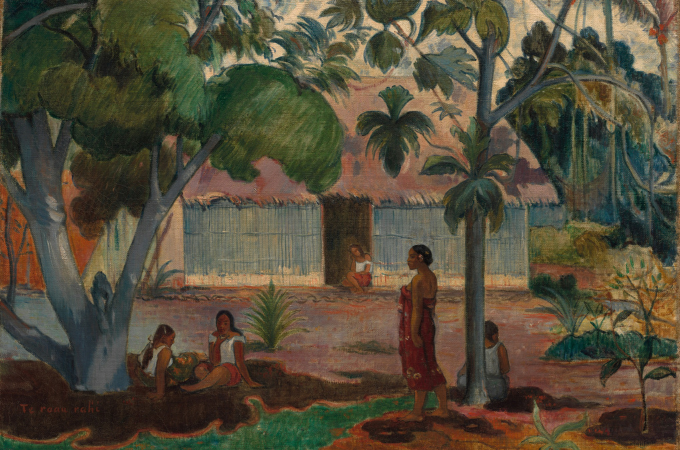
Photo by The Cleveland Museum of Art on Unsplash




COMMENTS -
Reader Interactions