

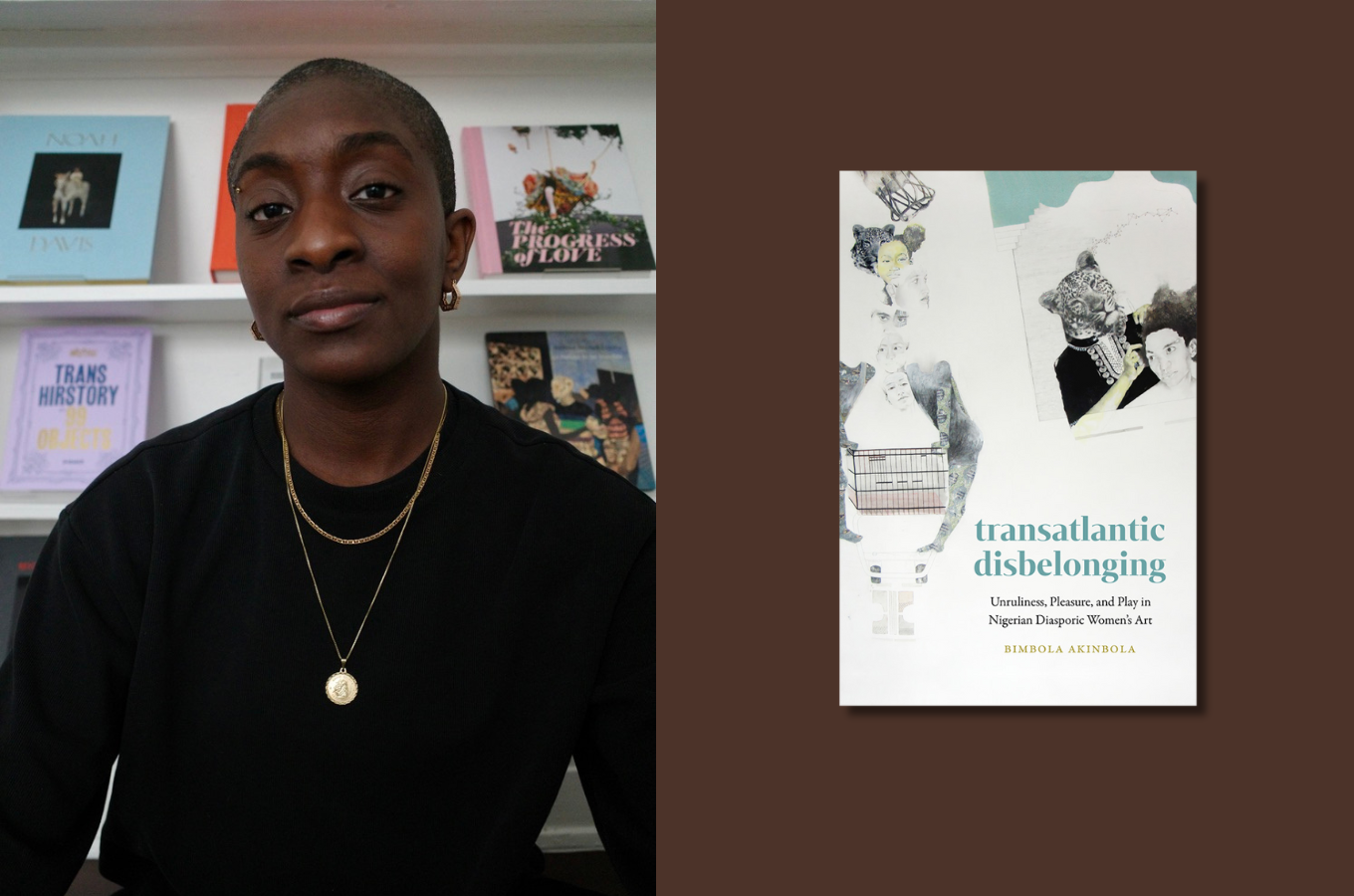
We are honored to feature Dr. Bimbola Akinbola in our ongoing celebration of contemporary voices shaping African diasporic studies. Akinbola is a scholar, artist, and second-generation Nigerian American whose work explores the intersections of visual culture, performance, and feminist thought. Her debut book, Transatlantic Disbelonging: Unruliness, Pleasure, and Play in Nigerian Diasporic Women’s Art, examines how Nigerian women artists in the diaspora create spaces of connection through anti-respectability, taboo, and what she provocatively terms “disbelonging.”
Over a decade in the making, Transatlantic Disbelonging brings together the work of five groundbreaking artists: Wura-Natasha Ogunji, Zina Saro-Wiwa, Njideka Akunyili Crosby, Nnedi Okorafor, and ruby onyinyechi amanze. Rather than centering trauma or dwelling on alienation as loss, Akinbola explores how these artists embrace outsiderness as a site of possibility; how they find joy, pleasure, and genuine connection precisely through their refusal of heteropatriarchal respectability norms. Informed by queer theory and deeply engaged with visual and literary arts, the book challenges both the false binary between diaspora and continental feminisms and lingering questions of authenticity that continue to haunt African diasporic artists.
In this wide-ranging conversation, we discuss the personal and scholarly journey behind Transatlantic Disbelonging, the concept of “disbelonging” as feminist practice, how queer discourse shapes her thinking on diaspora and belonging, the urgent need for cross-disciplinary approaches to African women’s creative expression, and what belonging—or disbelonging—might look like in a world increasingly hostile to movement and difference.
***
Dr. Ainehi Edoro
Hello Dr. Akinbola. Great to meet you, and congratulations on the publication of Transatlantic Disbelonging. How does it feel to finally have the book out in the world?
Dr. Bimbola Akinbola
It doesn’t quite feel real yet! This book has been in the making for over a decade, and a lot of that time felt quite solitary, as I was finding my way through the project and really trying to figure out what the art was saying. I’m both excited and nervous to be entering this new stage where I get to see how others interact with the book and draw meaning from the project! It’s a surprisingly vulnerable experience.
Dr. Ainehi Edoro
Let’s begin with the personal journey behind it. How did your path as a scholar (your migrations, your teaching, your encounters with art) inform the ideas that became Transatlantic Disbelonging?
Dr. Bimbola Akinbola
In addition to being a scholar, I’m an artist and I come from a family of artists, so the visual has always been central to my scholarly research. I’m also a second generation Nigerian American, and growing up my dad was always encouraging us to think about our dual identities and how to leverage them to make a difference. So in a way, I’ve also been thinking about what diaspora makes possible for most of my life. When I began this project as a PhD student at the University of Maryland, I was originally interested in trauma and the question of how 1.5 and second generation immigrants metabolized the traumas of their parents and grandparents using visual art and performance. The project was originally going to be a comparative one where I looked at different ethnic groups in the U.S. At the time, especially writing from an American Studies program, I didn’t feel like I could write only about Nigerian diasporic women but I had a mentor ask me once, “How many books about white European men have been written?” And that question really gave me the permission to do a project where Nigerian diasporic women were at the center.
The shift away from trauma came to me while I was revisiting an interview with ruby onyinyechi amanze, where she writes, “My African- packaged body embraces the freedom of play in this America that says other wise— that says I should be traumatized or anguished or cautious or angry. But joy is a birthright . . . an entitlement that cannot be stolen.” At the time that I re-read this quote I was feeling pretty stuck and when I allowed myself to see that none of the artists were actually solely preoccupied with trauma, the whole project and the idea of disbelonging really came into focus.
Dr. Ainehi Edoro
I’d love to talk about the concept at the heart of the book: “disbelonging.” It’s such an evocative term. What does it mean for you? And would you say it’s a distinctly feminist concept?
Dr. Bimbola Akinbola
About a year ago I bought a pin from a museum gift shop that says, “Alienation can be fun” and I jokingly say that this is the book’s argument in one sentence. Disbelonging is a practice and an attitude that embraces anti-respectability, taboo, and outsiderness in the pursuit of genuine and often imperfect connection to community. Disbelonging is about connecting across difference and discord. It’s about alienation as a site of possibility. I do think that disbelonging is a feminist concept, especially the way I’m using it because I’m thinking about it as a direct challenge to heteropatriarchal norms for African diasporic women.
Dr. Ainehi Edoro
Would you say disbelonging differs from ideas like cosmopolitanism or Afropolitanism, which we often use to describe global identities and mobility?
Dr. Bimbola Akinbola
I see disbelonging working alongside these ideas and in the book I do call disbelonging a type of “Afropolitian project,” to reference the work of Anima Adjepong. Where it diverts is in how disbelonging challenges the idea of an idealAfropolitan subject through its centering of taboo and anti-respectability.
Dr. Ainehi Edoro
You also mention that while your book isn’t strictly about queerness, it is informed by queer thought. I found that fascinating. Can you talk a bit about how queer discourse shaped your thinking on diaspora and belonging?
Dr. Bimbola Akinbola
This book is deeply informed by queer theory and is absolutely written through a queer lens, even though the artists I explore may not necessarily identify as queer. I really love the quote from Gayatri Gopinath, “Queerness here does not so much bravely or heroically refuse the normative, the way it appears to in some narratives of queer subjectivity, as much as it names the impossibility of normativity for racialized subjects marked by histories of violent dispossession.” I’m thinking through the queerness of diasporic identity and disbelonging as a particularly queer approach to being in community–one that embraces difference and friction rather than one that seeks to eradicate it. This book also centers hybridity and non-linearity in a way that challenges the ways culture, family and nation are often framed through a heteronormative and patriarchal lens.
Dr. Ainehi Edoro
The artists you bring together are fascinating: Wura-Natasha Ogunji, Zina Saro-Wiwa, Njideka Akunyili Crosby, Nnedi Okorafor, and Ruby Onyinyechi Amanze. What first made you see them as part of the same conversation? Was there a moment when it clicked that they were all exploring a shared idea of disbelonging?
Dr. Bimbola Akinbola
The connections between the artists in the book came into being quite organically. I chose to write about artists whose work I felt personally connected to. In hindsight I think I was attracted to the same energy in all of their art—an element of risk and transgression—that I came to understand as disbelonging only after I had spent more time with the works and also with the words of the artists. At the time that I began writing, there actually weren’t a ton of Nigerian diasporic women artists whose work I could readily access but today there are so many more of these artists and performers whose work I’m encountering and teaching in the classroom. I really hope this book becomes just one of many exploring Nigerian women artists!
Dr. Ainehi Edoro
Some people argue that diaspora feminism can feel detached from women’s realities on the continent. How do you navigate that tension in your work?
Dr. Bimbola Akinbola
I think “diaspora feminism” versus “continental feminism” is a false binary. Throughout my book, I cite the work of feminists living in diaspora and also those working on the continent, and our concerns are all connected. I also think the concerns of women on the continent are complex and diverse, and they differ according to things like class, religion, and geography.
I’m in support of all challenges to patriarchal violence against women and girls—both big and seemingly frivolous. Unruly or anti-respectable behaviors within families and communities are often some of the earliest ways women and girls challenge power and control. Even actions that may seem minor can be where we develop the skills needed to reject and dismantle broader systems of oppression.
Dr. Ainehi Edoro
The question of authenticity still haunts African artists in the diaspora. Do you think we’re past that, or does it still shape how these artists are read and valued?
Dr. Bimbola Akinbola
I’m not personally interested or invested in the question of authenticity, and I try not to use that word anymore, but I absolutely do not think we’re past it. I hope my book invites people to question their own investments in the idea of authenticity and release some of the inherent shame that comes with that.
Dr. Ainehi Edoro
No surprise that my favorite part of the book is Chapter Five, where you bring literature and visual art into conversation — the Okorafor and amanze chapter. What was it like thinking across those two forms? And do you think we need more of that kind of cross-disciplinary work when it comes to African women’s creative expression?
Dr. Bimbola Akinbola
I really enjoyed working on that chapter. I read a lot of diasporic literature, and it felt really natural to include a novel in this project. I really fell in love with the ways Sunny and Ada seemed to be moving through very similar worlds. I do think we need more cross disciplinary work when it comes to African women’s creative expression. Most of the artists I write about work across many forms and mediums and, as I discuss in my chapter about Ogunji, each of these artistic mediums actually tells us something new about the artists and how they’re making sense of their experience.
Dr. Ainehi Edoro
My own book, Forest Imaginaries, is out in January, and I’ve found that academic writing can sometimes drain the urgency out of work that’s born of emotion and risk. Did you ever feel you had to protect the works of the artists featured in Transatlantic Disbelonging from being over-theorized?
Dr. Bimbola Akinbola
Congratulations on your book! I struggled with this question while writing because often, I feel like the art is actually doing all of the theorizing and I’m just a translator. One thing that helped me write through this feeling was the belief that it’s a gift and privilege to be able to spend years looking at these works and talking to the artists, when most people spend an average of 27 seconds looking at a work of art. So, in that way, I see our research as an act of service to the artists and works themselves, and I hope our archiving and translating encourages more people to spend time with works they maybe wouldn’t otherwise even know about.
Dr. Ainehi Edoro
We’re living through a global backlash against feminism and a reassertion of nationalism everywhere. What does “belonging,” or disbelonging, look like in a world increasingly hostile to movement?
Dr. Bimbola Akinbola
The current global shift towards “traditional values” and nationalism absolutely speaks to the fear I name in my book that “the feeling of alienation is equal to cultural obliteration,” which to be clear, I’m arguing is false. I see a lot of policy being informed by the fear of not belonging and I also think that a lot of political and religious extremism is driven by a desire to belong to something.
Disbelonging is asking us to imagine the possibility of connection and safety outside of logics of exclusion, violence, and control. To imagine belonging as something that is constantly in the process of being created and falling away. To understand belonging as necessarily imperfect. And to imagine sites of belonging that actually allow room for all of our messy parts. Ultimately, I hope people take a moment to realize that feeling alienated or like an outsider can be liberating, and most importantly, that we ultimately have to do the work of finding home in our bodies, where belonging is our birthright.
Dr. Ainehi Edoro
Thank you for chatting with us, and congratulations again on such a beautiful and urgent book. All the best from all of us at Brittle Paper.


COMMENTS -
Reader Interactions