

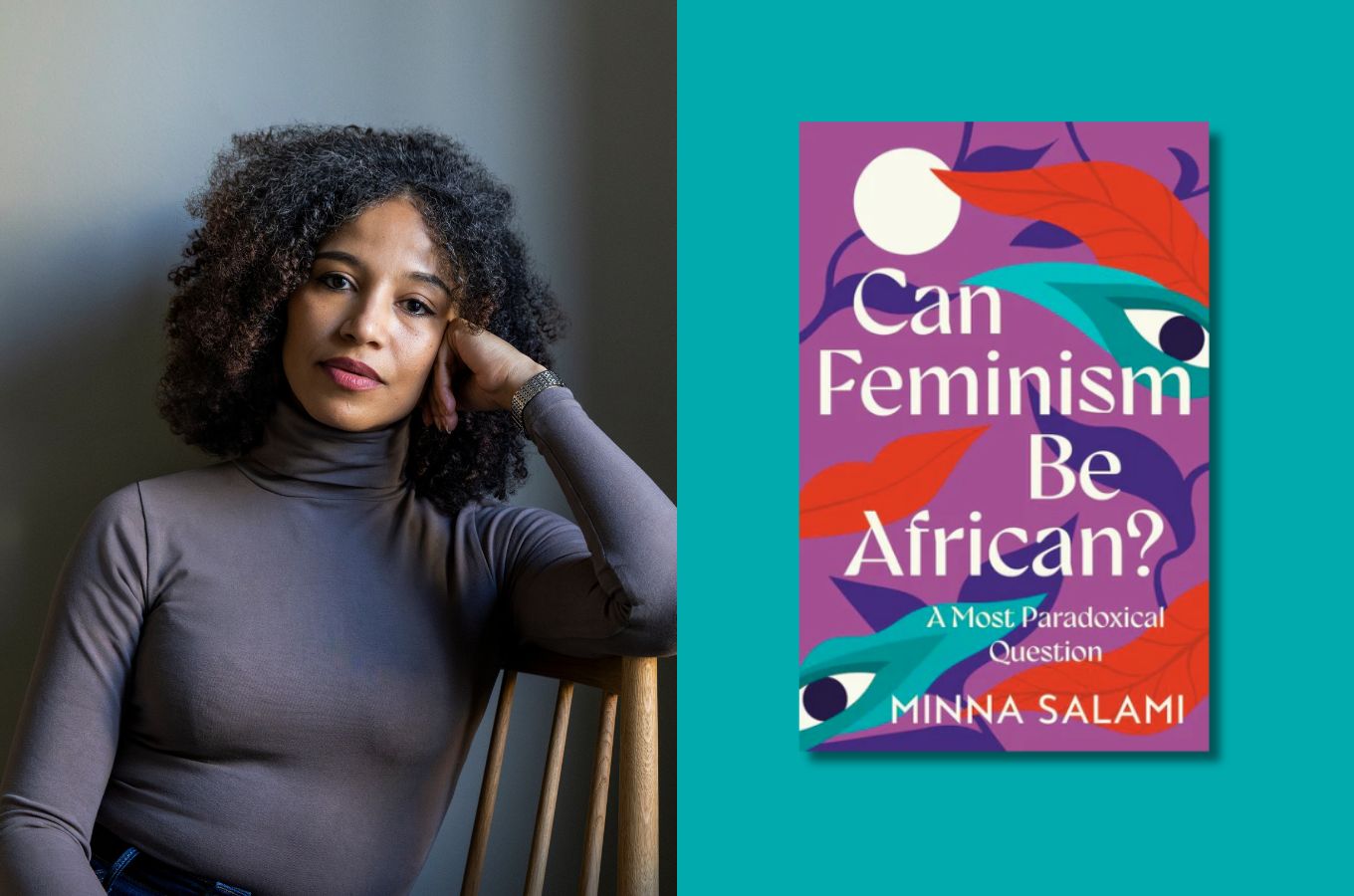
 We are honored to feature Minna Salami in our ongoing celebration of contemporary voices shaping African feminist thought. Salami is a Nigerian-Finnish writer, theorist, and the founder of the award-winning blog MsAfropolitan. Her work explores feminism, African studies, and the politics of knowledge-making with a rare combination of philosophical rigor and imaginative boldness. She is the author of Sensuous Knowledge: A Black Feminist Approach for Everyone (2020), which has become essential reading for those seeking to understand how African epistemologies can reshape feminist theory.
Her new book, Can Feminism Be African?, asks a provocative question that unsettles even as it illuminates. Rather than offering simple affirmations, Salami excavates the origins of African feminism as an explicit political movement, traces its intellectual genealogy, and argues for its place not merely as reclamation but as political philosophy. The book challenges both patriarchal narratives that claim feminism is un-African and neocolonial frameworks that reduce African women’s liberation to NGO projects. In doing so, Salami carves out space for what she calls “Metaphysical Africa”, an Africa beyond the debris of colonialism, and introduces concepts like Superiorism, Andro-Africanism, and the Pedagogy of Shakara to expand the language available for African feminist discourse.
In this interview, we discuss the relationship between Sensuous Knowledge and Can Feminism Be African?, the role of imagination in political resistance, why she chose to frame the book as a question, and how African epistemologies can reorient feminism toward more liberatory horizons.
***
Ainehi Edoro
You know, Minna, I feel like Sensuous Knowledge was already building toward this book. Do you see Can Feminism Be African? as a kind of continuation? Like, are the two books in conversation with each other, or do they belong to different moments in your thinking?
Minna Salami
Absolutely—I see Can Feminism Be African? as a sequel to Sensuous Knowledge. In fact, perhaps all my books will be, even when they take different forms or explore new terrains. It’s not so strange, since my books emerge from a specific way of being, living, and thinking. I love that you perceived Sensuous Knowledge building towards Can Feminism Be African? I felt it too while writing, and sometimes it felt synchronous, as though I was being transported back and forth in the writing process. If Sensuous Knowledge was my theory of change, then you could say that Can Feminism Be African? is a book written with that approach in mind.
Ainehi Edoro
When I was reading, I kept thinking, okay, so she’s challenging that idea that African feminism is mostly about policy, development, NGOs… those frameworks that feel very institutional. You don’t dismiss them, but you seem to be saying: African feminism also lives in imagination, in knowledge-making, in world-building. Would you say that’s fair? That the book is trying to reclaim the imaginative and philosophical core of African feminism?
Minna Salami
Yes, that’s very fair. The African feminist movement has faced two backlashes from the major forces it resists: patriarchy and neocolonialism. The patriarchal backlash has co-opted and mansplained culture, tradition, and history to claim that feminism is un-African. The neocolonial backlash, meanwhile, has contorted women’s liberation into a guilt project of the West. So much money, narrative, and policy have been funnelled into the NGO sector. While NGOs do important work, they seldom consult African feminists—even when leading gender-empowerment projects. That reveals one of two things, both equally telling: either these platforms are unaware of African feminist work, or they are aware but don’t care. One of the reasons for writing this book was to discuss this problematic behaviour.
Ainehi Edoro
And maybe related to that: do you ever feel like imagination itself can be a form of political resistance?
Minna Salami
Imagination is an essential tool of political resistance. We need to imagine new worlds, new language, new ways of relating to each other. Because once imagination produces new imaginaries, then institutional change follows.
Yet invoking imagination in politics can make resistance sound fun or easy. It’s not. To imagine often connotes play, we associate it with folktales, storytelling, myth. These are crucial realms for lasting transformation. But imagination is also in darkness, in the shadows, in theory and critical analysis. For me, it’s really about making the unseen seen. That was a key motivation when writing this book.
Ainehi Edoro
So when I first saw the title Can Feminism Be African?, my first instinct was: of course it can! But then, as I sat with it, I realized you’re doing something far subtler. There’s a provocation there. What assumptions were you hoping to unsettle with that question?
Minna Salami
You’re right! I posed this paradoxical question precisely to unsettle assumptions—my own included. For many years, I believed that feminism had always existed in Africa. I even titled an old blog post on MsAfropolitan “Feminism has always existed in Africa.” Then, during lockdown, I read an interview with the African feminist thinker Patricia McFadden, who challenged this stance, arguing that it was tied to a nationalist agenda. Her words struck a chord, and I began questioning why this view had become so ingrained within African feminism.
That shift in understanding was the genesis of the book. I went through the archives and realised that African feminism as an explicit political movement began in the 1970s. This led me to ask why feminism needed to have existed in Africa to be valid, and whose political agendas were served by such claims. The book discusses this at length because I think that proving feminism’s ancient roots is to a great extent a distraction from the urgent work of developing its political philosophy for today’s African woman.
In other words, I wanted to encourage readers to think of African feminism not only as a reclamation but also as a political philosophy. To do that, we must look more precisely at its origins, which are more contemporary than historical. That’s one reason behind the question. But it can be read in multiple ways.
Ainehi Edoro
And on that note—why phrase it as a question at all?
Minna Salami
I’m an unusual author, because I work from titles rather than content. My books (and most of my essays) begin with a title that appears from nowhere and consumes me. It was the same with Sensuous Knowledge and with the book I’m writing now. These titles land in my lap and I know immediately: this is a book that for better or worse has chosen me as its author. Haha. The writing then becomes an unpacking of the title. So the answer is that Can Feminism Be African? arrived as a title, and the book grew around this title-seed.
Ainehi Edoro
You have this thing you do, and I love it, where you coin acronyms for your ideas (like “GAD” for “gender and development” feminism. Smart but cheeky, by the way.) I first noticed it in Sensuous Knowledge, and you do it again here. It’s playful but also conceptually tight. Where does that come from? Is it part of how you think through language and memory?
Minna Salami
Thank you for noticing that. My concepts and acronyms emerge much like my titles—they’re unplanned. Returning to the idea of making the unseen seen: a concept usually appears when I’m describing something of feminist relevance and realise the existing language is inadequate; there’s no name for the thing I am seeking to name. At that moment, the feminist gods often bless me with the language I need.
Feminism has been a way of individuation for me, a tool of personal transformation. When you take that to its pinnacle, you begin to live in a different world that resists patriarchal norms and reshapes desire. From there, you see the world differently and the gaps in language become almost palpable. To share what you see, you need new language with which new memories eventually form. (Though to clarify, GAD isn’t mine; it’s an existing acronym.)
For instance, in this book I needed to describe the Africa I see—not the one that is the debris of European colonialism—and I could not find adequate language for that, so I coined Metaphysical Africa. Inventing language is also one of the things I most enjoy about writing, and in this book that side of my imagination ran wild. I developed the aforementioned Metaphysical Africa, and also Superiorism, Andro-Africanism, Harmony Feminism, The Legacy Trap, and others. Ultimately, the impulse is both political and spiritual. It’s also cultural, because both of my ancestral lineages (Yoruba and Finland) have a very poetic and metaphorical vocabulary, and this inspires me.
Ainehi Edoro
There is a long history of defining African feminism, from Buchi Emecheta to Amina Mama, to Chimamanda’s We Should All Be Feminists, to June Eric-Udorie’s Can We All Be Feminists? to Akwaeke Emezi’s indigenous-leaning feminism. And what’s still unresolved for you in how African feminism has been theorized or represented?
Minna Salami
While I admire all these works, there’s still so much to theorise and articulate. We have a lot of work ahead, and I see my contribution as one piece of a larger puzzle. I feel a deep yearning to explore Africa and feminism not as opposing frameworks but as mutually enriching worldviews. I’m passionate about investigating how African epistemologies—especially those oriented toward an ethics of freedom—can reorient feminism toward more liberatory and imaginative horizons.
The book also came from personal urgency. As a feminist of African descent navigating multiple worlds, I felt compelled to write the book I wish I’d encountered earlier in life. There are so many of this kind yet to be written.
Ainehi Edoro
Your work always feels big in scope, conceptually, philosophically. You don’t shy away from asking foundational questions about knowledge, power, and freedom. Where does that impulse come from? Why the pull toward large-scale questions rather than the “daily politics” of feminism?
Minna Salami
There are a few reasons. First, it’s an act of defiance—because black and African women are rarely encouraged to probe or philosophise on big foundational questions. Those are reserved for the “Big Men.” Men are encouraged to write macrocosmically; women, microcosmically. So I seek to flip the gaze.
That said, I do value the mundane too. Male-dominant knowledge systems create hierarchies between the particular and the universal, but I’m not wired that way. My writing may tackle large questions, yet I always interweave the personal. To me, the two are inseparable.
But to transform everyday reality, we must reimagine the order in which daily life is conducted. Otherwise, we remain trapped in dominant frameworks. That’s another reason I gravitate toward the big questions.
Most importantly, I’m drawn to the fundamental ontologies – the hidden grammar underlying the social stories we tell—and that’s also what I’m best at exploring. We each bring our strengths to the collective puzzle of change.
Ainehi Edoro
Okay, we have to talk about that ending — The Pedagogy of Shakara. It’s such a stunning, unexpected way to close the book. I was breathless by the end. Where did that come from? What drew you to shakara as a concept?
Minna Salami
That’s so wonderful to hear, thank you. The answer starts in my childhood in Lagos. It was an exciting time, but also a confined one. Nigerian society was so terribly conformist and I felt captured by it down to my bones. The women I felt psychologically drawn to were the ones accused of shakara because they didn’t seem to care about conventions. I longed to be in their worlds. That spirit stayed with me as a distilled image of feminism in an African milieu.
As a writer, I became drawn to shakara as more than a personal attitude—it’s a disposition towards intellectual and political life, and in this context, towards theorising African feminism. I wouldn’t want to reduce it to spectacle, but I see shakara as intellectual boldness of a heuristic nature. African feminists have created such a rich body of work: rigorous, cutting-edge, analytical, imaginative, encompassing in ways I rarely see elsewhere. Sometimes, thinking of our collective intellectual contribution, I think to myself—na shakara oo!
Ainehi Edoro
I’m currently teaching a course titled The Art of African Feminist Writing, which has me thinking a lot about archives and foundational texts. If you were to curate quick primer on African feminism, what five readings would you consider essential?
Minna Salami
What a wonderful course to teach! I love the title because I too think of African feminist writing as an art form, not least because so much of it is soulfully and imaginatively crafted.
My five essentials (so hard to choose) would be:
-
-
- Desiree Lewis and Gabeba Baderoon, Surfacing: On Being Black and Feminist in South Africa
- Sylvia Tamale, African Sexualities
- Yvonne Vera, The Stone Virgins
- Margaret Busby, New Daughters of Africa
- Maryse Condé, What Is Africa to Me? (I don’t know if Condé referred to herself as a feminist, but my-oh-my is this book a feminist gem.)
-
I’d choose these readings as they reflect the spectrum of African feminist writing from the interior to the exterior, the sexual, imaginative, factual, historical, contemporary, and importantly – the deep provocations our words invoke.

COMMENTS -
Reader Interactions