

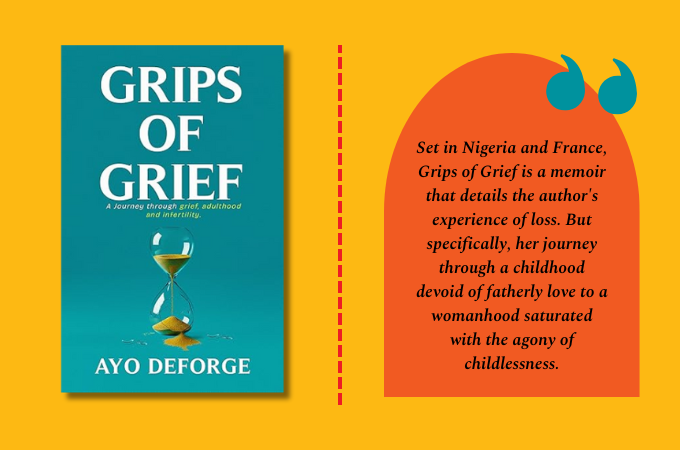
The social construct of womanhood remains a viable landscape for analysing the experiences of women within the precincts of cultural expectations. Stereotype, stigma, and related syndrome become overreaching issues. Perhaps the most concerning is childlessness. In Africa, there is still an unresolved issue around the purpose of marriage so long as children are absent. And the woman bears the reproach more. This, among a couple of tragic events, is the moving drama in Ayo Deforge’s Grips of Grief.
Set in Nigeria and France, Grips of Grief is a memoir that details the author’s experience of loss. But specifically, her journey through a childhood devoid of fatherly love to a womanhood saturated with the agony of childlessness. The story follows the solitude of the narrator after her mother’s demise. Deserted by an absentee father and an inconsiderate family circle, she is compelled to take responsibility for her own life. Smooth as the journey unfolds, it is not without some grey moments. The narrator recalls her experience with devious colleagues and friends. But in the twist of plot, she survives and gets married. From this point of the story till the end, an unprecedented weave of suspense holds the reader spellbound at the layered incidents of matrimonial agony consequent on her childlessness. It is the intrigue of it all that offers a sympathetic reader the evaluation of God’s intervention in a script of destiny.
While this reflective-toned memoir may be a story of resilience, it is important to point out that the narrator provides a couple of artistic modes of expression. That is, on one hand, this is an autobiographical narrative; but on the other, it passes for a work of raw literary genius. By that token, Grips of Grief becomes a fine portrait of the experiences of womenfolk in circumstances where it is impossible to trifle with the clamant intervention of a divine Force in the predicament of delayed motherhood. This phrase takes its apt description from the realistic patterns of a series of endeavours. If one were to interview the woman portrayed in the story, it is definitely going to be a palpable character in the social cultures of societies where motherhood is the benchmark of a woman’s recognition as a contributor. Striking as it may be, Grips of Grief is able to re-engineer this paradigm outside the borders of socio-cultural prejudice.
The reader will find this memoir realistic. But realism remains a fanciful idea: intellectual empathy is the ultimate way they connect with the narrator. Ayo Deforge has mastered the way of the artist’s memory. True, one reads about her times as a waiting mother, but the strategic points where the scenes leading to her predicament connect are motif-like. Thus, it is impossible not to find – as a matter of individual reflection – areas where the story touches beyond the recollection of God’s way and will. Suspense-packed and grief-laden, the story is truly gripping. It is more so when read not only as an expressive undertaking but a mimetic portrait of the several occasions of seeking solutions to such a human problem exacerbated with the anxieties of ageing and despair.
Grips of Grief raises both the reader’s concern and their consciousness. For the former, it borders on life’s drama. Mysteriously enough, the narrator paints a structural pattern of the immediate world of privileges. That is, it is quite common that, ironically, childlessness is a scourge among a given calibre: the haves, the privileged and the well-to-do. But the question that resonates with the discerning reader is the extent of that poetic justice! And for the latter, it would be a wonder to read through the debilitating episodes of the narrator’s near-successful efforts without acknowledging the classical tragedian’s thesis on fate, man and divine forces. Past the motif of dreams, prophecies and empirical explanations, the protagonist bears a clone of some classical hero. Such an odyssey through the challenge of delayed motherhood moves any reader anywhere in the corridors of our world with the workings of God. It is a fantastic recollection that challenges perspectives from science and tradition.
Again, this work of recollection produces catharsis in the reader. In fact, that is the point where it becomes both a fiction and a ‘play.’ The role of Deforge’s spouse in the story creates a matrix with her pastor’s and a more fascinating one at that with the doctor’s. When these are matched, it becomes apparent that the tragedy of waiting in the story is a painstaking endeavour of faith entirely. The nakedness of man’s helplessness and the vulnerability to unbelief – more so because the best imaginable medical services are proffered all along.
The reader will resolve within themself what representation is laid bare in the story. By representation, it is meant that it is an inexhaustible tapestry of the artist on the portrait of women in the lens of traditional fascination with motherhood, largely as the self-serving credibility of her existence, ambition, and gender reality. Issues of female representation, although Deforge may have woven hers into a memorable autobiographical narrative, still tax the observer on the evaluation of what things dislocate the woman’s life beyond the mettle to vindicate her helpless self. It is so human that we wait, but inhuman that social-cultural pressures make us waste.
Last but not least, there is something absolutely legendary about Deforge’s Grips of Grief: the balance of language. That the literariness of language is the core of literature is a well-known fact. But to expend that ability on enumerating the real-life struggles of a self-portrayed character is a balance that is inherent in a mastercraft. Such is what Deforge samples. The tone is skilfully held taut between fiction and non-fiction, between novel writing and keeping a diary, between personal experience and a universal challenge. The deduction is endless. Similarly, the manifold interpretations of the text will come across as themes, many of which will resonate with the reader, for experience and for empathy.


COMMENTS -
Reader Interactions