

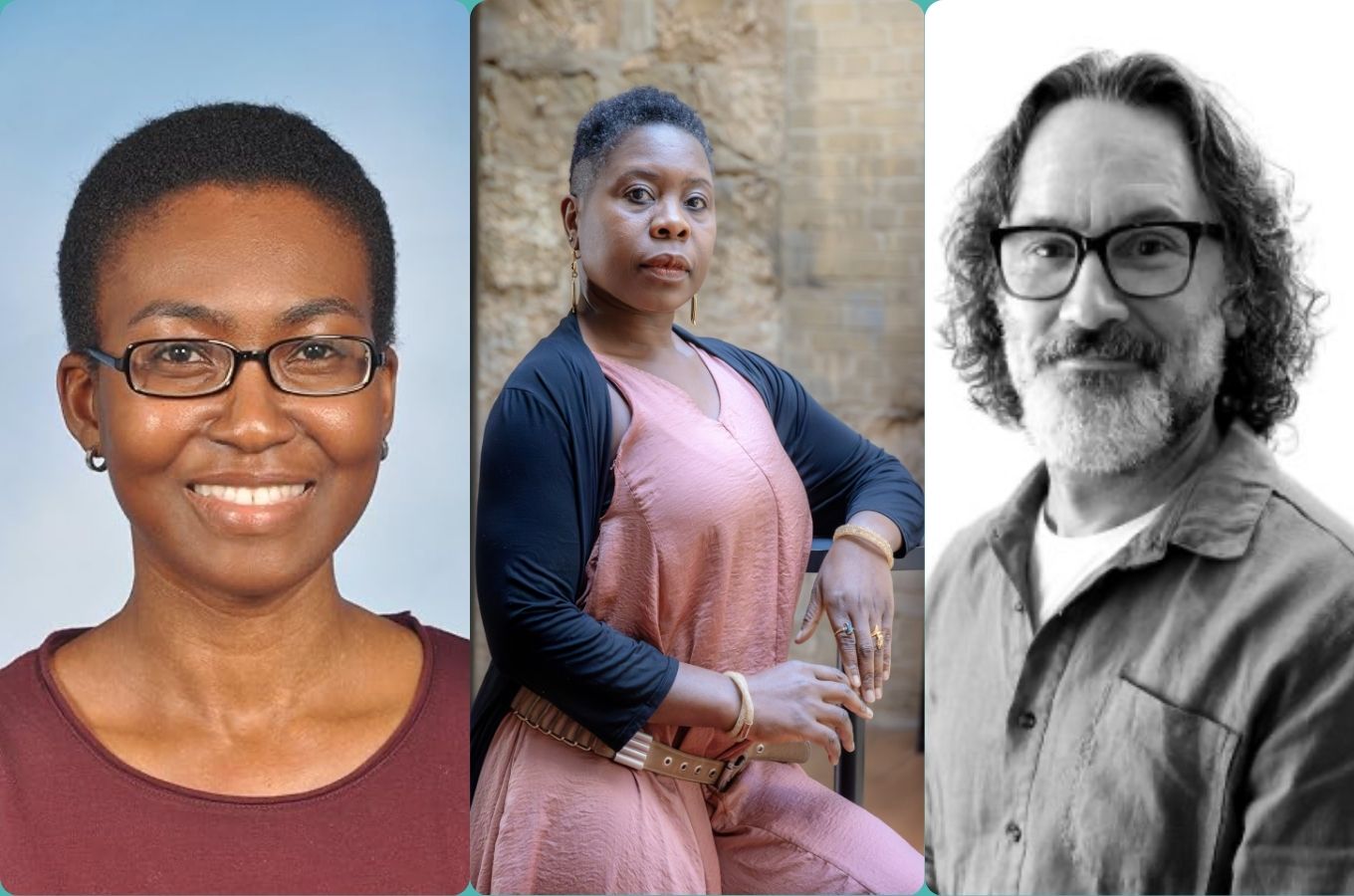
We had the incredible opportunity to talk to the editors of the Sauúti Collective, Eugen Bacon, Cheryl S. Ntumy, and Stephen Embleton, about their forthcoming anthology, Sauúti Terrors. They shared with us the origins of the Sauútiverse, a shared science fiction-fantasy world based on African traditions, and how collaboration has become central to their worldbuilding process. Sauúti Terrors is the second anthology from the Collective, following the successful release of Mothersound in 2023. While Mothersound offered a broad view of the possibilities within the Sauútiverse, Sauúti Terrors narrows its focus to the horror genre, challenging contributors to explore the darker aspects of African realities—climate change, drought, poverty, disease, war, and bad leadership—within the framework of their carefully constructed world.
The Sauútiverse is built around sound magic, inspired by African oral traditions and the mythological concept of the Mothersound; the first Word uttered by Our Mother, the creator of the universe. This sound resonates throughout the world’s history, technology, and magic systems. The world consists of five planets and an inhabited moon, each named after the word “song” in different African languages, all revolving around two suns. What began in 2021 as an initiative by Nigerian writer Wole Talabi, Haitian-American writer Fabrice Guerrier, and Brittle Paper has grown into a thriving collaborative space where African writers can step into an already-built world and tell their stories. The project has proven so successful that Sauúti Terrors is being split into two volumes, to be published in 2026 and 2027 respectively, and includes poetry alongside short fiction.
In this interview, the editors discuss the philosophy behind shared-world storytelling, the intricacies of their Story Bible, the significance of sound and oral traditions in their worldbuilding, and how they’ve created a framework that allows for everything from fantasy to hard science fiction to horror, all while remaining true to an Afrocentric vision.
Brittle Paper
Congrats on the forthcoming anthology Sauúti Terrors. It is a collection of speculative short fiction based in the Sauútiverse, a shared world? Plus, is it horror as well?
Eugen Bacon, Cheryl S. Ntumy, Stephen Embleton
After the successful release of the inaugural Sauúti anthology, Mothersound, in 2023, along with individually published Sauúti works, the Sauúti Collective decided to tackle the theme and genre of Horror for the next anthology. For this project, we sent out invitations to select African writers to participate, opening up the world to new voices and contributors. This meant new ideas being added to the world we had created, with the founding groundwork done over the previous two years, and expanding the possibilities.
Brittle Paper
For readers learning about the Sauútiverse for the first time: what is it? It’s not a novel, and it’s not just a setting. What kind of literary project are we actually looking at here?
Eugen Bacon, Cheryl S. Ntumy, Stephen Embleton
First and foremost, it is a collaboration. Secondly, it is an original science fiction – fantasy world with a specific history, mythology, and physicality, based on African traditions, which forms the framework within which individuals can create stories and artwork. Most writers will know that setting up a fictional world, the world-building, takes a lot of time, research and effort. The Sauúti Collective has taken the time, in fact three years, to do this, but have done so in a liberating way for storytelling. Some come to the world with an interest in fantasy, while others enjoy writing in hard science fiction, even horror – all are possible. It can seem daunting for those coming to collaborate in the world for the first time, but we are committed to nurturing the ideas pitched for the Sauútiverse, finding new ways of looking at our world, and expanding the core ethos of what our Afrocentric world represents – for us, for African storytellers, and the readers and fans we’ve grown since 2022.
Brittle Paper
Shared-world science fiction has existed for decades but has not really taken root in African writing. Correct me if I’m wrong. Tell us how the Sauútiverse project came into being.
Eugen Bacon, Cheryl S. Ntumy, Stephen Embleton
That would be accurate. At the same time, we looked to previous shared world projects to identify what worked and what didn’t work for them. Some have been successful, while others haven’t. The Sauúti project was initiated in 2021, by Nigerian sci-fi writer Wole Talabi, Haitian-American sci-fi writer and Syllble founder Fabrice Guerrier, and Brittle Paper.
After his call for African and African diaspora participants at the end of 2021, Wole Talabi convened the first video call with the interested collaborators on 6 March 2022. Based all over the globe, and from various backgrounds, it was immediately apparent how well the team’s dynamic would work. Much of the themes and groundwork were pitched in that first session for what would eventually become the Sauútiverse.
Meeting every fortnight, with some dealing with late nights/early mornings, rain and snow, and shifting timezone daylight savings, the next two years would bring forth rewarding creative ideas for African science fiction and fantasy world building.
Brittle Paper
African sci-fi/fantasy has exploded in the last decade or so. How does Sauútiverse provide an opportunity for even more growth?
Eugen Bacon, Cheryl S. Ntumy, Stephen Embleton
Back to one of our core philosophies: collaboration. It’s not just in the shared world of creating stories, but in the support we are able to give one another in a safe space of creativity. Many writers work in isolation, with not many opportunities to get their work read, vital feedback shared, understanding the nature of being a writer. The Sauúti space brings that and more. Back to the world-building: we’ve got all the groundwork done for African writers and creatives to step in, run with their ideas in the Sauútiverse, and blossom.
Brittle Paper
I’m also wondering whether the idea of a shared world like the Sauútiverse is, perhaps, particularly meaningful in an African context, given colonial histories of fragmentation, extraction, and erasure?
Eugen Bacon, Cheryl S. Ntumy, Stephen Embleton
It is vital we develop spaces for ourselves to create and collaborate in without waiting for someone else to do it for us. The wealth of storytelling, futurism thought, philosophy and more that we have bubbling up from our bellies needs supporting frameworks to encourage and nurture them. The Sauútiverse is a proven example of a collaborative project, building on African traditions, philosophy and ways of telling stories that are unique to us, but can form the basis for anything beyond a fictional science-fantasy world. Talking, listening, sharing and supporting are inherent in how we see others and build up communities for a common good.
Brittle Paper
I want to make sure whoever is reading this understands that the collective, Sauúti Collective, has essentially invented a world. So, let’s dig into some of the details. It has a creation story, which I read. It also has a bible. What is a bible in the context of shared worlds narratives?
Eugen Bacon, Cheryl S. Ntumy, Stephen Embleton
The Story Bible. This is a vital document holding everything about the fictional world cohesively together, at a glance, for anyone wanting to create in the Sauútiverse. It’’s a collection of essential lore, histories, physics and the natural world – from topography, to planetary characteristics, myths and beliefs – and, most importantly, the one key aspect of the Sauútiverse: Sound Magic. Anyone, even us regular members of the Collective, can read through, search concepts, read the glossary of terms, to get a good overview of what has been established. These are elements featured in published Sauúti works that are fundamental to the broader universe, rather than minutia relating to stories and characters.
Brittle Paper
Let’s talk about the physical world. Can you describe the geography? Aren’t there planets, moons, suns? Also, feel free to share other details about the physical world that you find particularly striking.
Eugen Bacon, Cheryl S. Ntumy, Stephen Embleton
Understanding that there are five very different planets, with their own moons – some seen and some unseen, revolving around two suns, and a timeline that spans eons, means creators have a wide choice for time, location, situation (politically, spiritually etc.) for their stories. They can span the solar system, or they can bring it down to a small group of people or an individual – human or non-human. And sound magic drives everything, from motivating characters, connection to Eh’wauizo – the spirit realm and ancestors, to spaceships and technology.
We had an absolute ball developing the unique traits of each planet, and beyond.
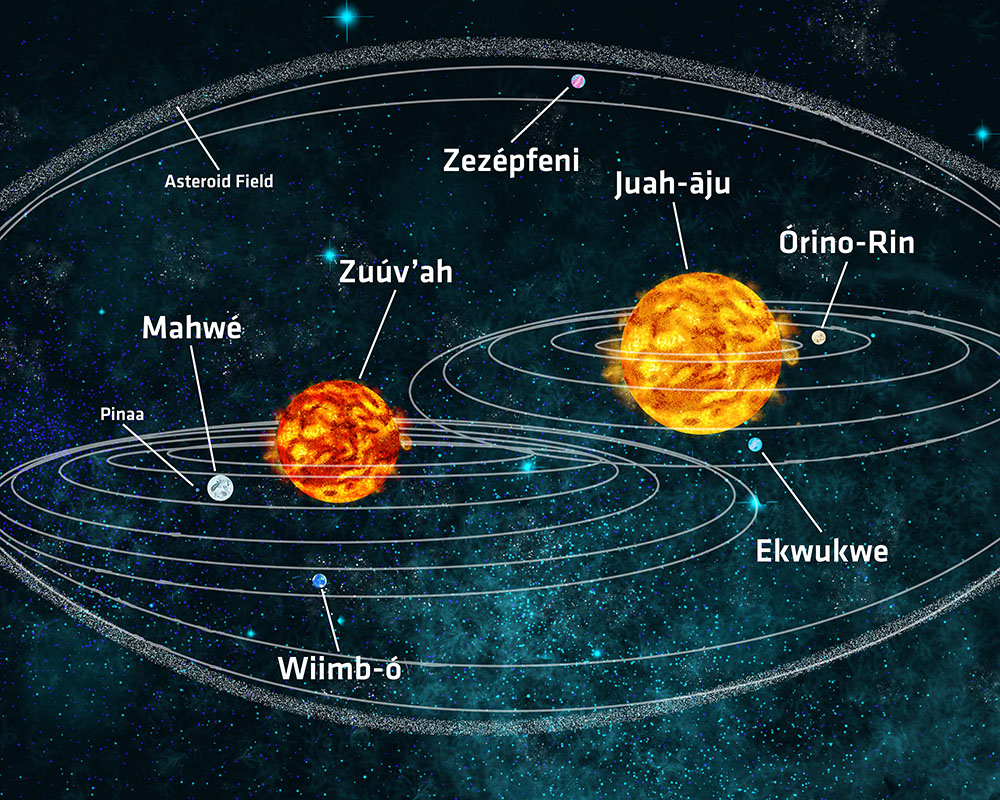
The Sauútiverse has two suns (Zuúv’ah—from the Shona word ‘zuva’ meaning sun or day, and Juah-āju—from the Swahili word ‘jua’ meaning sun) and two spirit moons (Vuiili-ki and Vuiili-ku, located on Wiimb-ó). There are five main planets, each named to mean ‘song’ in an African language:
Zezépfeni—from the Amharic word ‘zefeni’ meaning song
Wiimb-ó—from the Swahili word ‘wimbo’ meaning song—while the closing ó represents the planet’s Spirit Moon
Órino-Rin—from the Yoruba word ‘orin’ meaning song—here we use rhyme and repetition
Mahwé—from the Kirundi word ‘mawe’ meaning mother
Ekwukwe—from the Igbo word ‘ukwe’ meaning song or anthem—it’s the echo planet, we speak the word ukwe backward then forward: Ekwukwe.
There is also an inhabited moon, Pinaa:
Pinaa—from the Setswana word ‘pina’ meaning song.
Brittle Paper
In the Story Bible, there is a whole culture section, right? That covers everything from philosophy, to food, to education, even prejudices! I’m getting a bit too excited. I’m intrigued by the scope of your worldbuilding.
Eugen Bacon, Cheryl S. Ntumy, Stephen Embleton
It was essential to start with the basics – what is the world, where is it and how is it physically made up. This gave us the solar system – place. It gave us the historical timeline, and it gave us the core magic theme. From there we focused on Story. Our individual story ideas began to require certain things established, and only when they became part of a story, integral to a narrative that affected the greater world, did those elements become part of the broader worldbuilding. When someone created an interesting species, a familiar or common food, a notable place like a capital city, or a group of people making historical impacts – good or bad – those were taken on board and oftentimes used by other storytellers.
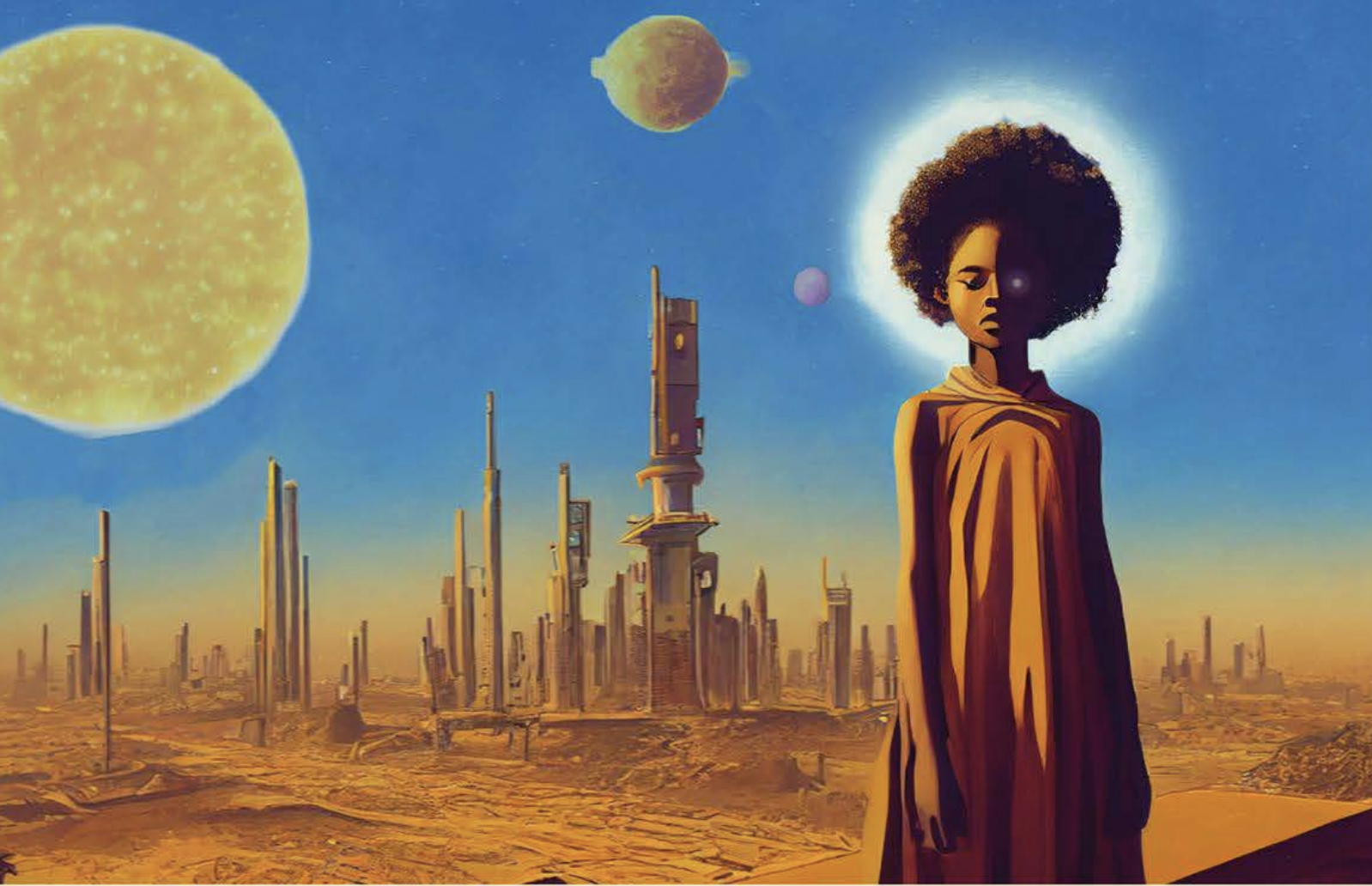
The creation myth is a good example, permeating characters’ upbringing and worldviews, and used to wield political power. Another is some of the non-human species developed and reused because of their unique characteristics and social habits, and amazing to explore in more stories. Political dominance, technological dominance, and power over others can have solar-system-wide effects, and it’s fun being able to foreshadow historical events in the future, or hint back at past disasters as warnings, all featured in other contributor stories. The world then becomes layered and rich through this expanding storytelling.
Brittle Paper
One of the most intriguing aspects of Sauútiverse is the focus on sound. It reminds me of Deji Olukotun’s After the Flare where sound is the world-changing technology of the story world. But why sounds as the heart of Sauúti worlds?
Eugen Bacon, Cheryl S. Ntumy, Stephen Embleton
Oral traditions are a singular driving factor for the world. Sound magic brings many of these factors into sharp focus: sound, voice, storytelling, mythology, technology, all resonating across time, and infusing everything we create. We even took this to the extreme of having no written form. Records are audio records, captured in a variety of creative ways by many contributors. Many African traditions are steeped in mythology, particularly creation of our world, and sound is integral to the Sauútiverse myth building and its unique language forms found in peoples’ names, place names, the planets and societal designations. Like the Big Bang, we created a society built around a mythological (or real?) matriarchal figure, Our Mother, the creator of the universe, who uttered the first Word – the Mothersound. And this resonates throughout time. This is the origin of sound magic in the world.
Brittle Paper
I sense that Sauútiverse is very Swahili-leaning. But how else would you describe the form and role of language in the universe?
Eugen Bacon, Cheryl S. Ntumy, Stephen Embleton
It’s not especially Swahili-leaning because we borrowed, and continue to borrow, from different African languages, even in the naming of the planets. As shown with the naming of the solar system’s suns, planets and moons, it’s important to be inspired by what we know, our variety of backgrounds, our numerous languages, beliefs and cultures to build a truly unique world for ourselves. We use our own languages, play with the sound effects like echos (doubled words), reversals (backward words), and more, to reinterpret our everyday language into a “Sauúti” version. This immediately makes our naming and phrases (usually magical phrases) both familiar to us – Afrocentric – and unique to Sauúti. And so our glossary of terms continues to grow in fun and interesting ways, with a root source that is meaningful.
Brittle Paper
Finally, is there a process in place for letting writers work within the shared world? Are you strict about making sure that the story fits the rules you’ve created or is there room for writers to stretch and reshape them?
Eugen Bacon, Cheryl S. Ntumy, Stephen Embleton
Stretch, yes! Push those boundaries. We’ve got time-bending stories, we’ve got horror, love, fantasy and artificial intelligence. As long as you work with the fundamentals, anything is possible. With numerous short works, poetry, novellas and novels (and art!) out there, successfully published, we are confident contributors will have more than enough space to play, and stretch the Sauútiverse.
We encourage those interested in contributing to read the Story Bible, then send a short pitch idea – a paragraph. We give feedback on that (usually inspiring even more), and the creator can write a detailed outline or get on with the story. We go through feedback sessions (sometimes on a video call) all in the aid of progressing and sharing ideas – even sparking new ideas for the Collective. Everything blossoms. Contributors sign an agreement that gives them permission to use the Sauúti IP – for them and for us. Work can either be submitted to external publishers, and many are on the lookout for Sauúti stories!, or, if we as the Collective are working on an anthology, we invite them to submit for that.
Brittle Paper
The second anthology titled Sauúti Terrors is coming out this month. Tell us about this new anthology. What is different about it, your debut collection of Sauúti stories, compared to Mothersound: The Sauútiverse Anthology?
Eugen Bacon, Cheryl S. Ntumy, Stephen Embleton
Where “Mothersound” was broad in its offering, giving a fantastic view of all the possibilities in the science-fantasy Sauútivere, we then wanted to challenge ourselves to find a theme or genre, and explore how the Sauútiverse could deliver in a narrower focus. Horror seemed like a good direction, to help us reflect on some of the darker aspects of African matters today, for example climate change, drought, poverty, disease, war, bad leadership… considering some of the extremes we had developed in the world. Some of us came to the horror genre fresh, unsure of where we could go as writers, but, oh boy, did everyone deliver! So much so that the anthology has been split into two terrifying volumes published in 2026 and 2027 respectively. We also wanted to open it up to poetry, and those are equally beautifully terror-filled.
What Sauúti Terrors has shown us is there are unlimited possibilities in the Sauútiverse, but most importantly, there is an appetite for this world which we hoped but never dreamed was possible, for the readers and fans, as well as African creators to enjoy for a long time to come.
Brittle Paper
Congrats to you all.

COMMENTS -
Reader Interactions