

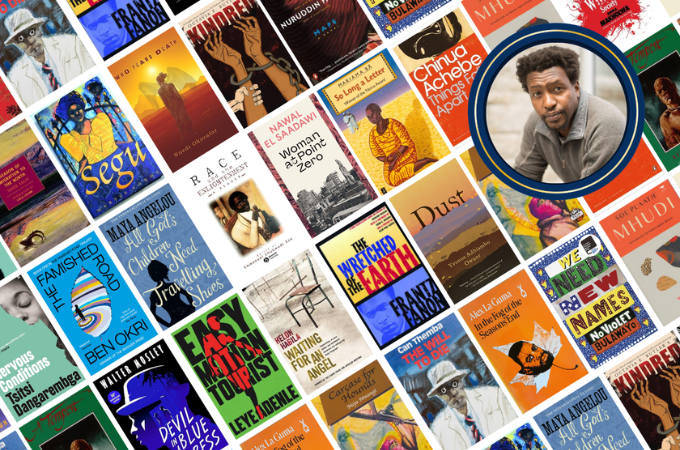
This is a list of 55 books, essays, writers and poets that I envy and love, that have influenced my own writing and thinking, or that I teach. It started out as a conversation between friends about what books I love and teach. The invitation here is to make a list that matches your age.
Pure Writerly Envy/Perhaps Jealousy List
1. Segu – Maryse Conde (1984): The expanse of it, intergenerational and diasporic – one of those novels where I wish I could do that.
2. Kintu (2014) – Jennifer Makumbi: Centering African historical fiction across generations in Uganda.
3. Dust (2014) – Yvonne Adhiambo Owuor: Kenyan epic history beautifully told, each character is drawn with care.
4. The Famished Road (1993) – Ben Okri: The fucking breath of imagination -folkloric/magical? African realism?
5. Who Fears Death (2010) – Nnedi Okorafor: African futurism or Afro futurism, you do not come out of reading this without being in awe of Nnedi’s imagination.
6. Kindred (1979) – Octavia Butler: Afri or Afro or African futurism, Depth and expanse of black lives beautifully written, but the language use is something else – I still have goosebumps from her prose.
7. A Grain of Wheat (1967) – Ngugi Wa Thiong’o: The storytelling of Kenya’s history of resistance and how it affected those who resisted and collaborated, but here Ngugi is also a literary painter at work.
8. Nervous Conditions (1988) – Tsitsi Dangarembga: One of the few novels to capture questions of gender and patriarchy in neocolonial Zimbabwe beautifully. And the storytelling itself!
9. Season of Migration to the North (1966) – Tayeb Salih: The fucking audacity! A treatise on colonialism and anti-colonial revenge through the eyes of a prototype black Englishman.
10. Maps (1986) – Nuruddin Farah: A novel set in what will soon be a disintegrating Somalia at war with Ethiopia that never leaves you the same each time you read it. Nuruddin, to my min,d is the best African writer.
Books I Love to Teach
11. We Need New Names (2013) – NoViolet Bulawayo: The movement from Zimbabwe to the US with a critical eye, with fully fleshed characters, plus it comes with questions about reception.
12. All God’s Children Need Traveling Shoes (1986) – Maya Angelou: Set in Nkrumah’s Ghana in the 1960’s, this memoir is a lyrical poetic take on the politics of being an African American in Ghana at that time. And ultimately, a reflection on the relationship between black America and Africa.
13. Race and Enlightenment (1997) – Emmanuel Eze: To understand colonialism, we must understand the racism engendered by enlightenment philosophers like Immanuel Kant and David Hume that gives rationale to civilizing missions.
14. Woman at Point Zero (1977) – Nawal El Saadawi: An intersectional novel set in neo-colonial Egypt. No one who reads can forget the fierceness of the main character, Firdaus.
15. So Long a Letter (1979) – Mariama Ba: A long letter debate on African feminisms and the betrayal that comes with neocolonialism.
16. Things Fall Apart (1958) – Chinua Achebe: It creates debate around language and the African novel, and of course, the meeting between the various forms of resistance (from cultural to the political) and colonialism
17. Mhudi (1930) – Sol Plaatje: Written in 1930, it is a beautiful novel (hardly read in African Literature circles), but it is more hard hitting/questioning than Things Fall Apart as it captures the dawning of apartheid.
18. Black Widow Society (2013) – Angela Makholwa: Crime fiction that captures the neo-apartheid, the born-free generation, patriarchy, and good old-fashioned revenge.
19. A Tempest (1969) – Aime Cesaire: This is best when read alongside Shakespeare’s The Tempest. Cesaire takes the basic plot and redraws from a colonized perspective, where imperialism is heightened. If Cesaire were alive today and on Twitter, perhaps he would tweet to Shakespeare to tell him, “There. I corrected it for you.”
20. Easy Motion Tourist (2016) – Leye Adenle: Crime, opulence, and corruption in a Nigeria with a soundtrack (in words) behind it.
Books That Have Influenced My Writing
21. Devil in a Blue Dress (1995) – Walter Mosley: Characters you will never forget in a detective novel set in 1950’s LA that brings in questions of race and class. The movie Devil in a Blue Dress with Denzel Washington and Don Cheadle is a must watch.
22. Fool’s Crow (1986) – James Welch: I read this for a class I was TA-ing back in the 2000s, an epic on Native American history, but the descriptions were my first understanding that words can be physical objects.
23. An Audience of One (1980) – Gerald Barrax: He was an African American poet, not well known, and I have never understood why. His poems artistically tell a story in ways few poets can manage. I like that he says he writes sonnets because he can.
24. Assata: An Autobiography (1987) – Assata Shakur: Nothing like it for sure, language and black panther politics that eventually force her into exile in Cuba.
25. Carcass for Hounds (1974) – Meja Mwangi: It was a high school set book that captured in thriller form the Kenya Land and Freedom Army’s struggle against the British colonialist (An enjoyable Grain of Wheat on steroids)
26. Waiting for an Angel (2002) – Helon Habila: A novel that, in form and content, captures our generation of writers imaginatively grappling with neocolonialism via Nigeria.
27. The Will to Die (1972) – Can Themba: The drum generation in apartheid South Africa, the surgical cynicism of living as a human being around a racist system that condemns – tragic with humor.
28. Beloved (1987) – Toni Morrison: When black people write history, it comes across as surreal, but the horrors, the absolute evil of slavery as literature has to be surreal. Re-memory, the tree, the hunger, trauma and resistance, Sethe’s is a true story of slavery.
29. In The Fog in the Season’s End (1972) – Alex Laguma: A look at the struggle against apartheid in South Africa and the material and psychological toll it takes on the revolutionaries. It was a set book in high school that we read at the height of the Moi dictatorship, that our teacher used to channel our own Kenyan story. It is the patient drawing out of the characters that got me.
30. What is to be Done? (1863) – Nikolai Chernyshevsky: The novel is a fleshing out of the more polemical What is to be Done by Lenin, an imagining of a socialist society, including home life.
Must Read Books
31. Arrest the Music! Fela and His Rebel Art and Politics (2004) – Tejumola Olaniyan: It is a scholarly treatise on Fela that matches him beat for beat as Teju cuts through Nigerian politics and cultural production. He does a close study of Fela’s lyrics and instrumentational against the oppressive backdrop of Nigerian politics. Side note, I doubt that had I not read Teju’s book when I was his student, I would not have written my Tizita novel, Unbury our Dead with Song (2021).
32. The Black Jacobins: Toussaint L’Ouverture and the San Domingo Revolution (1938) – CLR James: Not only is it a beautifully written book, it is about the 1804 Haitian revolution against the French, for sure, but really against the West.
33. How Europe Underdeveloped Africa (1972) – Walter Rodney: The title speaks for itself. It should be a must read for anyone wishing to understand how Europe, through slavery, colonialism and neocolonialism, developed at the direct inverse expense of Africa.
34. The Wretched of the Earth (1961) – Frantz Fanon: Achebe famously said we need to know when the rain started beating us. This is how the rain has been beating us. It remains to my mind the best analysis of the ‘pitfalls’ of independence struggles, the colonial psychological rot of nationalist leaders and captures the coming betrayal
35. Women, Race and Class (1981) – Angela Davis: About intersectionalism before it became a word, but this is more radical than the word – a duty call to historical knowledge of black feminism and capitalism. True, interconnectedness of struggle is a mouthful, but it does capture needed radical approaches to change, better than intersectionalism.
36. When Victims Become Killers: Colonialism, Nativism, and the Genocide in Rwanda (2001) – Mahmood Mandani: The price we pay when history comes calling, and how the genocide came about through the colonial racialization of Tutsis and ‘niggerization’ of Hutus at the sharp edge of a machete.
37. History Will Absolve Me (1953) – Fidel Castro: To understand Cuba today, you must understand where it was coming from. Delivered as part of his defence in 1953 when he was being tried for his first attempt at getting dictator Batista out of power, History Will Absolve Me is a treatise on Cuba as a banana republic and the need for revolutionary change. The passion behind the voice is what one hears, though.
38. Underdevelopment in Kenya: The Political Economy of Neo-Colonialism, 1964-1971 (1975) – Colin Leys: There are no accidents in history – Kenya is fucked up because of colonialism and the inherited form of it, neocolonialism. And the betrayal of the fight for independence by people like the first president, Jomo Kenyatta
39. Britain’s Gulag: The Brutal End of Empire in Kenya (2005) – Caroline Elkins: Fuck British colonialism and its soothsayers – Elkins has the receipts in this book. It is Kenya’s King Leopold’s Ghost: A Story of Greed, Terror, and Heroism in Colonial Africa by Adam Hochschild.
40. A Taste of Power: A Black Woman’s Story (1992) – Elaine Brown: Decolonization cannot happen along patriarchal lines. Elaine Brown runs decolonization against Black Masculine liberation.
Brilliant Essays I Love Teaching and Talking About
41. “I Am Prepared to Die” – Nelson Mandela Rivonia Trial, 1964: I love reading this alongside Fidel’s History Will Absolve Me. It is a historical ‘court’ document that captures why the ANC had no choice but to form Umkhonto We Sizwe, and a far cry from the more pleasant Mandela that is embraced today.
42. Why I’m no longer talking to Nigerians about race – Panashe Chigumadzi: A necessary reminder that Africans did not experience or internalize racism and colonialism the same way.
43. How to Write About Africa – Binyavanga Wainaina: The best introduction to enlightenment racism and how it is still pervasive today, through satire.
44. Chinua Achebe and the Invention of African Culture – Simon Gikandi: The Makerere generation via Achebe and how it redefined, retroactively (for better or worse), what today we call African culture.
45. The Nature of Things: Arrested Decolonization and Critical Theory – Biodun Jeyifo: Can decolonization as a dialectic be arrested mid-synthesis? And what harm did it do to African literary criticism?
46. The Eighteenth Brumaire of Louis Bonaparte – Karl Marx: Just the succinct beauty of language (in translation, of course), capturing how the French Revolution was betrayed.
47. Cuba Libre – Amiri Baraka: I read this essay in the 1990s alongside Castro’s History Will Absolve Me – a critical treatise of Baraka’s experience visiting Cuba in 1960, shortly after the revolution. But I also enjoy it for the long view essayistic discerning writerly voice.
48. Why I’m No Longer Talking to Kikuyus About Tribe – Rasnah Warah: We talk about white privilege, but how often do we talk about power and ethnicity and its pervasiveness even in neo/post-colonial Kenya? A companion piece to Panashe’s “Why I’m no longer talking to Nigerians about race.”
49. We badly Need to Converse – Micere Mugo: Philip Curtin wrote an essay, “Ghettoizing African History,” where he essentially argued that letting Africans teach African history would lead to a watering down of African history. Micere’s response (amongst many others) is a brilliant rebuttal.
50. The dead end of African Literature – Obi Wali: An indictment of African writers following a European literary. It is the watershed essay that opens up the language debate amongst Ngugi, Achebe, Gordimer, Ken Saro-Wiwa, et al.
Favorite Poets
51. Sonia Sanchez: Language is rhythm and it is resistance; she does both beautifully. The first poem I memorized as a kid was “Poem at Thirty” because it spoke (in hindsight) to the nightmares of growing up in dictatorship (where the inverse was to make the political person – so persecutions for my family)
52. Warsan Shire: Her poetry makes beautiful, surgical intersectional cuts
53. Patricia Smith: I understood the beauty of spoken word as an art form after seeing her perform back in the 2000’s in Boston
54. John Clare: Most people would default to Wordsworth or Keats, but John Clare, derided for generations as a minor romanticist poet or peasant poet (think Amos Tutuola’s reception), but he is a lyrical ‘political’ poet with something to say about the English aristocracy.
55. Bob Kaufman: An African American poet, that like Arthur Nortje, captured beautifully (in the fullest sense of the word) the racist sky under which he lived, and the struggles that come with that.
*See Mũkoma wa Ngũgĩ’s “Poem at 55”

COMMENTS -
Reader Interactions