

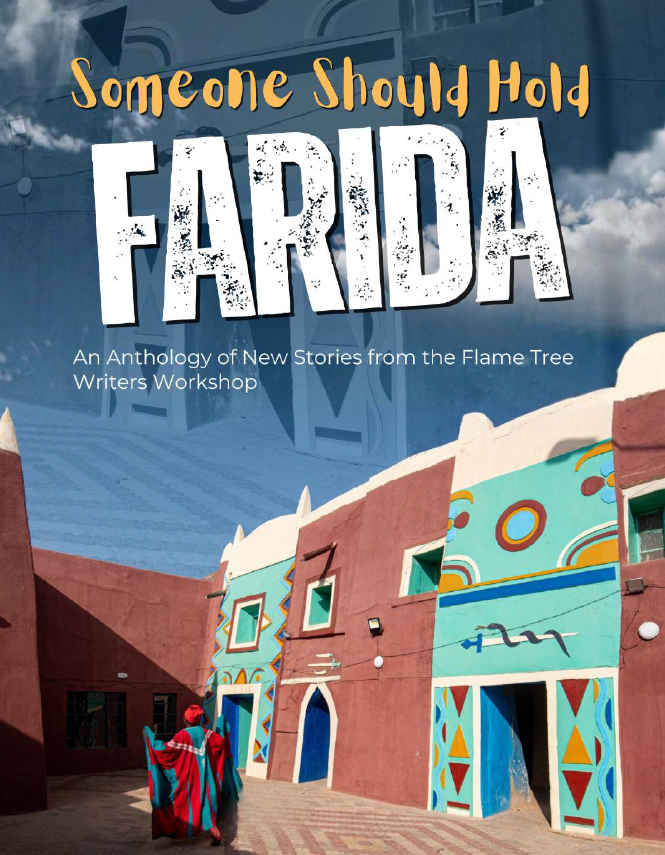
Twenty young Northern Nigerian writers have published Someone Should Hold Farida, a colorful anthology addressing what editor Abubakar Adam Ibrahim describes as “a disparity in the Nigerian story.”
Supported by the Heinrich Böll Foundation’s Abuja office and emerging from the Flame Tree Writers’ Workshop, the collection tackles a fundamental problem in Nigerian literature: while other regions contribute their stories to the national canon, Northern Nigeria has fallen behind, leaving the rest of the country to understand the North primarily through stereotypes and illusions of hegemony. Ibrahim, a winner of the NLNG Nigerian Prize for Literature who co-facilitated the workshop with fellow winner Chika Unigwe, argues that this absence makes national unity impossible—”if the North is not contributing its stories, its culture, and perceptions to the body of Nigerian literature, then this story, this desired unifying culture, will remain malformed.”
The anthology features eighteen stories that rethink how Northern Nigeria tells its stories, moving beyond existing Hausa-language literature that Ibrahim notes has been “preoccupied with conversing with itself, telling its stories to its people, the Northerners, to the exclusion of outsiders.” Contributors include Hussani Abdulrahim (Big Head), Hadiya Tilde (Snip! Snip! Snip!), Nana Sule (The Interview), Msendoo Rachel Tarter (Seember’s Cradle), Safiiyya Usman Bello (Becoming Huda), Mariam Abdullahi (Barka Da Sallah), Shedrach Akanbi (Someone Should Hold Farida), Zainab Abubakar (Stepping on Thorns), Ahmad Mubarak Tanimu (A Trail of Blood and Fire), Edwin Mamman (Kala), Yasmin Bawa (Ink Trails), Mansura Baba Ahmed (What Will People Say?), Alewa Jonathan David (The Last Water Lord of Bare), and Saeed Muhammad Lawan (Yours Barmani), among others. The stories address familiar themes with fresh perspectives: childlessness through adoption in Seember’s Cradle and reproductive choice in Snip Snip, the refugee crisis through a girl pursuing modeling dreams in an IDP camp in Yours, Barmani, environmental concerns mixed with myth in The Last Water Lord of Bare, and identity navigation in Big Head and Becoming Huda.
The workshop model brought twenty writers selected for their promising potential into collaborative learning with expert guidance, including coaching from Professor Rasheeda Liman, filmmaker Ishaya Bako, and literary agent Emma Shercliff, who also copy-edited the stories. Ibrahim positions the project within a longer tradition of storytelling as nation-building, recalling how griots once traveled village to village, “suturing our cultures, our peoples, and our histories together,” while acknowledging that stories have also “created enmity and chasms between people.”
The anthology is available as a free PDF download here. Ibrahim frames the project as essential work for “our new-age griots”—writers, thinkers, and opinion shapers tasked with building bridges instead of walls between Nigeria’s divergent tribes, cultures, and religions. His hope is that the stories “not only entertain but also showcase the potential of a new generation of Nigerian writers” while building “greater understanding among Nigerians as we address the fundamental issues of gender, identity, national unity, and peaceful coexistence.”

COMMENTS -
Reader Interactions