

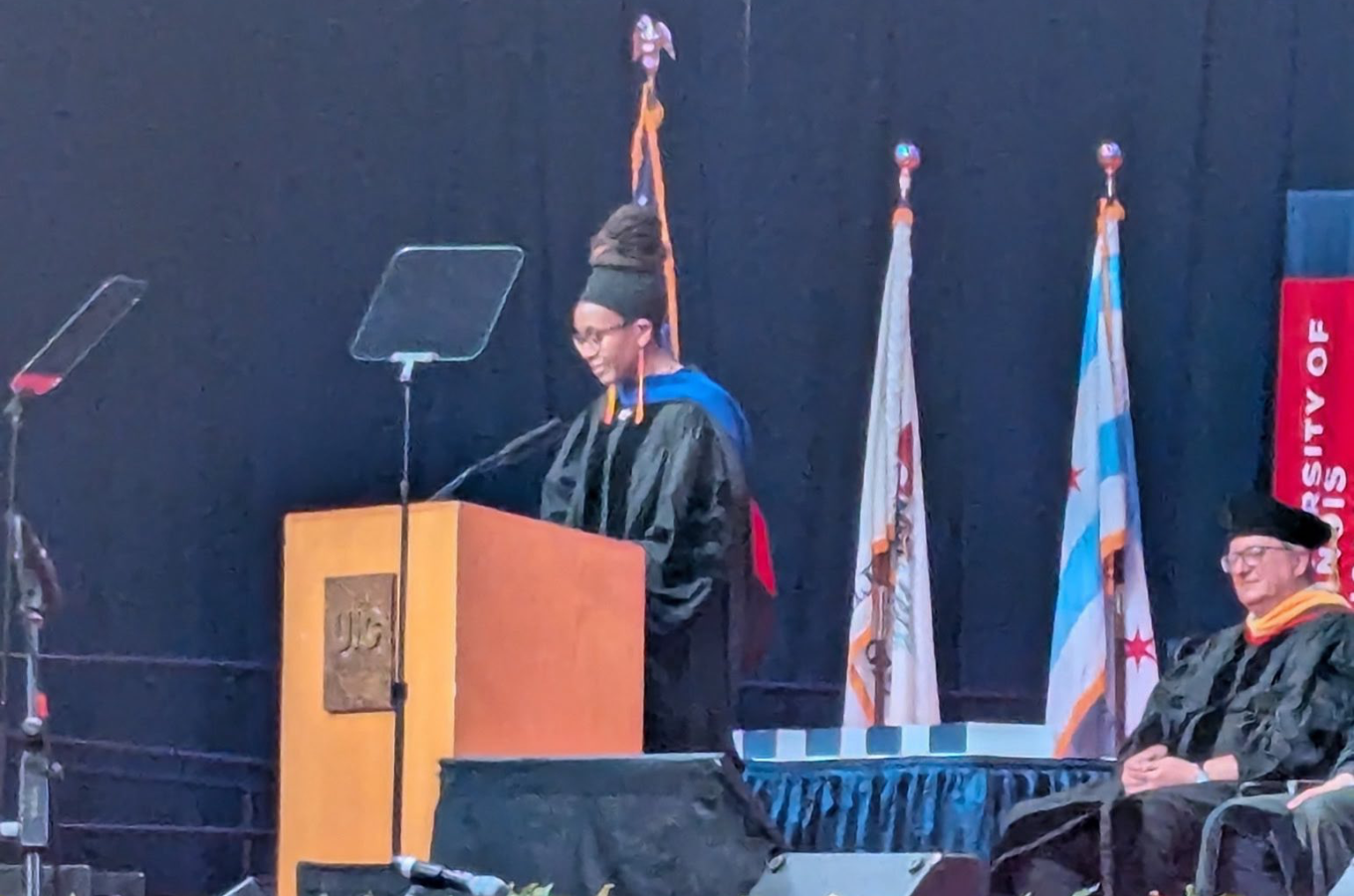
New York Times bestselling author Dr. Nnedi Okorafor returned to the University of Illinois Chicago on May 10, 2026, to deliver the commencement address for the College of Liberal Arts and Sciences, a full-circle moment for the novelist who earned both her Master’s and PhD at the very institution she was addressing. Speaking to a crowd she would only later learn numbered 10,000 inside Credit Union 1 Arena, Okorafor delivered a speech that drew praise from attendees and university leadership alike, with the provost reportedly calling it one of the best commencement addresses he had heard.
The speech centered on themes of individuality, adaptability, and empathy in an era increasingly shaped by artificial intelligence. In her own words, Okorafor urged graduates to “follow what holds your attention. Follow what pushes you to ask questions. Follow what feels alive to you. That’s your compass.” She framed these instincts not merely as personal virtues but as professional assets, telling the class that their humanity, their unique worldview, and “the particular stories that only you can tell” are things no AI system can replicate or imitate.
Okorafor addressed the AI question head-on, a choice she defended even after her daughter urged her to cut the section from the speech. “Heck no, that’s staying,” she reportedly told her daughter. “It needs to be said. It’s on everyone’s mind and I have thoughts and advice to give on the topic.” The decision proved prescient: while several commencement speakers at other institutions were reportedly booed for mentioning AI, Okorafor’s nuanced framing, focused on empowering graduates rather than dismissing their anxieties, was well received.
The occasion carried deep personal weight for the award-winning author. Okorafor noted on social media that she had not allowed herself to fully reckon with the enormity of the speech until the night before, managing a packed stretch of obligations that included a Yale lecture series and a writing workshop at the University of Pittsburgh. She arrived in Chicago without any of her family present, an experience she described as unprecedented and briefly overwhelming, but was accompanied by close friend Nzingha Nommo, owner of Afriware Books, whose presence she credited with steadying her the night before.
The day also held bittersweet dimensions. Okorafor reflected publicly that her late mother, father, and sister Ngozi would each have been proud or moved by the occasion. It was Mother’s Day. Her nephew Dika was simultaneously graduating from Illinois State University, meaning, as she put it, that “Okorafor’s were spread kinda thin yesterday.” Despite the logistical and emotional weight of the day, Okorafor said the response from the audience, including from graduates who approached her afterward, left her still processing the experience days later.
In the wake of the ceremony, Okorafor also pushed back against a narrative circulating in media and podcasts suggesting that any commencement speaker who mentioned AI was met with boos. She argued the viral speeches that drew negative reactions were tone-deaf to students’ real concerns about AI’s environmental costs, data center placement, and economic disruption, not simply the mention of the technology itself. “It’s not a ‘you’re either anti-AI or not,'” she wrote. “It’s a ‘What do I do now? With all this craziness and greedy bullshit I have to navigate?!'” For Okorafor, who spent years at UIC studying under professors who dismissed speculative fiction as serious literature, the moment of standing at that podium, before 10,000 people, at her own alma mater, was a rebuttal decades in the making.
See moments from the event on her Facebook page



COMMENTS -
Reader Interactions