

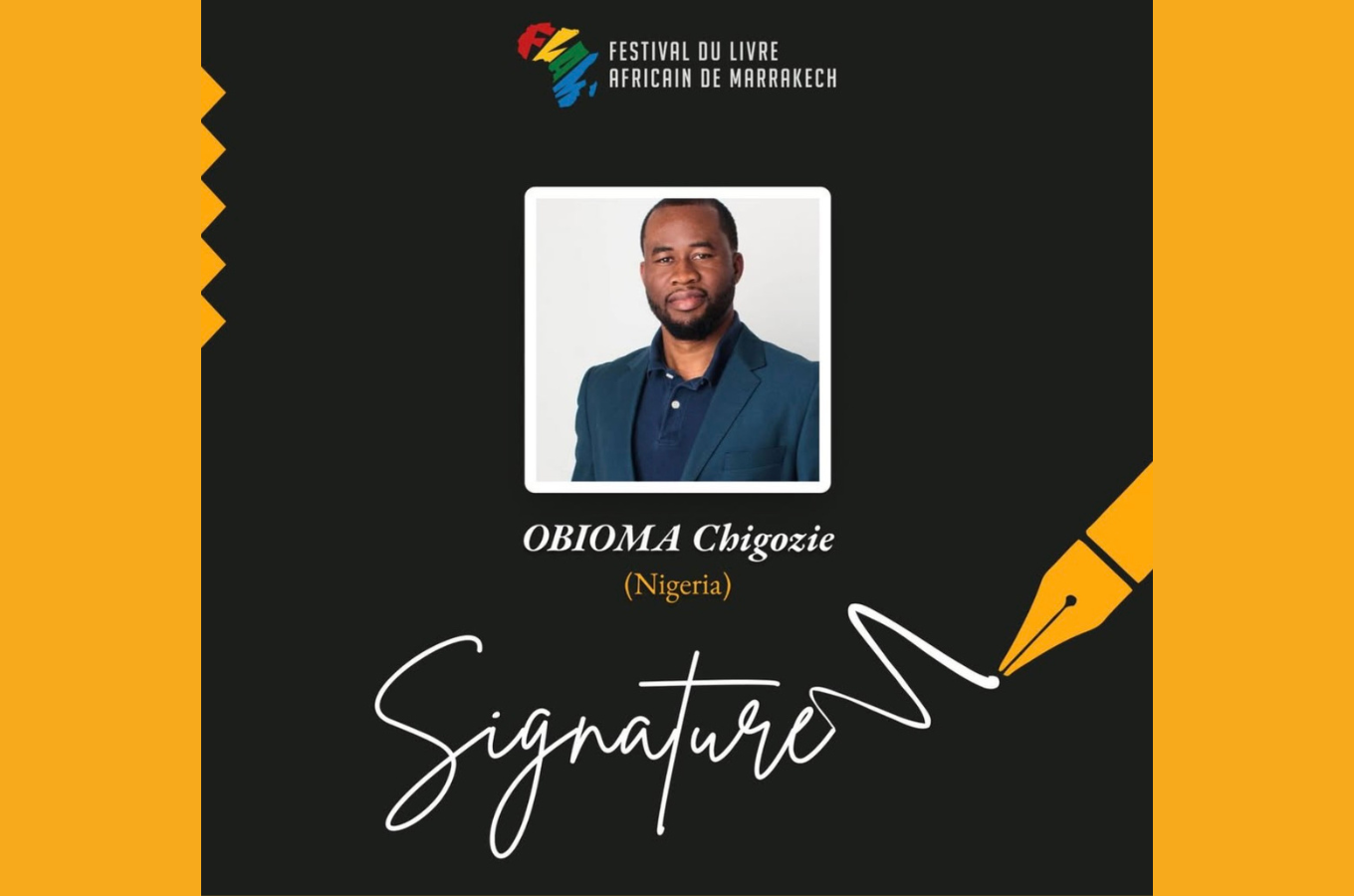
 Marrakech’s Jamaa El Fna square turned literary crossroads last month as the Festival du Livre Africain de Marrakech (FLAM) held its fourth edition from April 23 to 25, 2026, under the theme Imaginer d’autres possibles (Imagining Other Possibilities). Hosted at Les Étoiles de Jamaa El Fna and presided over by Nobel laureate J.M.G. Le Clézio, the free, open-to-the-public festival brought together writers from across Africa and its diaspora, among them Patrick Chamoiseau, David Diop, Yanick Lahens, and Alain Mabanckou, for three days of panels, debates, readings, and book signings. One of the most anticipated guests was Nigerian novelist Chigozie Obioma, twice-shortlisted for the Booker Prize for The Fishermen and An Orchestra of Minorities, who spoke to France 24 on the sidelines of the festival about what it means to be an African writer in the world right now.
Obioma was candid about why gatherings like FLAM matter to him personally. He recalled doing a book tour in Nigeria last year and finding in it a joy that recognition in the US, UK, or Germany simply does not replicate. Meeting readers and fellow writers on the continent, he said, is “a special joy”, not least because, as someone who cannot read French, he has long felt cut off from the literatures of North Africa or the Congo, and sees FLAM’s ambition to bridge that linguistic and geographical divide as “extraordinary.” He had been invited two years ago and couldn’t attend; this year, he made sure he came.
On the festival’s theme of imagining other possibilities, Obioma offered a window into his theory of composition. He is not interested, he said, in writing about the world as it ought to be, a remark he quickly called “a tease.” What he is really after is the dimension of an experience that everyone has lived but no one has named. He used sibling rivalry as his example, something almost universal, yet capable, when properly examined, of revealing something that even someone with ten siblings would not have thought to articulate. The writer’s job, in his view, is to prop up what is concealed until it feels almost new.
Asked how he navigates the very different ways his work is received across continents. He maps the reception geographically; as a representative voice in Southern Europe, as a philosophical project in France and Germany, as a statement on race in America, and as an ambassador of Nigerian stories on the continent itself. He described recognising these divergences in 2017 on a six-country European tour, and concluded that the only honest response is to write as “genuinely felt” as possible.
Perhaps the most counterintuitive argument Obioma made concerned the relationship between distance and imagination. Living in the United States and away from Nigeria, he explained, is not a disadvantage for his fiction, it is the condition that makes it possible. If he were living in Lagos, he suspects his writing would become more documentary than imaginative. Distance allows memory to do its work: the obvious details fade, and what survives are the small, precise, unobvious things, “the small red in the white flower”, that produce the vivid similitude of great fiction. He travels back to Nigeria regularly, he said, precisely to generate new memories that can then be left to transform in his absence. He also recommended, Nigerian women writers he admires: Ayobami Adebayo, Chika Unigwe, Chimamanda Ngozi Adichie. From the wider continent, he cited Tayeb Salih’s Season of Migration to the North as a formative influence, alongside Alan Paton and, among contemporaries, Scholastique Mukasonga, of whom he said, with certainty, that she will one day win the Nobel Prize.
The interview closed on the metaphysical terrain that runs through all of Obioma’s fiction. Asked whether he still believes more in destiny or in choice, he told a story about a woman who intuited, with no medical basis, that she might have breast cancer, dismissed by doctors, she grew obsessed with the idea, and six months later was diagnosed. For Obioma, this is not a cautionary tale but a philosophical one: sometimes, he suggested, we call things into being without making the choice consciously. It is, he said, “the other side of life” that keeps surfacing in his work. Watch the full interview here.


COMMENTS -
Reader Interactions