

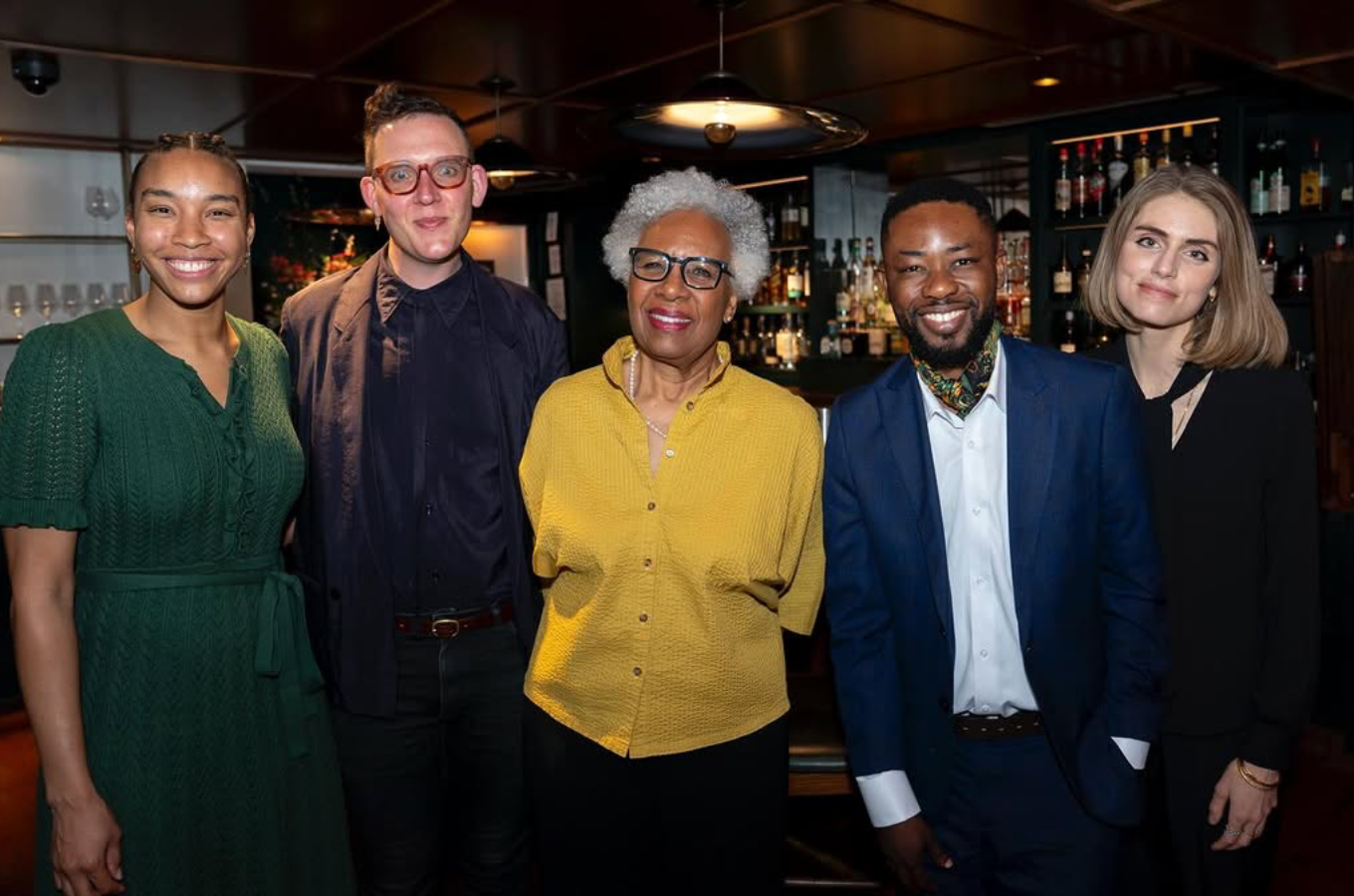
Gbenga Adesina has won the 2026 Anisfield-Wolf Book Award for Poetry for his debut collection, Death Does Not End at the Sea (University of Nebraska Press). The Anisfield-Wolf Book Awards are the only national endowed juried prize in the United States dedicated to literature that contributes to our understanding of race and our appreciation of the rich diversity of human cultures. Founded in 1935 by poet and philanthropist Edith Anisfield Wolf, its legacy of winners includes Zora Neale Hurston, Langston Hughes, Martin Luther King Jr., Nadine Gordimer, Wole Soyinka, Toni Morrison, Isabel Wilkerson, and Colson Whitehead. Adesina now takes his place in that lineage.
The prize is beginning to feel like the only appropriate response to this collection. In the space of weeks, Death Does Not End at the Sea has been shortlisted for the Griffin Poetry Prize, worth C$130,000, the world’s largest international prize for a single collection in English, and now this. For a debut, it is a staggering run.
This year’s jury was chaired by Natasha Trethewey, Pulitzer Prize-winning poet and 19th Poet Laureate of the United States. In her citation, Trethewey described the collection as a haunting, elegiac work centred on its stunning titular poem, a meditation on the difficult journeys, both spiritual and physical, undertaken by migrants fleeing troubled lands in hope of new lives. The winners were announced at a private luncheon in New York City, marking the first time in the prize’s history the announcement has been made in New York.
It is worth noting that all four of this year’s winners are debut authors, a convergence that jury chair Trethewey described as making the honour all the more profound.
Adesina will travel to Cleveland for the annual Anisfield-Wolf Book Awards ceremony on September 18 at the Maltz Performing Arts Center.
For the poet himself, the win carried a weight that went far beyond the prize. He shared the following on Instagram:
I’m genuinely still too stunned to process this great fortune. When I got the news that I was a finalist and that Natasha Trethewey, the 19th poet laureate of the United States, was the chair of the jury that had selected me, I sat still and thought, “Oh, Natasha Trethewey read my book, she held my book in hands, she read my book!” That was the reward. That was it. I’ve read, studied, and taught her magisterial work for years. I always have a book of hers by my bed stand. She’s truly one of 21st century’s masters of the craft. At the award luncheon, she said “I want to begin with 1943” and went ahead to tell us how Zora Neal Hurston won the award in 1943 for her book “Dust Tracks on a Road.” As the name of that ancestor was invoked in the room, I felt a chill run down my spine.
When I was a child, one of my favorite books was “Ake: The Years of Childhood” by Wole Soyinka. It existed way before I was born. I remember I couldn’t even read or comprehend the book yet, I was fascinated by it as an object from what remained of my parents’ book shelf. I played with it, slept with it beside me on the bed, I went everywhere with it, constituting a delightful nuisance. The Anisfield-Wolf Book Award was written on the book cover. I did not make the connection until the other day at the award luncheon when a list of previous winners and their books were scrolling on the screen, and it suddenly struck me, oh it’s that book from my childhood! I was moved to tears. It was a healing melody to my inner child. What an extraordinarily great fortune. We give thanks!





COMMENTS -
Reader Interactions