

African literature has shown to be conversant with women’s emotions. Littered across African literature are stories of grieving mothers, scorned wives, long-suffering daughters, women battling the cards that patriarchy and misogyny have dealt them. These situations are tethered to strong emotions but a closer look and you see that a specific type of emotion is what has been represented. There is sadness, jealousy, despair but few texts have broached the idea of female rage. Why is that?
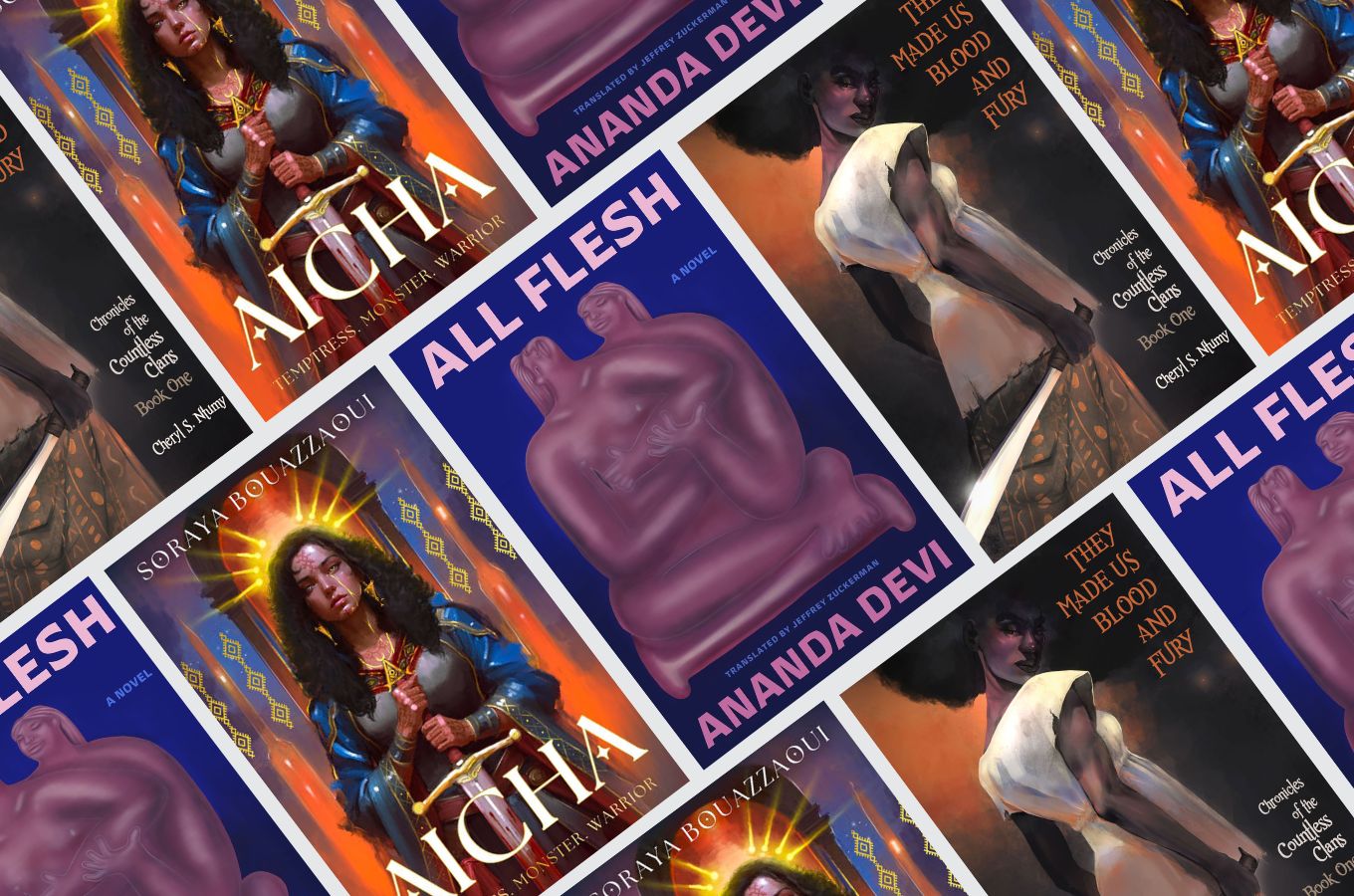
“Women are generally not allowed to express their inner feelings forcefully or openly, let alone violently,” Ananda Devi, author of All Flesh, explains. All Flesh follows a young woman who is bullied for her weight and blamed for consuming her twin in the womb. She briefly discovers bodily pleasure and freedom before society’s cruelty drives her toward a tragic, self-destructive act of defiance. Society has long been uncomfortable with female rage; the concept deviates from the perfectly sculpted patriarchal notions of gender. “Women are supposed to birth things, not kill them; we’re supposed to be soft, not fierce. If we don’t follow the script, it’s deemed “unnatural”, expatiates Cheryl S. Ntumy, author of They Made Us Blood and Fury. Like Devi’s All Flesh, Ntumy’s They Made Us Blood and Fury is scintillating with female rage. The book is centred on a dying clan where Queens produce vital lifeblood; a silent god and fading power push rebellion. The protagonist’s—Aseye’s—hidden past and forbidden love collide as an ancient weapon awakens dangerously.
Patriarchal understanding of gender begins to take form early on in childhood. Girls are told not to be loud but boys are allowed to be lousy. Even our use of language is gendered. “Assertive” is not a word we commonly use for women. And an assertive woman is often seen as a headache. The word is rarely ever used to describe a man. Nobody says “An assertive man” not because men are not assertive but because it is the expectation. No one needs to announce what is a default setting. Men are to be audacious and brash while women are to pick their words carefully. “If we were socialised to accept female rage the way we’re socialised to accept it in men, nobody would be uncomfortable,” Ntumy states, forming the basis of why we are uncomfortable with female rage.
It is our discomfort with female rage that birthed the stereotypical saying “angry black woman”, a term that paints Black women as aggressive and pugnacious. But what that stereotypical term does is ignore the systems that made the originators able to make that assertion in the first place. “Most people, when they see a woman in rage, don’t read it as something long suppressed—an emotion pent up and stifled across generations,” Devi affirms. “Even when women are the primary breadwinners and carry extraordinary responsibilities—raising children, earning income, running the household—they are still expected to accept patriarchy and male dominance in other aspects of life. It is a deeply paradoxical position, where even their labour does not translate into full authority or autonomy.” The biggest problem with society’s view of female rage is it fails to recognise it as a reaction to an action, a reaction to a brutal system. It is not a temperament but a structurally engineered outcome. Thus, this rage becomes political.
“Female rage can’t help but be political. Our societies made it so by framing it as aberrant while constantly creating situations that evoke it.” Ntumy agrees. “When every woman’s place has to be negotiated, any kind of rebellion is indeed a political act,” Devi supports. There have been instances where female rage showed up in African literature, like in Sorayya Bouzzaoui’s Aicha, a reimagined tale of the Moroccan warrior goddess. Ntumy affirms that African literature has begun opening its arms to stories laced with female rage but it still nurses an affection for the resilient martyr “the so-called portrait of an African woman”. That strong enduring woman who survives war, betrayal, abuse, and heartache; the ultimate overcomer. “Nowadays more African stories are saying, “Why must women repeatedly overcome rotten, broken systems? Why can’t we tear them to pieces and build better ones?” The rage is brewing, but it hasn’t fully consumed our literature.” Ntumy notes.
Female rage may appear in African literature but oftentimes angry women are punished or forced into redemption arcs because of it. “We don’t like angry women and they’re often treated as anomalous, despite having plenty to be angry about. I explore this in my novel, via the character of Queen Senanu and how she’s perceived.” Ntumy corroborates this thought. Once again, it all boils down to patriarchal perceptions of gender. “It is definitely not the case for male protagonists who can easily be antiheroes and still emerge as sympathetic characters. This reflects the way society looks upon admissible behaviours in men and women,” Devi argues. This perception forges the need for literature to explain “morally grey” or raging female characters. But rage isn’t just an emotion that is blooming inside of the character. For both Ananda Devi and Cheryl S. Ntumy, it shapes the way their stories are built.
“Emotions are a powerful narrative tool in that they force you from the realm of ideas into the realm of sensation. The story becomes a living thing inside you; you’re feeling it, rather than thinking about it in some abstract way.” Ntumy explains. For Devi, women’s bodies have always been central to her work, as seen in All Flesh, “the body is where the violence of men is often expressed,” so for her, that rebellion comes from the body and it is how the skeletal parts of her story worlds are built. “In a way, for me, fiction creates its own ecology where people’s emotions play an important role in so far as they act upon the climate, the weather, the colours, the wind, and everything. It is a very powerful way of enhancing what your characters are thinking and feeling, as if they are shaping the world and not the opposite.”
Beyond female rage being the foundation upon which stories are built, it can drive resistance and change. In They Made Us Blood and Fury, female rage is embodied in a magical entity and her human host, which allowed for the exploration of rage and its implications from different angles. Angry women can bring into scrutiny long-standing systems that have oppressed women. It is female rage that started the #MeToo movement and sparked the four waves of feminism.
To quote Ananda Devi: “I’m not saying that rage in the absolute is a good thing but it is like a revolution.” African literature has always been a place for revolution; therefore, female rage should have a seat at the table.




COMMENTS -
Reader Interactions