
My youngest daughter is barely two years old. She is old enough to walk around the house with purpose, but still too small to arrange words into sentences. Her world exists in fragments — laughter, curiosity, tears, and sudden fascinations that vanish almost as quickly as they arrive.
Like most children her age, her attention span is astonishingly short. A toy holds her for three minutes at most. Then it is abandoned in the dirt. A plastic cup becomes more interesting. Then the cat.
Poor creature. He receives two minutes of torment, because two minutes is the length of her kingdom. She chases him through the house, drags him by the tail, strikes him with a tiny shoe, and attempts to hug him with the violence only toddlers can mistake for affection, occasionally lying on top of him as if he were a pillow. The cat endures. He looks at her with one tired eye. Strangely, he does not flee from her as he flees from me. Perhaps he understands that she is still a child; perhaps mercy exists even among cats. And then, after two minutes, she forgets him. The cat is released from his sentence.
Next comes the scooter: two minutes. Then the spoon. Then the curtains. Her attention jumps from object to object like a sparrow searching for seeds. This, I have come to understand, is the natural rhythm of childhood.
But there is one thing in our house that obeys different laws: the glowing mirror. Place a phone in her hands, and something strange happens. The same child who cannot remain with a cat for more than two minutes can sit for thirty, sometimes longer. Her body becomes still. Her eyes widen. The world disappears. No cat, no scooter, no curtains, no dirt, no father — only illuminated glass.
I find myself asking a question that would have sounded absurd to my grandparents: How does a child who barely understands language seem to understand the language of the machine? She cannot read. She cannot explain what she is seeing. She cannot tell me what an algorithm is. Yet when she touches the glowing mirror, it is as if she has entered into a conversation with something that understands her perfectly.
And I wonder what exactly the machine has discovered — not about children, but about us.
The Resurrection of the Machine
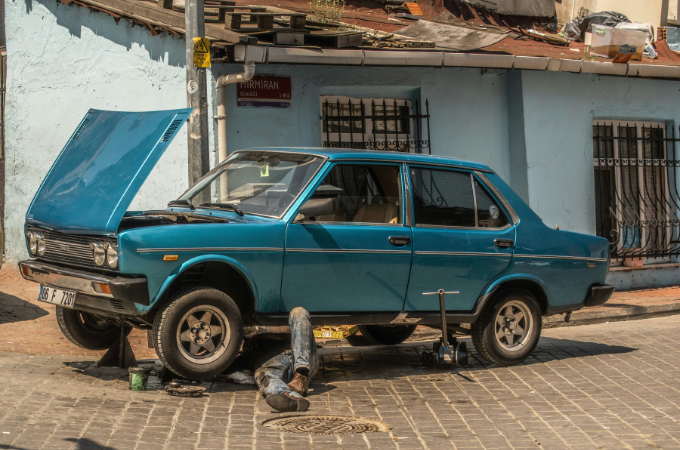
I bought the car because of a piece of paper. Before the auction started, I walked around the vehicles for sale one last time. People’s attention was captured by the newer, shinier cars — even though many of them were badly broken and priced much higher. No one was watching the junk car I had my eye on. It had an engine, but it was broken badly. To most people, it looked like a corpse.
Because of my tight budget and years of experience in auctions, I knew I had a much higher probability of winning the junk car and spending less on its maintenance than chasing the shiny ones. The only thing needed was patience and time.
I won it for eighty dollars. Over the following months, I brought the machine back to life, piece by piece — a tire here, a seat there, an engine, headlights, wires, bolts. Nothing glamorous — just patience. In the end, I spent around five hundred dollars.
Today, the car performs the same humble miracle every automobile has performed for more than a century: it carries me from one place to another. And that is what puzzled me, because elsewhere in the world, people spend thousands, even hundreds of thousands, for the same miracle.
Some people spend hundreds of thousands of dollars on sports cars — machines with one thousand horsepower, like animals trapped beneath steel. These are vehicles that were meant to stay on a racing track: thousands of horsepower, extreme aerodynamic fins, and chassis lowered so aggressively they were never intended for public roads. The first touch of the accelerator feels almost violent, like a young horse fighting the reins.
Yet on the streets of Addis Ababa, these beasts never reach the speeds where their fins become useful, never fight the centrifugal force their low chassis were designed to conquer, and never deliver the acceleration meant for track records. Their loud exhausts roar to amaze spectators who will never see them at full power. But eventually the beast reaches the same red light as my resurrected eighty-dollar car. We obey the same traffic signal, share the same road, and neither machine reaches its destiny. The lion roars, but the cage remains.
The Ancient Machine
My daughter considers my mechanical watch part of her toy collection. She reaches for it with the same curiosity she reserves for the cat. I trust her with the cat, with dirt, and with spoons, but not with the watch. It is worth more than the broken car I once bought; the irony never escapes me.
Mechanical watches stopped evolving long ago. The size has reached its natural limits, and the wheels, springs, and gears have been refined over generations. The great revolution is over. Unlike cars, whose faces change every few years, watches entered old age decades ago.
Yet the older the watch, the more attention it attracts. Age, uniqueness, and history become valuable. I have seen watches capable of purchasing a commercial building in Addis Ababa, yet they cannot purchase one additional minute. The wealthy and the poor both receive the same ration from eternity.
The phone in my pocket tells time with terrifying precision. Meanwhile, the ancient machine on my wrist demands constant maintenance and loses tiny fractions of time every day. By every practical measure, it should have died. Yet it survived — not because people need it, but because people desire it.
I suspect many do not purchase these old machines to know what time it is. They buy them for the same reason peacocks carry feathers and kings wore crowns: not to know, but to be seen.
The Companions
Tonight, my daughter will sleep. The cat will finally recover from another day of service, and the toys will remain scattered in the dirt like forgotten civilizations. Somewhere on a table, dark and silent, the glowing mirror will wait for morning — patient as ever.
The cat asks for fish; the machine asks for data. Both have become companions to my daughter. One made of flesh, the other made of light. One has whiskers and teeth; the other has notifications and no body at all — not yet, at least. And somehow, she loves them both, but she prefers the newer creature.
Every generation inherits a companion its grandparents could not imagine. Mine inherited television. My father’s inherited radio. My daughter inherited a creature that eats electricity and drinks data.
I do not know what future historians will make of this arrangement. I only know that tomorrow my daughter will wake up, torment the cat, abandon her toys, laugh at shadows, and chase invisible things. And somewhere in the middle of it all, she will become bored.
I find myself strangely grateful for that, because boredom leads children back to the world — back to clouds, dirt, butterflies, and cats. Perhaps boredom is not a defect, but mercy; perhaps wandering is not weakness, but freedom. And perhaps the old cat, with his endless patience and one tired eye, understands something the machine never will.
Love does not capture attention.
Love waits for it.
Photo by Carlos Torres on Unsplash




COMMENTS -
Reader Interactions