

I.
After my father’s demise, I travelled from Ibadan, back home to visit my mother after a year apart. I had gotten home late in the morning, but the sun was still scorching, spurting hotness into the streets. The warm air surrounded me, carrying the smell of nearby canteens and restaurants. Groaning generators rising and falling like a smoker coughing heavily after a few puffs.
Contrary to what I expected, the time passed had not been marked in changes. When I walked into our large single-room apartment, everything still looked the same. The green and orange paint on the walls still clung dearly for their life, looking old and dusty. The green had dulled almost into grey, the orange had experienced faint rust, both colours held together by years of heat and use. The smell of overheated soup soared lazily around the room like it had nowhere else to go. Dirty, swarthy cobwebs spread around the weary off-white ceiling. The ceiling fan screeched softly as it embraced dust coming out of nowhere. Large buckets filled the top of my mother’s big wardrobe, holding plates and stainless steel and plastic spoons all stacked carelessly. The black marker inscription, Black Poet Once Lived Here, still stared at me from my small drawer. Everything still looked familiar and nostalgic.
My curious eyes met the new grey hairs threading through my mother’s scalp; the thin silver strands spreading round her once-dark hair. The only new addition to the house were my cousin and his mother. But my father’s absence lingered, especially around his favourite seat, a turquoise plastic chair tucked into a corner of the room. It now looked older than the room itself, as if it had survived years before my birth, and had already commenced its journey into decline before my arrival. I could still see my father there, seated, his ghost filling the chair completely with questions cloudy in his eyes.
II.
The turquoise plastic chair was scratched badly at the edges, its colour now faded into a dull bluish-green. I remember how his thighs would rest against each other, his chest rising and falling into soft steady rhythms of secret joys. I could picture father there, his obese belly resting loosely on his thighs, his cream-colored body towel wrapped around his waist, tiny pieces of meat trapped between the gap in his teeth, sweat beading across his forehead down to his face then to his neck as he swallows his meal of amala and egusi. Then after the sumptuous meal, he would make repeated jokes, mostly about his colleagues or the neighbors at the first wife’s house, and our mouth would burst into laughter as if it was the first time we heard the jokes.
But no matter what my mind could conjure up, the plastic chair was now empty. I sat on it slowly, as if any sudden or careless movement might disrupt the memory still clinging to it. My chest became heavy with feelings, warm tears rose without request, blurring my eyes as the room had begun to paddle away from me while I remained there, in silence. I wished it was him sitting here instead. I could almost see the curiosity in his eyes, how he would have questioned me about life in Ibadan. How he would have been half concerned, half playful with his questions. “Àwon ìyàwó e nkó?” I imagined him asking if the city had taught me about life. I would have smiled through it all, and told him how I had become a man in his absence, through shouldering responsibilities; like how I paid my house rent from a literary magazine contributor’s payment. Also, how I had fallen in love, and about how my small independent publishing house, Afrihill Press, is slowly gaining recognition in the writing industry.
I would tell him about the city of Ibadan’s bustling activities, just like that of Lagos in its own way. The micra drivers with similar reckless driving as the Danfo drivers in Lagos, hurling insults towards one another — “Orí e ti dàrú,” “Olòshì,” and “Wèrè” — at the slightest irritation. The street vendors were also just as persistent as those who fill Lagos roads and markets, calling out endlessly in traffic, “Aunti, broda, cold minerals! Gala! Dòdò ìkirè,” refusing to be ignored. And I would tell him how my neighbours and landlady often teased me, thinking I was rich simply because I was always the first in line to pay the utility bills, unaware of how I made plans for every expense before the month ended. But somehow, Ibadan still feels different. It was a city still learning how to carry its own weight without breaking under it.
I remember how present he always was when we were young. Despite being a polygamist, a cultured way of living in many Nigerian homes, yet one that often could trick the women and children involved into emotional penalties, he somehow found a way to move between homes without making any of us feel entirely forgotten. His life seemed permanently suspended between wives, children, responsibilities, and expectations, yet he carried himself with the restless determination of a man trying to hold several worlds together at once.
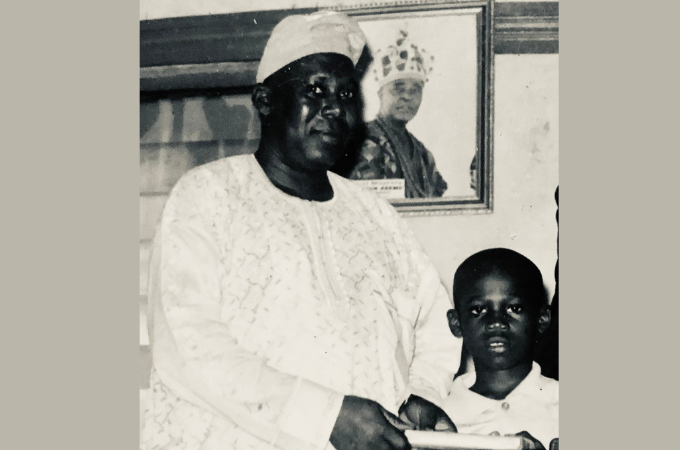
He rarely missed PTA meetings or our school prize-giving ceremonies. I can still picture him arriving in his richly patterned lace attire, the fabric hanging heavily on his large frame, its embroidered details catching my eyes softly under the afternoon sun. The sleeves were usually stiff with careful stitching, and carried the faint smell of starch and talcum powder. His leather sandals slapped lightly against the dusty school ground as he walked, greeting teachers with the seriousness of a man who believed showing up for his children mattered, even when life pulled him in many directions. During ceremonies, while other parents chatted distractedly, he watched attentively, leaning forward whenever one of our names was called, clapping with an enthusiasm that sometimes felt oversized for the occasion.
Inside my mother’s wardrobe sits the old family photo album, its sides worn and dusty from years of being opened and closed. Between its fading plastic covers are dozens of photographs of him scattered across different stages of his life. In some, he stands at his workplace with the posture of a man exhausted by responsibility but unwilling to bend beneath it. In others, taken during his pilgrimage to Mecca, he is clothed in white garments, looking almost weightless compared to the version of him we knew at home. Then there are the graduation photographs, different years, different uniforms, different children, but always him standing somewhere in between us, smiling with that familiar gap in his teeth, as though fatherhood itself was something he wanted documented carefully.
He was a responsible man, though not without flaws. While he tried to bridge the gap, his greatest flaw was still his polygamy, something I resented heavily when I was younger. As a child, I understood it only through its tensions, but as I grew older, my anger softened into curiosity. I started to wonder what it must have felt like growing up as the only child of his parents. Sometimes I think that loneliness might have followed him into adulthood in ways even he may not have understood. Maybe that was part of the reason he became a man with nine children. Maybe he spent his entire life trying to create the kind of family he never had for himself.
III.
Before his death, my father ensured that all of us, his children, had access to tertiary education. No one was left out. We were raised with both the Western and Islamic education. He made sure we blended in, as though he understood that we needed both to stand fully in the world he was preparing us for. But he did not earn in millions like the men in the home videos my mother watched, glued to the TV all afternoon, their swinging briefcases carried like an extra limb guarding their steps, as though opening it might release the secrets of sudden wealth. But he carried our education needs with a steadiness I still struggle to comprehend, and I still wonder how he didn’t crumble underneath all the financial burden. Especially when he retired, with his pension unpaid, while I was in JSS3, my elder brother still in senior secondary school, and my older siblings already in higher institutions. I often wonder if, in those days, he looked at himself and quietly felt like a man whose hands had been asked to carry more than they were built for.
I remember the first time I heard the word “shares.” I thought he meant selling “chairs” to pay my school fees and my Junior WAEC fees. In my mind, I pictured him in some quiet, impossible market of furniture, my father negotiating survival one chair at a time. I even wondered how I had lived so long without knowing he sold chairs. It is the kind of childhood confusion that feels funny only when you are far enough from the hunger of it. There was also the time he tried to raise part of my school fees from a tenant’s meagre rent in our family house in Ilorin; a house he had built with his own hope and humble earnings. That was the first time I saw him not as the man who solved problems, but as a man surrounded by them. Grief settled on him like dust that refused to be wiped away, and depression followed quietly. It was the first time I began to understand what it meant to be “a man” in a world that turns expectation into a kind of inheritance. My father’s trials and travails left me wary of ever becoming the kind of “man” society demands; a mold I have resisted ever since, and continue to reject to this day.
IV.
There was a time I stopped being my father’s son. I drifted from the boy he used to call kékérè, and began to grow inside other people’s versions of him, stories that were never fully mine, but that I carried anyway. Growing up changed that. I began to see him differently, especially his marriage. He was a man stretched across too many responsibilities, too many expectations, holding two wives, one of them late, and nine children with hands that were never given rest.
I even found myself questioning my younger self, trying to understand what it meant to stand in his shoes. I no longer took sides as easily as I once did. In hindsight, I think he was the one most worn down by the life he was expected to hold together. Sometimes, I wish I had known that sooner. I still carry the feeling of being a bad son; absent when he needed me, slow to understand him, quick to judge him. I remember most clearly when the sickness arrived and changed everything.
He used to walk ahead of me, like the world was always a step behind him. As a teenager, I would rush to keep up. Then slowly, that changed. I became the one guiding him. He would hold my hand to the hospital, or when I went with him to the barber near Sabo Market. His grip grew weaker, quieter. And in that shift, I saw how much I had taken for granted. I regret how impatient I was when his body began to slow down. That same body had once outpaced mine without effort. He followed me to the cybercafé to check my WAEC and JAMB results, and sat for hours outside Ikeja Army Cantonment while I wrote my NDA exams with excitement. He built my education with what little he had, and never made it feel like a duty. I rarely saw him cry, until the illness took away what posture he used to hold together.
He was later moved to live with my older siblings for care. After that, there were only phone calls. Some days, he didn’t recognize me. The man who used to call me his last child happily could no longer hold my name. I had called him on the day I graduated, happily expecting a final stamp of hard-won approval. But his voice came through thin, far away. I remember smiling through it, because I didn’t know what else to do. How does a man who has lived through all of these already, lose so much of himself?
V.
Now, I’m staring at my phone, scrolling through my gallery where my father lives rent-free. I wonder what my father would think of me as I’m yet to visit his grave. Here was a man who, during my formative years, was always present in my life, and I couldn’t even honour his absence with a visit to his grave. But I have written poems after him. I sometimes ask myself if they’re enough to reach him. But I would visit his grave soon, not to bring him flowers, because flowers have no meaning from where we come from.
I would bring the memories of his jokes, and the way he laughed, full-bodied and unguarded, rising from his chest in sudden bursts, as though something in him had been tickled too well to be contained. Memories of how he would sit during Eid-Kabir in Ilorin, observing my older brothers slaughtering and butchering the Salah ram, memories of how I am no longer his kékeré, memories of the roasted corn or plantain he bought and shared with us almost every Saturday when he is around my mother’s place, memories of how he brags about me before his friends, memories of how he stood before the stage taking pictures with me as I bagged prizes at school graduation ceremonies, memories of him during his Hajj, memories of everything he always wanted to be, memories of being an only child who was greater than his parents, memories of the houses he built and the land he bought despite his financial burden, memories of being the best father in the world. How I wish he could see and read all these in Jannah, forgive himself, forgive his wives, forgive his children, and forgive the world for abandoning him so soon.





COMMENTS -
Reader Interactions