

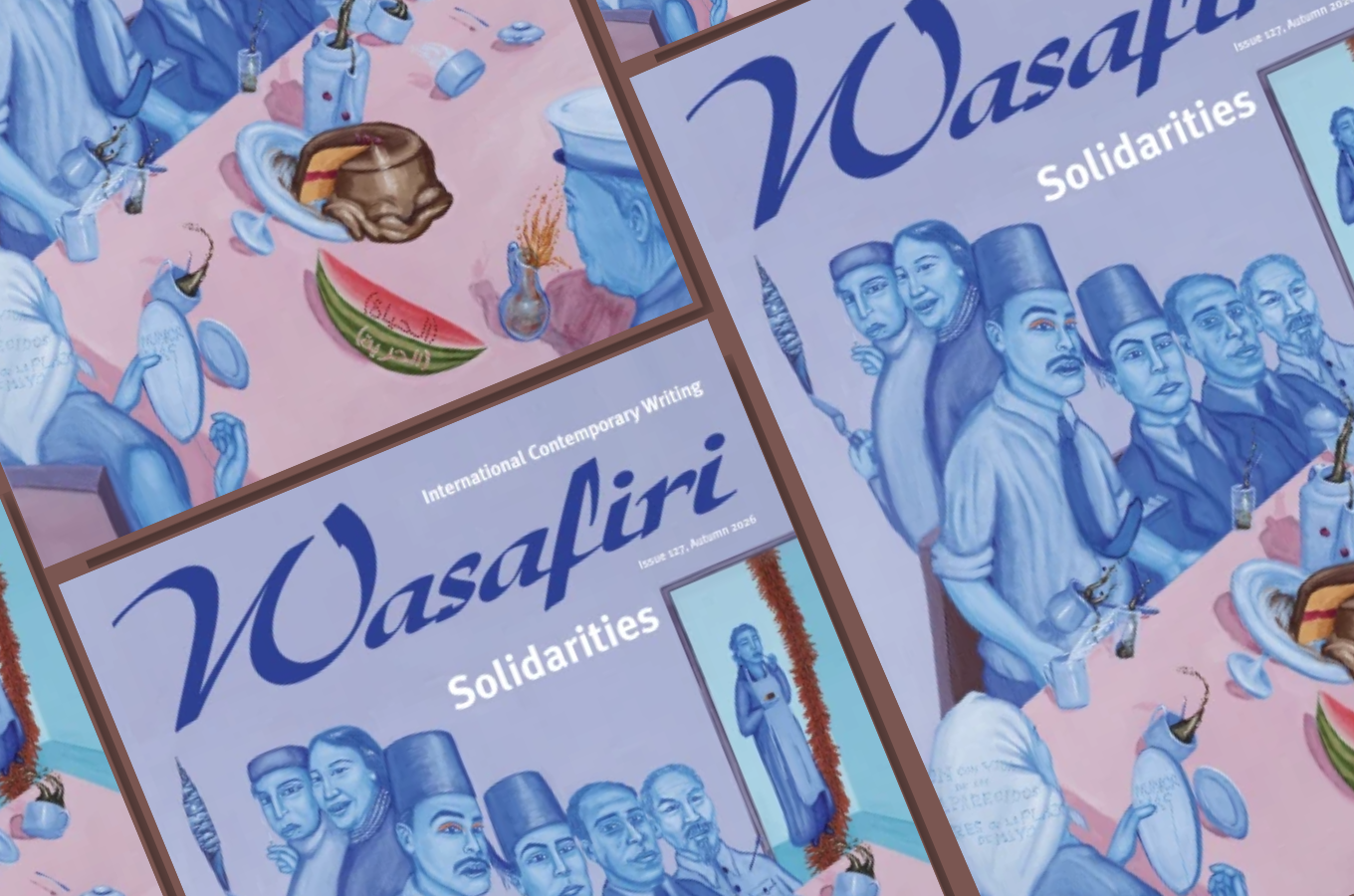
Wasafiri, the London-based magazine of international contemporary writing, has released its 127th issue, themed Solidarities. The autumn 2026 issue takes on one of the most urgent questions of the present moment: what shapes do solidarities take in these strange times we are living in, and how can they be found and forged when faced with genocides, human rights violations, and daily injustice? At its center is a further question about literature’s own capacity for action, whether storytelling itself can play a role in liberation.
The issue opens with an editorial from Sana Goyal, Wasafiri’s Editor and Publishing Director, titled “Awaiting the Next Time.” Goyal frames the issue around Max Porter’s 2026 PEN Lecture, “Peace,” a piece composed almost entirely of unanswered questions about complicity and failed solidarity in an age of militarism and genocide, questions Goyal extends into her own editorial reflection on editing this issue, describing being moved between grief and something closer to hope, a “tingling feeling” she borrows from contributor Lola Olufemi’s own writing on what solidaristic action can feel like from the inside.
The issue gathers work from a formidable lineup of thinkers and creatives, including Tareq Baconi, Jay Bernard, Safia Elhillo, Saleem Haddad, Lola Olufemi, and Joe Sacco, each approaching solidarity from distinct positionalities and perspectives. Safia Elhillo, Wasafiri’s inaugural International Writer in Residence, opens the issue’s main section with the lead feature “Psychogeography,” while Lola Olufemi contributes a standout article examining a 2016 Black Lives Matter UK airport runway protest as a form of literature in its own right, what she calls “the grammar of ungovernability.” Elsewhere, readers will find interviews with major writers including Daniela Catrileo, Isabella Hammad, and Mirza Waheed, the latter two in conversation about Palestine, Kashmir, and the shared foundational violence of 1947–1948, alongside poetry, life writing, and fiction that moves through student encampments, displaced universities, protest archives, and dissident publishing cultures.
The issue also carries new research into the histories and legacies of Palestinian and Black resistance in the UK, and features cover art by Arab Jewish painter Massoud Hayoun, whose 2025 work “General Strike” anchors the issue’s visual identity, accompanied by an interview conducted by Deputy Editor Vamika Sinha. Rounding out the issue is Gavin Herbertson’s 2025 Wasafiri Essay Prize-winning paper on Derek Walcott, along with a wide sweep of criticism and reviews covering work by Dalit, Maori, Kashmiri, and Kurdish writers.
Wasafiri 127: Solidarities is available now via the Wasafiri shop.





COMMENTS -
Reader Interactions