

The alarm glowed 3:30 am, in pale red digits. Abdullah’s hand found the silence button before the first electronic chirp could fracture the silence of the room. He sat at the edge of the mattress, feet flat on the worn wool rug, its fibers coarse and familiar against his soles. The remnants of sleep hung in the air, stale, warm, intertwining with the clean ghost of the sandalwood incense he’d burned after Isha. He took a deep breath and released his shoulders.
“Alhamdulillah ahyana ba’da ma amatana wa ilayhin nushur.” Praise be to Allah Who has given us life after He caused us to die and to Him is resurrection.
A whisper, a private vibration. Gratitude for a spine that uncurled without any pain, for a heart that continued its steady, uninterrupted thumping, for the Soul God had returned to its temporary housing.
He rose and the floorboards acknowledged him with a single, low creak, the sound immediately swallowed by the hush of the house. In the bathroom, cold water from the tap bit his fingertips then his face. Three rinses of the mouth, the nose. The splash against his closed eyes sent a small shock through his skull, rinsing away the last cobwebs of a dream he couldn’t recall. He ran wet fingers through his beard and caught his own reflection – a shadowed face, eyes still adjusting, a man in his late thirties who looked simultaneously younger and older in the dim light.
Back in the bedroom, he shook out the prayer mat. He stood at its edge, made his intention for Tahajjud, then raised his hands to his earlobes, “Allahu Akbar.” The words were a keel, and his body a hull. With those words, the room expanded and made space for something sacred. He recited Al-Fatiha, The Opening, and the familiar verse flowed through him like a current. He bent at the waist, spine straight, fingers pressing just above the knees, the stretch pulling at the hamstrings.
“Subhanna Rabbiyal Adheem.” Glory is to my Lord, The Most Great. Down to prostration – forehead and nose to the mat, the smell of wool filling his senses, the hard floor a stern comfort against his knees. The world fell away and left only a rectangle of woven fabric and the space between his whispered supplications.
After the prayer, he remained seated. The room, which had felt vast during prayer, now drew in close. His hands rose again, palms upward, cupped like a man expecting to catch rainwater. His voice thinned to a near-inaudible thread.
“Ya Rabb, grant me a companion. With whom to share this path.” Tears flowed at the request, welling at the inner corner of his eyes, tracing a warm, slow path through the remnants of wudu water. “Ya Rabb, I long for my Naseeb, the one whose name has been written alongside mine.” The darkness in the room a held breath. “Insha’Allah Ameen.”
Outside, the Johannesburg winter had painted the street with a thin, crystalline frost that clung to parked cars and turned the asphalt to a muted silver. The air bit at the exposed skin of his face and hands, a dry, penetrating cold that smelled of dust and distant veld fires. No traffic. No voices. Only the hollow, rhythmic crunch of his own footsteps on the grit-dusted pavement.
Then, from somewhere beyond the dark silhouette of the jacaranda trees, the adhan began. A man’s voice, weathered and unhurried, climbing the minaret of sound.
“Allahu Akbar, Allahu Akbar.” The words rolled across the sleeping suburb, a call without urgency, certain of its audience.
“Allahu Akbar. Allahu Akbar,” Abdullah’s lips moved, whispering the response, his breath forming small, transient clouds.
“Hayya ‘alas Salah.” Come to prayer, the voice beckoned.
He walked toward the voice, his steps falling into its rhythm, the cold a thing forgotten.
The masjid’s wudu area was a symphony of small, watery sounds: the hiss of taps, the splash of water against porcelain basins, the wet slap of a foot being dried. The air was humid and warm, steeped in the smell of damp concrete and cheap rose-scented soap. The benches were crowded. Abdullah found a single space between a young man scrolling through his phone, his thumbs a blur of silent motion, and an older man with a beard the color of smoked salt. The old man’s hands moved slowly, methodically washing forearms up to the elbows, his gaze fixed on the water’s path as if reading a holy text in its flow.
Abdullah offered a quiet salaam and sat. As he removed his socks, he felt the older man’s eyes on him, the kind of calm unhurried attention of someone who learned to read men’s souls by the way they moved. Abdullah completed his wudu, the old man inclined his head, a gesture as slight and deliberate as a turning page.
“May Allah accept,” he said.
“And from you,” Abdullah replied.
Inside the mosque, the men stood shoulder to shoulder. The imam’s recitation of Surah Qaf was plain, each word placed with careful precision, without the honeyed self-conscious melody of a performer. Abdullah closed his eyes and let the stark, unadorned truth of the verses settle in his chest.
***
The cafe’s roller shutter was a cold, corrugated beast. When Abdullah said, “Bismillah,” and heaved it upward, it rattled and shrieked, a metallic complaint that echoed down the narrow side street. The shop exhaled the stale breath of yesterday, a layered scent of finely ground Ethiopian coffee, the sweet, earthy ghost of cardamom pods crushed for the day’s first pot, and the faint, waxy aroma of old wood warmed by a dozen bodies that had long since departed. A singular, poignant note of burnt sugar hung in the air, a small failure from a rushed afternoon brew.
He flicked the switch, and the fluorescent lights hummed to life. His hand, moving on its own, wiped the already-clean counter with a damp cloth. The muscle memory of the gesture was older than the business itself, a ritual learned in the cramped kitchen of his late mother, where a clean surface meant a clear mind.
The cafe itself was an accumulation of a decade of invisible labour, savings diverted from new clothes and holidays, sleepless nights spent renegotiating a lease, the stubborn, quiet refusal to let the first three, profitless years have the final say. Success, he’d learned did not arrive with a trumpet blast but settled like the fine Johannesburg dust, silent and inexorable, until one day you looked around and saw it had covered everything.
His staff arrived, a small, synchronised ballet. Fatima, her hijab pinned with a practical swiftness, started the espresso machine, its first, deep groan filling the room. Sipho, his face still puffy with sleep, began arranging the pastries under the glass dome, the tongs clicking a steady, percussive beat.
The milk steamer hissed its high-pitched song, cutting through the low murmur of the early morning when the first customer came. Pushed through the door with the bell’s cheerful jangle, Mr Patel, newspaper tucked under his arm, announced, “The usual, Abdullah.”
The morning rush had receded, leaving behind a litter of empty cups and scattered crumbs, when the bell rang again. A single, decisive note. The old man from the masjid stepped inside, pushing the door with a flat palm, his movements unhurried. He stepped in as if he were crossing a familiar threshold, his eyes already finding Abdullah behind the counter. He wore a heavy wool coat.
“Assalamu ‘alykum,” he said, his voice carrying easily in the near-empty space.
“Wa alaykums salaam wa rahmutallahi wa barakatuh,” Abdullah replied, the extended greeting a reflex from a joy he didn’t quite understand.
The man, whose name he’d soon learn was Yusuf, studied the chalkboard menu with a mild, patient curiosity, as if the offer of “Flat White” and “Rooibos Latte” was a slightly amusing riddle. Then he looked at Abdullah and smiled, the skin around his eyes crinkling into a map of decades. “Coffee, please. Black, no sugar.”
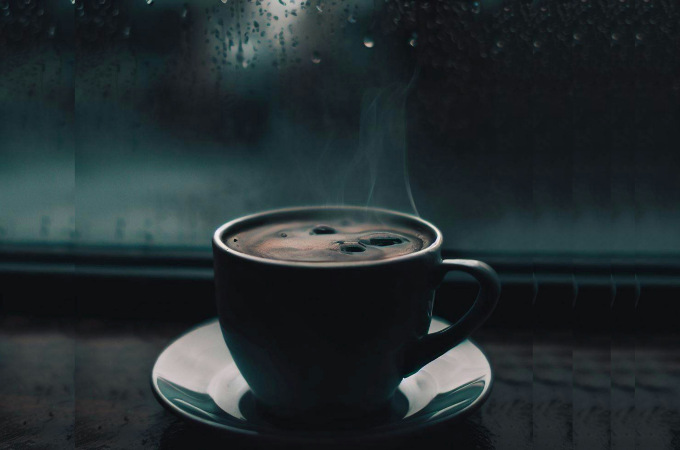
Abdullah nodded and turned to the machine. The portafilter heavy and cold in his hand. He tamped the grind with a precise, practiced pressure, feeling slight resistance through his wrist. The shot pulled slowly, a dark, molasses-thick cream that smelled sharply of dark chocolate and earth. As he placed the small cup on the counter, he felt the weight of Yusuf’s attention again. It was a discerning, tactile presence, as if the old man could measure the quality of the coffee, and the man who made it, by the sound of the cup meeting the saucer.
“You open early,” Yusuf observed.
“Barakah is in the morning,” Abdullah responded with a one-sided smile.
Yusuf grunted, “And exhaustion, don’t forget the exhaustion.” He lifted the cup, inhaled the steam with a slow, reverent breath, and took a sip. He swallowed without a wince, and gave a single, declarative nod. “This is honest work.”
This became the architecture of their days. Yusuf would arrive after the morning tide had ebbed, always alone. He’d claim the corner table by the window, the one where the morning light cut a sharp, golden parallelogram across the dark wood. He’d cradle the cup in both hands, his gaze resting on the street outside or on a middle distance that seemed visible only to him. He never looked at his phone, never fidgeted. His stillness was a powerful, gravitational force. Some days, they spoke. Other days, Yusuf would simply sit for an hour, a solitary, dignified island in the quiet hum of the cafe, and then leave with a Salaam. Abdullah learned to read the silence, to distinguish the full quiet of contentment from the heavier quiet of a man chewing on a difficult memory.
One Tuesday, the steam wand’s shriek had just faded when Yusuf asked, “Do you enjoy this?”
Abdullah paused, a jug of milk in his hand, its coldness seeping into his palm. “The coffee-making?”
“The owning,” Yusuf said. “The responsibility, the weight of it all.”
Abdullah put the jug down. He considered the question.
“I enjoy building a thing that’s clear,” he finally said. “If I neglect it, it retaliates. A drop in quality, and the regulars’ eyes sharpen. If I care for it, it grows. The machine is indifferent, the beans offer no excuses, it’s all brutally honest.”
Yusuf’s eyes, a deep, sedimentary brown, held his own. “That’s as good an answer as any,” he said. “You seem to have made peace with a very difficult friend.”
A week later, Yusuf asked the question that had been floating, unspoken, in the steam of every cup.
“Are you married, Abdullah?”
“No.” The response came quick. A raw, single-syllable confession.
“Why not?” Yusuf’s tone was devoid of judgement.
Abdullah leaned against the counter, his arms crossing over his chest. “I told myself the lie for years. That I wasn’t ready financially, then emotionally, then spiritually. I had to be a finished man before I could be a partner. A complete individual project before joining the greater project.”
“And now?”
“Now I see that ‘ready’ is a fantasy.” He looked at his own hands, the fine lines of dry skin, the callus on his index from tamping. “You take a step and everything else follows.”
Yusuf set his cup down. The small clink a punctuation. A profound, weary sadness softened his features, a gentle settling. “That realisation,” he said, “for most people, arrives when the time to act is long gone. It’s a good answer.”
Months folded together like fabric. Their conversations turned inward, charting the unseen territory of faith as a lived, bleeding, doubting, returning thing. They spoke of the sour taste of a missed Fajr, the dry-mouthed desperation of a prayer made in the turbulence of a plane, the secret, venomous arrogance of feeling spiritually superior to another. They talked of disappointment, the specific cold anger of being let down by a scholar who preached charity while cheating his brother.
One afternoon, a storm had emptied the streets, and the cafe was a dry, warmly-lit capsule in a world of rushing water. The rain hammered the windows in thick, gelatinous drops. Yusuf had let his coffee go cold. He stared into its black surface as if it were a scrying mirror.
“I had a wife,” he said, his voice rougher than usual, stripped of its polished calm. “She died from a fever. She was okay in the morning, scolding me about my socks, by Asr…” He didn’t finish. The silence was filled by the drumming rain.
“Inna lillahi wa inna ilayhi raji’un,” Abdullah whispered. Verily to Allah we belong and unto Allah do we return, the words a fragile boat on a suddenly dark ocean.
“May Allah ease your grief.”
“The grief is proof she was real.” Yusuf continues, “The other proof is our daughter, Safiyyah. I raised her alone. Can you imagine the gaps? The failures? I failed her in a thousand invisible ways. But the grief did not embitter me. A bitter father is a poison.” He looked up, and his eyes were full of a fierce, unsentimental love. “She is strong, a blade forged by my clumsy hands, sharpened by her mother’s absent spirit. She has my stubbornness, unfortunately. But it is tempered with a kindness that is entirely her own.”
After that, his visits became sporadic. The weekly rhythm faltered. When he came, he was visibly diminished. The heavy wool coat now hung on his frame with a new, loose resignation. His hands, steady for so long, now had a fine, constant tremor. His eyes, though, remained the same – clear, deep and utterly at peace.
Then weeks passed. The corner table by the window remained empty. The golden parallelogram of light lay across the dark wood, uninterrupted. The absence in the cafe was a physical weight, a missing note in a familiar chord.
A man Abdullah did not recognise pushed through the door, bringing with him a swirl of cold, dry air. He was stocky, with the same deep-set eyes as Yusuf, but a harder jaw. He walked directly to the counter.
“Assalamu ‘alaykum, you are Abdullah?”
“Wa alaylumus salaam, yes.” His heart was a tight fist.
“I am Khalid, Yusuf’s brother.” The man’s voice was a blunt instrument. “He didn’t wake from his sleep yesterday. It was as peaceful a transition as I could have hoped for him. His janazah was after Asr.”
Abdullah received the words without flinching, but the sound of the world around him dimmed, as if someone had thrown a thick blanket over the room.
“He was a good man,” Abdullah said, his voice emerging from a tight throat. “A teacher.”
Khalid nodded, a short, sharp gesture. “He spoke of you, more than anyone else. He said, ‘there’s a man on the corner who knows the weight of a cup of coffee.’ My brother always spoke in riddles but this was his finest one yet.” He chuckled and then paused, his gaze raking over Abdullah’s face. “He wanted you to meet his daughter but didn’t want to impose. I’ll ask her for you. It’s up to her.”
Abdullah felt the air leave his lungs. A single, hot tear betrayed him, sliding down his cheek and into the corner of his mouth. Khalid reached across the counter and tapped his shoulder, a firm, grounding pressure.
“Don’t be so shocked. My brother was a quiet man but he was never wrong about people. He said a good man like you shouldn’t be alone. ‘Good men are for good women,’ he’d quote. But again, it’s up to her.”
“Subhanallah.” The word was a breath, a sob, a complete prayer.
***
The nikkah was small, held in a quiet room. Abdullah stood, his spine a rod of nervous, joyous steel, his palms damp. He wore his best white thobe, the fabric crisp and cool against his skin.
When Safiyyah entered, the room filled with a new, charged presence. She was tall, her posture a straight, unapologetic line reminiscent of her father. Her eyes, the same deep brown, scanned the room with a quiet, analytical composure, assessing, registering, understanding. She saw him and a small, almost imperceptible nod was her greeting, a gesture so purely Yusuf that Abdullah’s heart ached and swelled simultaneously. This was the most serious trust he had ever been given.
Weeks after the wedding, the cafe was closed and the chairs upturned on the tables. The only light was the amber glow from the street. Safiyyah sat on a stool by the counter, her hands folded around a cup of rooibos tea, the sweet, woody scent mingling with the residual coffee aroma of the room. Abdullah stood across from her and placed a small, steaming cup on the counter, in front of an empty stool. Black. No sugar.



COMMENTS -
Reader Interactions