

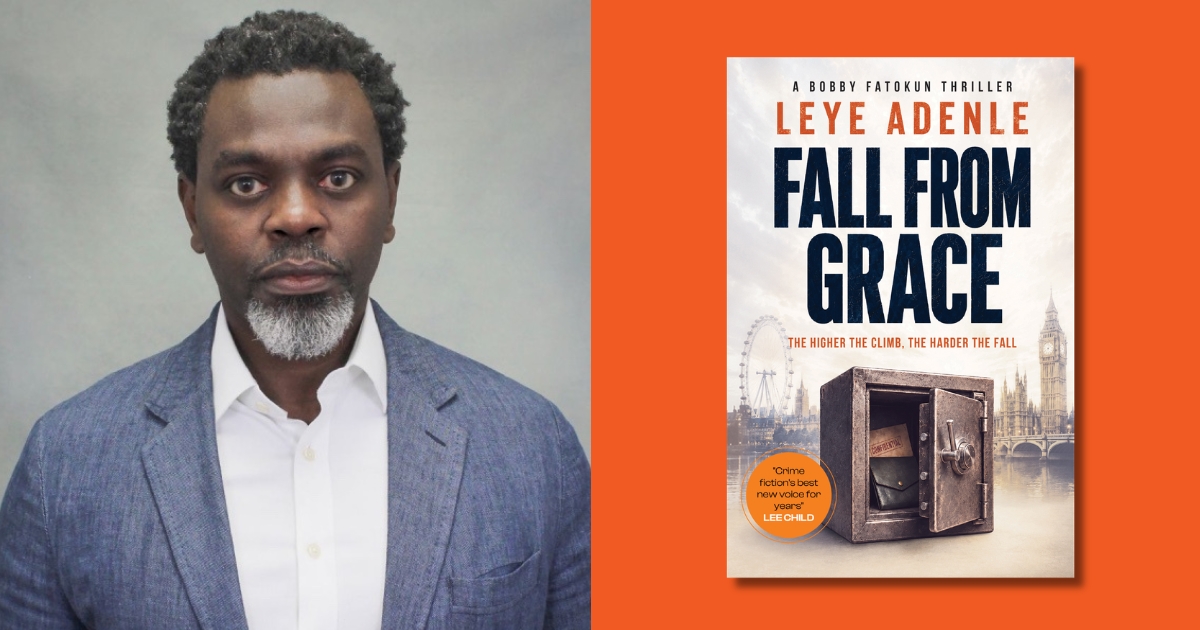
Plot twists, high stakes, suspicious deaths and the thrill of uncovering a crime are what readers come to crime thrillers for. But when we think about the genre, America and Britain are often the first places that come to mind. Nigeria rarely is. Yet crime thrillers have been steadily rising in the African literary scene, with writers like Leye Adenle showing that the genre can be just as compelling when its stories are rooted in African realities.
There are many things that work in American and British crime thrillers that make their stories feel immediately possible. This has often raised the question of whether the genre can work in Nigeria, where the institutions, systems and realities that crime fiction relies on can look very different. But writers are writing these stories, and readers are embracing them. Adenle, who is known for his crime thrillers, is part of a growing literary conversation about what the genre can look like when it is written from an African perspective. In his latest crime thriller, Fall From Grace, Adenle follows Bobby Fatokun, a former police officer turned ‘Bad Coach’ who now reforms corrupt officers within the Met.
When a client asks for an urgent meeting and then turns up dead, Bobby suspects there is more to the death than an accident. His investigation leads him to a church where the victim had been working undercover and eventually into a conspiracy involving a wealthy pastor and a powerful enemy at the heart of the British Establishment, one that will stop at nothing to neutralise the threat.
In this conversation, we talk about writing crime thrillers, what makes a Nigerian crime thriller believable, and how much reality a writer can bend to make a story work. Adenle also discusses what led to Fall From Grace and what the novel has to say about power, institutions, religion and wealth.
Brittle Paper
What was the thread that started Fall From Grace for you? What was the thing that clicked and made you know this was a story you wanted to tell?
Leye Adenle
I needed to start writing again after a painful experience had made the very act of writing unbearable. I also needed a new series, as writing Amaka had become too painful. So, one late afternoon, I took myself on an artist date to Battersea Park with one mission: let the new book come to you. It did.
By the end of my meandering walk through the park, I had the protagonist, the twist, and the title, Hallelujah, which was later dropped for the far better one, Fall from Grace. What clicked? Bobby Fatokun. I even sketched him out later that night and also jotted down his bio. I stole his name from a childhood friend who’s also a coach.
Brittle Paper
In Fall From Grace, what did you want to say about the intersection of power, religion and wealth, and how they can protect people from the law?
Leye Adenle
I wanted to entertain. I wanted to tell a gripping story that earned the time invested by the reader. I wanted to write something new, something fresh, something funny, and most of all, something entertaining. What do I have to say about power, religion, wealth, and the institutions that prop them up? Nothing that has not been said: those who seek power mean to do harm.
Brittle Paper
You’ve written crime fiction around Nigeria before, but Fall From Grace is set within a very different policing and institutional landscape. When you move between Nigerian and British settings, how do you adjust the rules of the crime thriller? What does the setting make possible or impossible for your detective and your plot?
Leye Adenle
I think the rules of a good thriller are the same everywhere: enjoyable characters, believable plots, relatable dilemmas, and inevitable denouements that still shock, surprise, and astonish. The rules are universal, so I didn’t need to adapt other than equipping my characters with jackets for the cold.
Brittle Paper
Crime thrillers come with a lot of conventions that readers have learned from American and British fiction: the relationship between detectives and the police, access to forensic evidence, how quickly investigations move, and what the police can realistically do. How do you localise those conventions when writing a Nigerian crime thriller, where some of those systems simply don’t work in the same way?
Leye Adenle
I sidestep that problem by not attempting to write police procedurals. I find people fascinating, so I write about people: their foibles, their biases, the things they hide about themselves, the faces they show to the public, what drives them, how far they would go, and the lines they won’t cross.
I also treat institutions and cities like characters. In my mind, the Nigerian Police Force is a no-nonsense bureaucracy with a licence to kill. The Met is a gentlemanly brute that smiles until it smashes. This guides my writing. Of course, both the NPF and the Met are filled with highly capable, highly dedicated people who genuinely want to serve their nations in uniform.
Brittle Paper
There’s an interesting tension in Nigerian crime fiction between realism and the reader’s willingness to suspend disbelief. How much does a crime writer have to bend reality to make a thriller work, and where do you draw the line between creative licence and losing the Nigerian reader’s trust?
Leye Adenle
Nigerians are very sophisticated readers, and that’s a good thing for an author. I write for readers, and when I write crime thrillers, I write them for readers of crime thrillers. Crime readers are like Nigerian readers – they can spot an inconsistency from a mile away. It’s the best audience to write for. They keep you honest in your fabrications.
Brittle Paper
A lot of crime fiction is ultimately about a society revealing what it is willing to hide: corruption, class, institutional failure, religion, and political power. What do you think is uniquely fertile about Nigeria as a setting for crime stories, and what can a Nigerian crime thriller explore that an American or British one cannot?
Leye Adenle
When I started writing crime, I wanted to write about police brutality, thieving politicians, violence against women… But as I’m not American, I decided to set my first books in Lagos. My point is: people are people anywhere they are; crime is crime wherever it’s committed. Any good crime thriller can be adapted to any locale with clever substitutions.
To the question, ‘What can a Nigerian crime thriller explore that an American or British one cannot?’, I can’t think of one. Crime is crime. People are people. People do crime wherever they are.
Brittle Paper
You’re beginning a new private-investigator series with Bobby Fatokun. After writing the Amaka series, what have you learned about writing crime thrillers that you’re bringing into this new series, and what are you deliberately trying to do differently this time?
Leye Adenle
Get a good agent, and get a good agent. I have learned that while the typing is done at the desk, the writing is done everywhere else. I realise that staying at home 24/7, sitting at the desk totally immersed in the world I’m creating, might be productive, but to be phenomenal, what works for me is movement and living. I do something I call Directed Dreaming.
Whenever I need to figure something out – a plot point, a twist, a character’s motivation, a character’s speech, the next chapter – I do two things: First, I put a simple thought into my mind: ‘Who should discover the body?’ Then I accept the instruction that comes to me. I go for a walk. I cook jollof rice. I go see friends. I go to lie in the hammock. The solution always comes in the midst of doing whatever came after planting the thought.
The trick is not to try to figure it out: just plant the thought, wait for instructions – listen to what your body wants to do – and let your brain’s pattern recognition get to work without your conscious mind’s disruptive staring.
Brittle Paper
Thank you for speaking to me; this was an enlightening conversation.
Leye Adenle
Thank you.



Michael September 28, 2026 04:23
Enlightening, it was!