

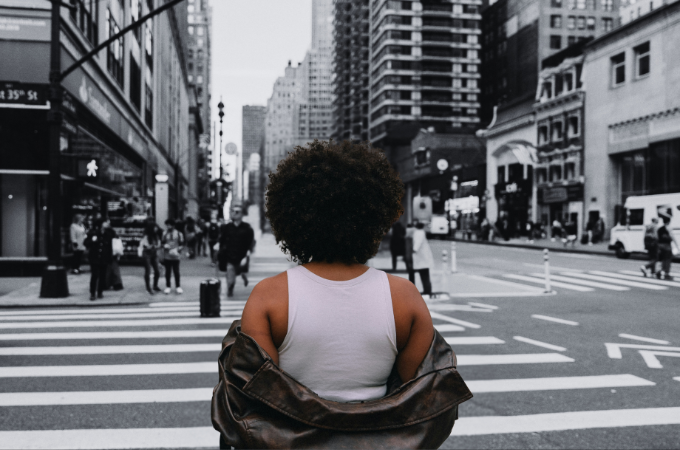
It’s the year 2000, a warm August day in Nairobi. Nani will become Black in the next 24 hours, she just doesn’t know it yet.
She stands in line, clutching her passport so tightly between her fingers that her thumb leaves a sweaty print. Jomo Kenyatta International Airport feels like the pits of hell she’s heard about in church sermons. Her shirt sleeve is damp from wiping beads of perspiration from her forehead.
Another announcement crackles through the intercom; she strains her ears, but the blur of people zooming past, the whirring of suitcase wheels, and the thud of footsteps blend the words into an indiscernible hum. She’s lost count of her breathing sequence. She presses her tongue against her teeth to stop them from chattering. Any minute now, her heart will explode out of her chest, she’s sure of it; or maybe push through her throat into her mouth and onto the floor.
It’s her first time traveling out of the country by herself, her first time on a plane, her first time away from her siblings. She turns to see their faces still pressed against the glass barrier that separates them. Her grandmother nods, a reassuring gesture. Nani can still feel the weight of Cũcũ’s hands on her shoulders as she prayed to the gods of the skies, asking them to steady the plane. She hopes the pilot’s grandmother did the same.
“Next!”
Nani is startled and hesitates for a moment before meeting the gaze of the woman at the counter. She drags her heavy feet past the yellow line, looking back to ensure her family is still there. She’s heard of people being denied entry onto planes and secretly hopes to be one of them. The woman has already pulled Nani’s passport from her sweaty palms; she flips through the pages, popping her gum as she shifts it from one side of her mouth to the other. She lifts the passport, and Nani is now certain her heart is about to land on this woman’s desk and splatter her with blood — that, or the person behind her is about to be in for a rude shock! All her orifices threaten to spill.
The woman, Maria, according to her badge, hands the passport back to Nani and shouts, “Next!”
Nani doesn’t move. It’s not that she doesn’t want to; something is wrong with her legs. The person behind her, a young man with almost yellow hair, edges closer and stands next to her. He gives her a half-smile, as if to say, ‘You’re in my spot.’ Maria’s gum chewing grows louder, one eyebrow raised, her long nails tapping on her desk. The young man picks up Nani’s suitcase and hands it to her, still holding that half-smile. The weight on her legs ease, and she starts shuffling, but pauses to look at her family one more time. In their place, though, are new faces pressed to the glass barrier, and salty tears run into her mouth.
The same guy catches up with her again, so she follows him through a door that leads to a windy tunnel. A whirring noise greets her, growing louder the further she goes. At the end, two women clad in body-hugging navy-blue uniforms, matching hair bands, and smiles, show her to her seat. One brings her tissues and water.
“First time flying?” she asks.
All Nani can do is nod as a hand rubs her shoulder, uttering something she’s sure is reassuring, but she doesn’t hear it.
The young man with the yellow hair settles in next to her. This time, he gives her a full smile. “Don’t be nervous,” he says. “I do this all the time, and you’ll get used to it.”
Announcements follow, along with safety instructions that Nani tries but fails to pay attention to. She tries to imagine her mother waiting for her at an airport in America, but she’d still rather be going back to her house in Nairobi with Cũcũ and her siblings. It’s not that she doesn’t want to see her mother, it’s just that no one ever asked her if she wanted to move to America. She was told she was going, sent to the visa office — where she was sure her application would be denied — and now here she is, sitting next to a chatty boy who’s offering her multi-colored snacks.
The plane is moving now, like a bus at first, and Nani has given up on trying to control anything that’s happening with her body. The boy keeps handing her tissues and chattering reassurances. Something strange is happening under the floor, and she’s thrust back into her seat. Her feet involuntarily press into the floor, trying to find gravity. She’s acutely aware that under this flimsy, shaky vessel lies nothingness, so she starts praying to the gods of the skies, and hopes it’s the same ones her grandmother prayed to before she left.
The boy with yellow hair takes her hand; she doesn’t resist. He’s asking her to breathe. Did he just say, ‘Open your eyes and look out the window?’ Her eyes squeeze shut even harder. Finally, her body comes forward in her seat, and the vessel stops shaking so much. She can still feel his hand holding hers, so she opens her eyes, one at first, and then the other. The boy is smiling and holding a bottle of water.
“Congratulations,” he says. “You survived your first ascent; you are officially a pro.”
She lets out a nervous laugh, then slowly pulls her hand from his. “Thanks,” is all she can manage.
“I’m Eric, by the way.”
“Nani,” she responds. “Nice to meet you.”
They are flying above the clouds, and this unnerves Nani, so she pulls the window shutter down. Eric seems disappointed but doesn’t say anything.
“So, what’s your final destination?” he asks.
She tries to hide her exasperation; how can she not engage him in conversation after he’s held her hand and offered snacks?
“Philadelphia,” she says proudly. She practiced saying it several times and is happy with the way it rolls off her tongue.
“Philly?” he repeats excitedly.
So much for practicing the pronunciation. “Yeah, Philly,” she responds.
“Mine is New Jersey,” he says without Nani asking.
Her body seems to have sorted itself out, and she now realizes she hasn’t eaten for a few hours. The sight of a snack trolley wheeling down the aisle is much welcome.
It’s an eight-hour flight to Amsterdam, so she decides to indulge her new friend.
“So, what were you doing in Kenya?” she asks.
While sharing packets of chips and cans of soda, she learns that, just like her, Eric just finished high school last year, is on something called a gap year, and is traveling the world. While cruising over Egypt, they talk about the mixed emotions of finishing high school, of saying goodbye to friends, of parental expectations, and the fear of becoming adults with no blueprint. They laugh over their love for The Fresh Prince of Bel-Air, Friends, Backstreet Boys, and Boyz II Men.
Somewhere over Croatia, they play a game of cards. Nani has forgotten they are flying, and a few hours later, she’s once again spooked when the plane starts to descend. Eric holds her hand, but this time, she keeps her eyes open and even pulls the window shutter up for just a minute, only to close it again.
“Baby steps,” Eric says, giving her hand a squeeze.
Four hours in Amsterdam fly by as they walk around the shops, watch flights landing and taking off, and even take a nap on the sofas. Nani, too engrossed in this vibrant new environment, barely registers the slight widening of eyes, or the way a shopkeeper’s smile falters for a split second before brightening at the sight of Eric. In one boutique, as Eric browses a display of scarves, a sales assistant immediately approaches him with a warm, “Can I help you find anything, sir?” while completely ignoring her presence.
The take-off from Amsterdam is less traumatic. Nani’s feet feel funny, but she knows it will not last. And when they descend into New Jersey, she leaves the window open as Eric points out landmarks.
They deplane in New Jersey, where they will part ways. The air here is thicker, lights brighter, and everything is louder.
“Don’t worry, I’ll be with you till customs,” he says to her when he notices her studying her last boarding pass. “This has been lovely,” he says.
“Yeah, it has,” she responds. “Thanks for not asking for another seat when you saw me crying.”
He smiles, then says, “You know, I never would have thought that I’d have so much in common with someone like you.”
A crease forms above her forehead, but they are moving fast now, and there’s no time to ask questions. The weight of that statement will only make sense later.
He explains that they have to go to the domestic terminal via a train. The marvels are coming too fast at Nani for her to ask why there’s a train inside an airport. When it pulls up, it’s smaller, and people sit facing each other. The doors open, and they are hit with a strong scent of cologne and aftershave. It’s eight o’clock in the morning, and five men in black suits are seated in the train reading newspapers (it’s the year 2000, remember?). Nani is suddenly aware that she hasn’t taken a shower in over 20 hours, and a sneaky sniff of her armpit confirms this. Eric misinterprets her discomfort.
He smiles at her, then casually asks, “How does it feel to be the only Black person in this train?”
For Nani, everything shifts into slow motion. She stares at her hand, lying next to Eric’s, then back at the men in the train, who are now staring at her. A reflection in the window shows her standing beside Eric, a stark contrast. His pale skin and golden hair, and all the men on the train, seem to perfectly blend into one another as the train zooms past. Yet there she stands, conspicuous, undeniably different. She looks at her hands again, the same ones Eric had held on her first terrifying flight, except now, they are Black. She looks back at Eric, studying him: his almost yellow hair, the same kind eyes, that familiar smile…
“Until you said so,” she utters, “it wasn’t on my mind.”
He doesn’t respond, but continues to talk about New Jersey, having opened a can and discarded the lid. The men tip their heads down again, and get lost in their newspapers… leaving Nani to reel in her new identity.
Kikuyu, yes. Kenyan, as decided by the borders the British drew when they were dividing up the continent like a pie, yes. African, yes. But she had never been Black. Yet standing there, saying goodbye to Eric as she’s about to go through customs, she is very aware that the hands that hug him are Black, the ones that hand her papers to the immigration officer are Black, and each day from then on, another part of her becomes Black. Each form she fills demands that she claim a race.
White
Black
Hispanic
Other
And one day, after a shower, she stands in front of the mirror and studies her body. Every part of her has become Black. It’s in the way the police pull her over when she drives through certain neighbourhoods. It’s in the way that she is followed at stores or ignored at others. In the way a colleague so casually tells her that she didn’t know that ‘Black people read newspapers.’ She knows it in the way the wind zaps the moisture out of her skin when winter descends. Just like her move to America, the Black identity has been given to her without her asking for it, and her Blackness will be the first thing to walk into the spaces she will occupy from then on.
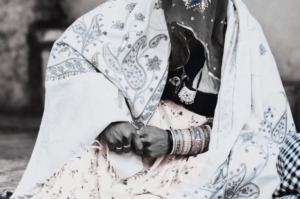
Photo by Georgi Kalaydzhiev on Unsplash




COMMENTS -
Reader Interactions