

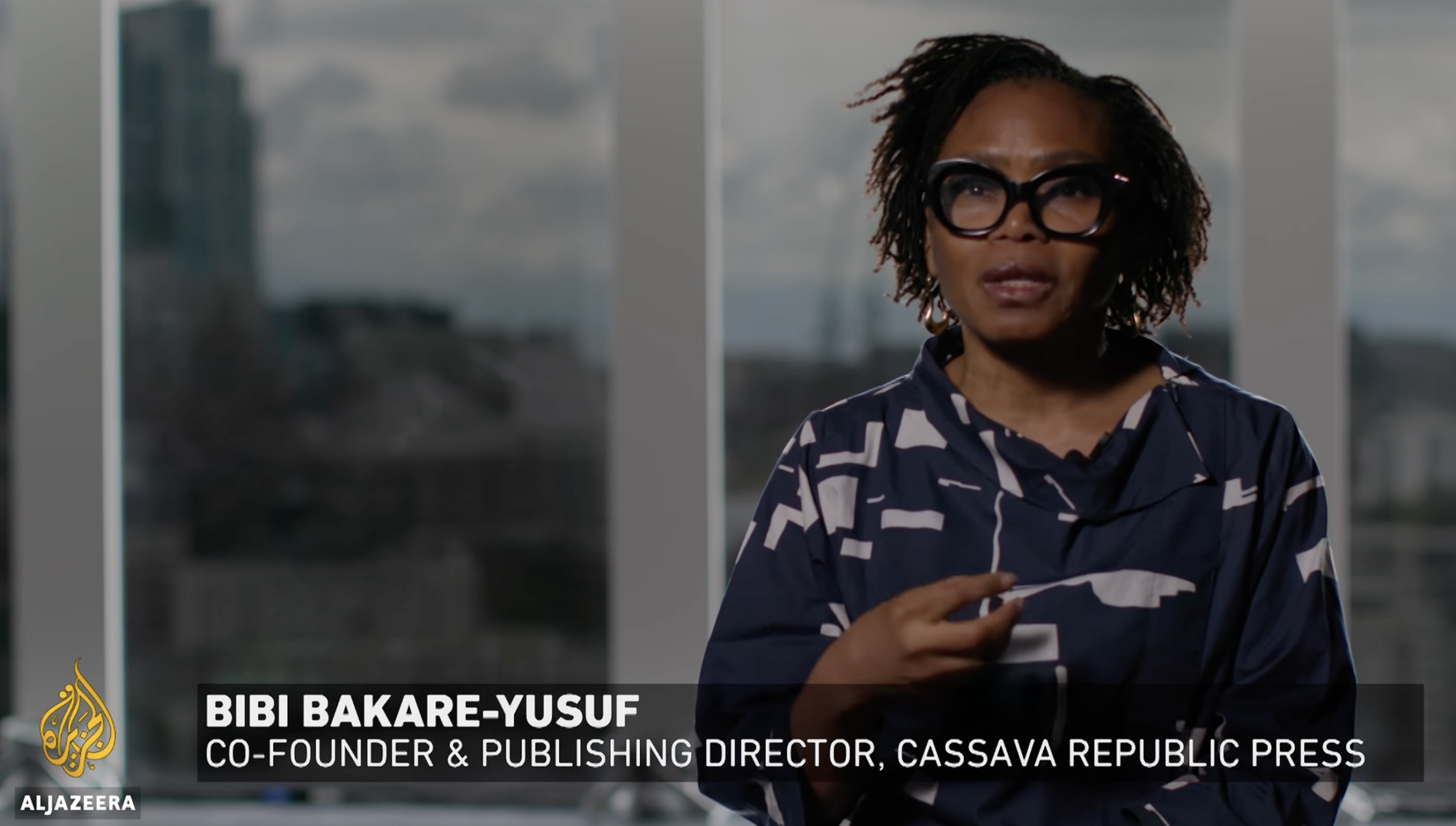
Al Jazeera has released a feature documenting two decades of Cassava Republic Press, the Nigerian publishing house that’s spent 20 years arguing against one of the industry’s most persistent assumptions: that African books don’t sell. Cassava shared the feature on Instagram, writing that the press “began with a simple belief: African writers deserve the space to tell their own stories, and those stories deserve readers everywhere,” and that the belief still guides every book it publishes.
Cassava Republic co-founder Bibi Bakare-Yusuf opens the feature recalling the skepticism she faced starting the press in Abuja in 2006. “People were mistaking the lack of infrastructure for the absence of desire,” she says, describing the idea that Black literature has no market as a “very dangerous idea.” Twenty years on, with Cassava titles circulating on international bestseller lists, prize shortlists, and festival programs, Bakare-Yusuf frames that growth as proof of concept, but insists visibility alone was never the goal. For her, the deeper argument has always been about ownership: “it’s not enough to have African stories. We have to own the means of production, because whoever owns the means of production determines how that narrative is going to circulate in the world.”
The feature traces that argument back through publishing history, to Heinemann’s African Writers Series, the orange-spined imprint that introduced the world to Chinua Achebe, Ngũgĩ wa Thiong’o, and Buchi Emecheta starting in 1962. Bakare-Yusuf credits the series as foundational to Africa’s literary heritage, while noting its editorial and distribution decisions stayed firmly in European hands, what she calls an “orange ghetto” that, even as it opened doors, also entrenched certain stereotypes of the continent. Cassava’s founding, in her telling, answers a different brief: not a sympathetic outsider publisher, but what she describes as “a Black publisher with strategy.”
Novelist Chika Unigwe adds a complementary vantage point in the piece, speaking to how publishers’ preferences shape which African stories actually reach readers. She describes manuscripts rejected simply because a publisher already had a book from the same region or country, “even within the same country, we’re not a monolith,” she notes, and points to a persistent preference among international publishers for “legible” narratives of war and migration over the ordinary lives of middle-class Africans. Unigwe also speaks to what gets lost when writers are published without that cultural fluency, describing the particular freedom of working with an editor who doesn’t need the basics explained: “there’s nothing as good as being published by somebody who understands where you’re coming from.”
That infrastructure argument has had a very current proof point in Marcia Hutchinson’s The Mercy Step, one of Cassava’s most successful runs to date. The Bradford-set debut, following a precocious young girl’s childhood against a Windrush-era backdrop, made Cassava Republic the first African-owned, Black- and woman-led independent press to land on the Women’s Prize for Fiction shortlist in the award’s thirty-year history, before going on to win the Discover Prize at the 2026 British Book Awards. Hutchinson, who was awarded an MBE in 2010 for services to cultural diversity, has spent much of the year on tour with the novel, from Manchester to Brixton to Leeds, with reviewers repeatedly singling out Mercy’s voice as one of the year’s most arresting literary debuts, it even made it to Oprah Winfrey’s current reads!
The feature points to Abubakar Adam Ibrahim’s Season of Crimson Blossoms, a love story set in conservative northern Nigeria exploring desire, grief, and aging, as one marker of what Cassava’s catalogue has made possible, now considered one of the country’s most celebrated contemporary novels. But Bakare-Yusuf closes on a note of caution rather than celebration. Even as African and Black writers gain visibility, she points out, the infrastructure behind that visibility, the prizes, the major publishers, the festivals, still largely sits outside the continent, which risks pushing writers toward stories calibrated for acceptance by gatekeepers elsewhere. “Representation without control is nothing,” she says. “For as long as you don’t have the control of your own narrative, you are at the mercy of somebody else.”
Watch the full interview here.



COMMENTS -
Reader Interactions