

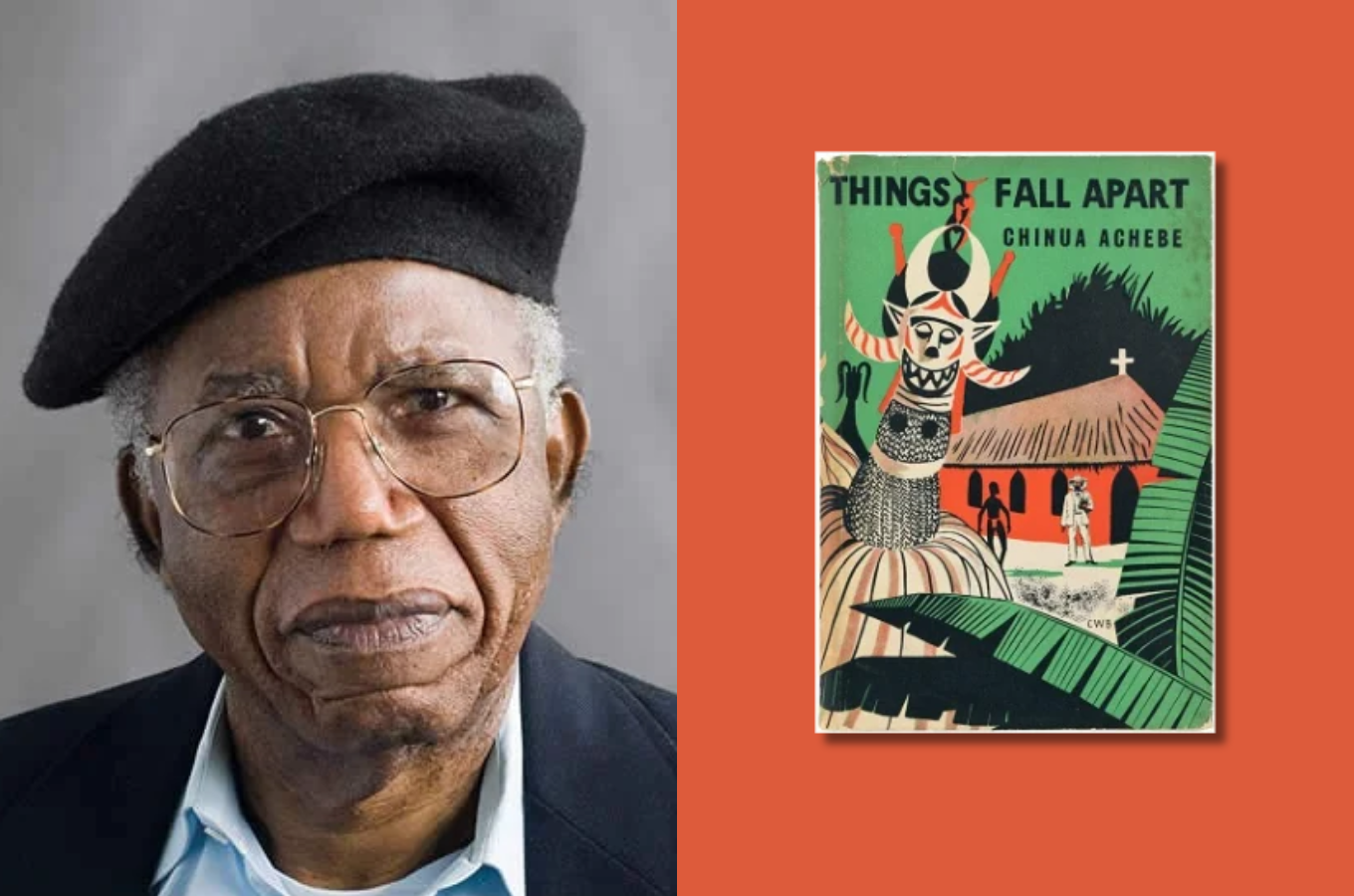
In April 2008, on the fiftieth anniversary of Things Fall Apart, the scholars David Chioni Moore and Analee Heath visited Chinua Achebe at his home on the Bard College campus. They brought along some twenty editions of the novel from its fifty-year publishing history and asked him to react to the covers one by one. The conversation, published in Transition100 (2008) by the Hutchins Center for African and African American Research at Harvard, is a rare record of how the author himself felt about the packaging of his most famous book, starting with the very first one.
That first cover, the green 1958 Heinemann jacket by the illustrator C.W. Bacon, shows a towering masked figure above a village scene, with a church cross in the distance and a white man in a pith helmet standing nearby. Achebe told his interviewers that he had no say in it. He was in Nigeria, Heinemann was in London, and he saw only the final proofs of the text, so the design was entirely the publisher’s idea. When he first saw it, he said, he found it striking, and the thrill of seeing his first book exist as a physical object outweighed any reservations. Looking at it fifty years later, he was more critical. He noted that the Black figure on the cover stands and dresses in a way that doesn’t match the people he knew, pointing to his own father, a convert and evangelist teacher, who would not have looked like that. He had never heard of Bacon.
Moore pressed him on whether the cover was racist. Achebe wouldn’t go that far, but he said it was exoticized, that the white and Black figures are not shown as equals, and that it was not neutral. He contrasted it with the 1959 American edition from McDowell, Obolensky, whose plain black cover carries the subtitle “The Story of a Strong Man,” which he preferred for its neutrality. He summed up his broader worry about how his generation was packaged, saying African writers have been “presented as oddities.” He also recalled that Heinemann nearly stopped after the first print run of 2,000 copies, and that the editor Alan Hill’s argument for a paperback led to the creation of the African Writers Series.
What surprised many readers of the interview is how little Achebe fought back. He said he wasn’t sure he had ever influenced the cover of any of his books, that publishers have their own sense of how to sell a book, and that he would not have had violent quarrels with them. Later in the conversation, discussing the mid-1980s Heinemann edition, he said he was neither involved with the marketers nor consulted, and added that he didn’t think he needed to be, because it was a matter of the market.
However, he plainly disliked the Fawcett Crest cover with its handgun and oil derrick and was delighted when Anchor Books replaced it. When Anchor showed him two options for the fiftieth-anniversary edition, he preferred the more dramatic one, but the publisher steered him toward the one she believed in, and he came around to agree with her. He also admitted that he hadn’t had an agent when he started out, couldn’t understand why now, and said that kind of protection is needed today.
The discussion is worth having in 2026. Many authors now expect to see cover options, approve them, or at least push back, and cover reveals have become small publicity events, which we know well from the excitement around Wole Talabi’s The Fist of Memory. Achebe’s acceptance can look strange, even a little painful, from this vantage point, especially when the covers in question exoticized the very culture his novel was written to explain from within. But it also reflects the conditions of 1958: a young radio producer in Nigeria, with no agent and no leverage, publishing in London. His closing answer in the interview looks ahead to 2058, when he hopes people will finally see Africans as people, nothing more and nothing less, and that words like exotic and primitive will be gone. So we’ll ask our readers: do you think writers today should have a say over their covers, and what would a cover for an African novel look like if it were designed without the “oddity” in mind?






COMMENTS -
Reader Interactions