

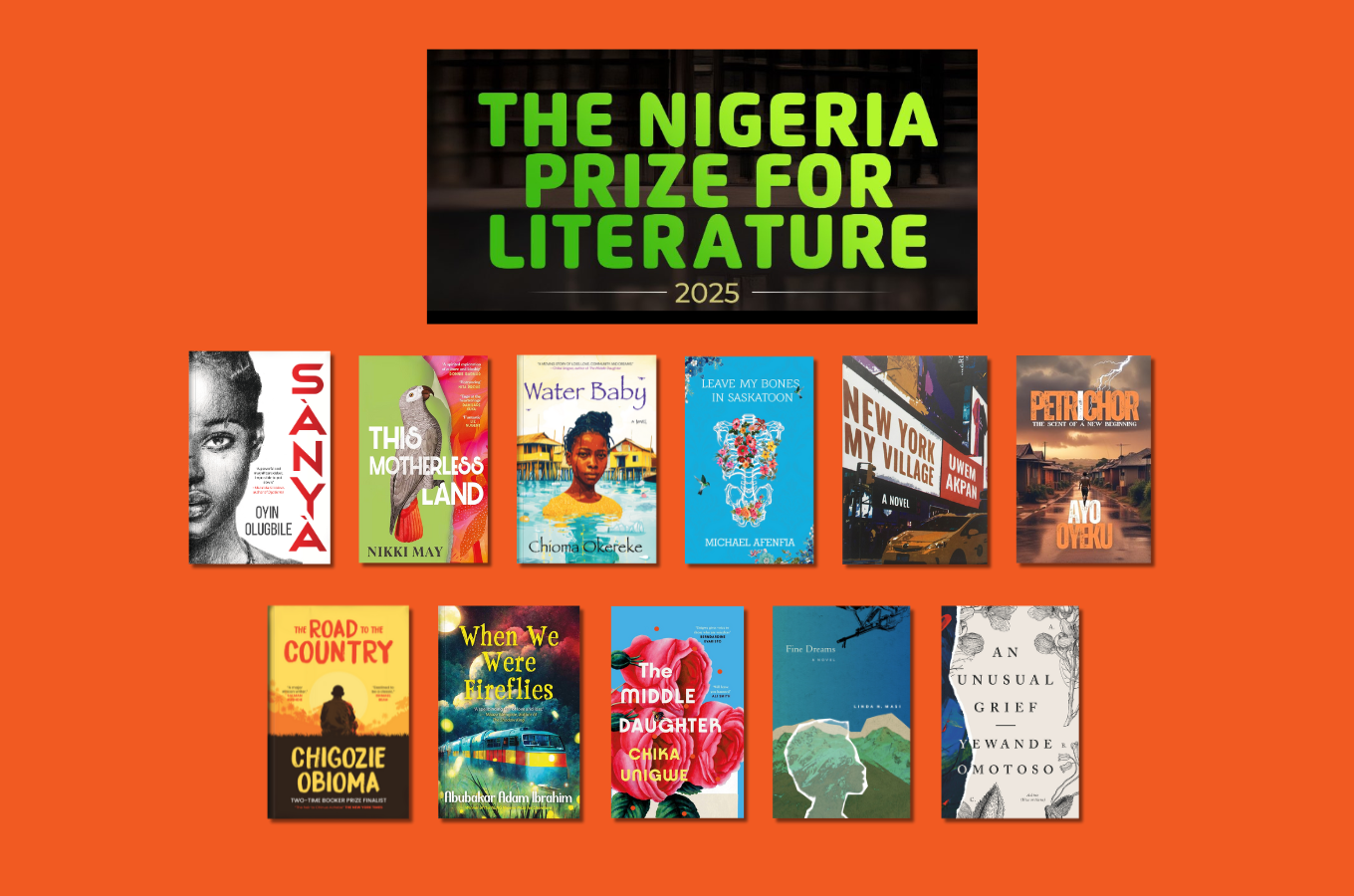
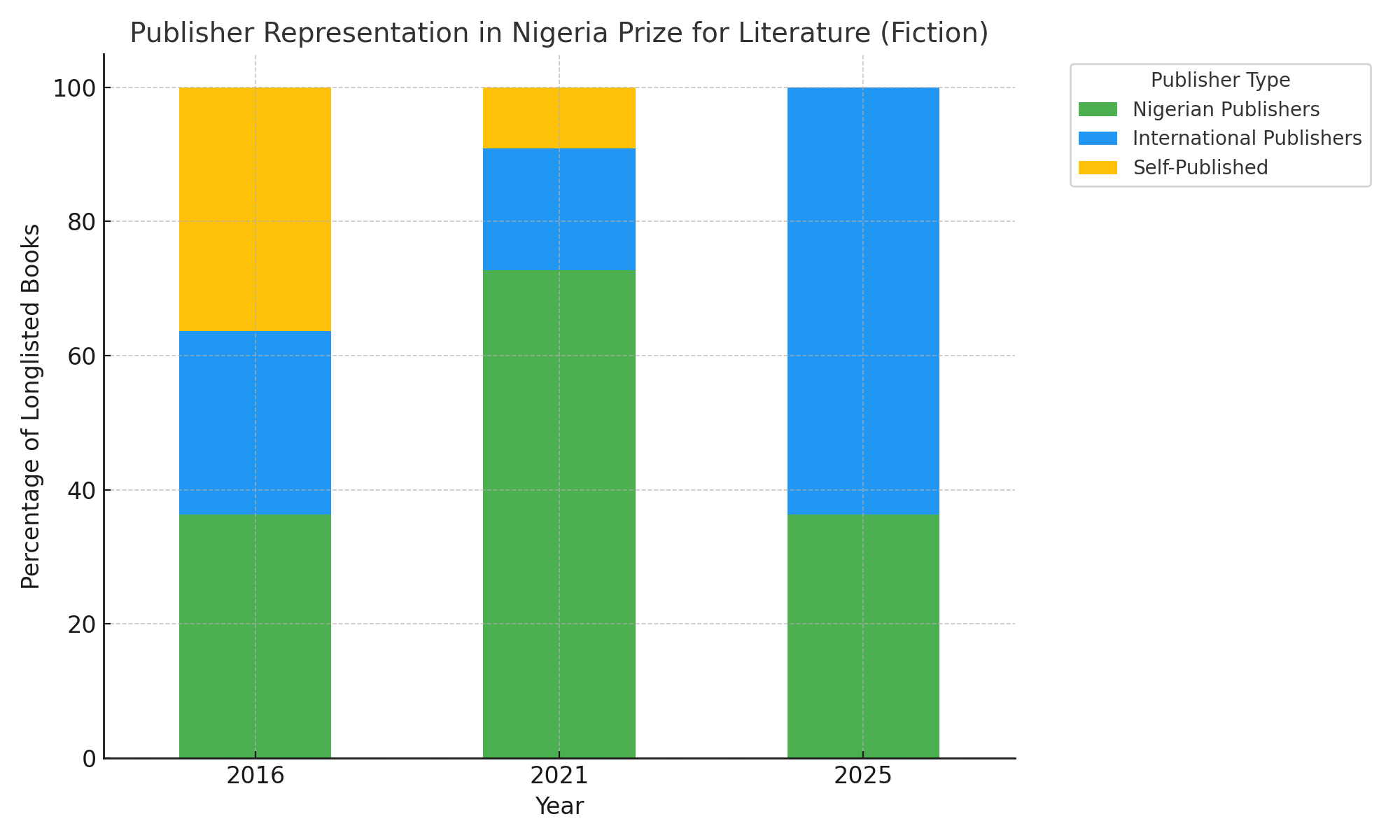
The Nigeria Prize for Literature is one of Africa’s richest literary prizes, with a $100,000 purse. This year’s longlist includes titles from prominent international publishers, with a significant share coming from major global imprints, including those under publishing giants like Penguin Random House and HarperCollins, as well as large independents. With seven titles (out of 11) published by presses based outside Nigeria, the 2025 longlist features the highest number of internationally published books in a fiction longlist since the prize launched in 2004. In this piece, we examine the implications of this shift by comparing it to the longlists from 2021 and 2016. This focus on 2021 and 2016 reflects the prize’s genre rotation since it alternates annually between fiction, poetry, drama, and children’s literature. These are the most recent comparable years for fiction.
On the surface, the 2025 longlist is strong and well-balanced. Out of 252 submissions, the 2025 judging panel, chaired by Dr. Saeedat Bola Aliyu, selected a mix of established authors and newer voices. Of the eleven authors, six are women and five are men. Thematically, the books range widely: from mourning and migration to spirituality and political violence. Familiar names like Chika Unigwe (The Middle Daughter), Chigozie Obioma (The Road to the Country), Yewande Omotosho (An Unusual Grief) and Abubakar Adam Ibrahim (When We Were Fireflies) appear alongside newer figures like Linda Masi (Fine Dreams) and Ayo Oyeku (Petrichor). The presence of returning winners like Unigwe and Ibrahim also points to the long game of literary excellence, writers who have held a strong, steady influence in the literary scene. The genre range is equally striking: Sanya and When We Were Fireflies lean into speculative fiction; Petrichor, New York, My Village, and The Road to the Country reimagine historical time; while This Motherless Land and The Middle Daughter are family dramas.
But a closer look reveals a shift in publishing patterns.
Seven of the eleven longlisted books were first published outside Nigeria in the US, UK, and Canada. These include:
Fine Dreams – Linda Masi (University of Massachusetts Press, US)
Leave My Bones in Saskatoon – Michael Afenfia (Griots Lounge, Canada)
New York, My Village – Uwem Akpan (W. W. Norton & Company, US)
The Middle Daughter – Chika Unigwe (Canongate, UK & Dzanc Books, US)
Water Baby – Chioma Okereke (Quercus, UK)
This Motherless Land – Nikki May (Mariner Books, US & Penguin Books, UK)
The Road to the Country – Chigozie Obioma (Hogarth Press, US & Hutchinson Heinemann, UK)
The remaining four books were published in Nigeria by local presses:
Petrichor – Ayo Oyeku (Eleventh House)
Sanya – Oyin Olugbile (Masobe Books)
When We Were Fireflies – Abubakar Adam Ibrahim (Masobe Books)
An Unusual Grief – Yewande Omotoso (Cassava Republic)
This is a clear reversal from earlier fiction cycles. In 2016, 4 longlisted books came from Nigerian publishers, 3 from international presses (Jonathan Cape, Interlink, and Penguin Canada), and 4 were self-published. In 2021, there were only 2 international titles, The Girl with the Louding Voice (Dutton, US) and The Son of the House (Dundurn, Canada). In 2025, that balance has flipped. Seven of the eleven longlisted titles were first published in the US, UK by major houses including Penguin, Mariner, Canongate, Hogarth, and W. W. Norton and in Canada by Nigerian-owned press Griots Lounge.
A few implications are worth considering. The prize has clearly grown in stature since it was first launched in 2004. It no longer functions mostly as a platform for emerging voices or underrepresented publishers. This year, it certainly mirrors the international literary marketplace. Obioma’s The Road to Country received at least 5 major honors, including International Dublin Literary Award Longlist and Kirkus Reviews Best Book of the Year.
This evolution comes with opportunity and concern. On the one hand, it speaks to the success of Nigerian writers abroad and their efforts to connect with Nigerian reading publics. On the other, one has to ask: how does this turn to books published in the US and UK align with prize’s original purpose to support the local Nigerian literary infrastructure? Is the prize becoming a reward for writers already embedded in elite international networks? Are local publishers being crowded out by better-resourced foreign counterparts? What pressures or opportunities does this create for local publishers?
This shift hasn’t gone unnoticed. Writer and critic Ikhide Ikheloa took to Twitter to express concern over what he sees as a missed opportunity.
“The longlist features many works initially published abroad… and then served as, refried beans, republished back home after exhausting their runs abroad. We are missing an opportunity to structurally support the ailing literary community and its publishers with the over one million dollars it costs to execute the prize annually. What a waste of resources.”
Chika Unigwe, one of this year’s longlisted authors, offered a rebuttal:
“First, the prize is for Nigerian writers, period. It does not specify that it is only for Nigerian writers living in Nigeria. Or only for Nigerian writers who visit Nigeria often…That some of the books were published abroad first doesn’t make them less worthy. They are not “refried” , they are just the same books, with Nigerian rights sold to Naija publishers so that the books are more easily available (and cheaper ). That’s a good thing, no?”
Their exchange gets at the heart of the debate. The NLNG Prize is growing in global recognition, but that growth comes with a new set of stakes. The challenge is thinking about where that excellence is being cultivated and who gets left out when visibility shifts elsewhere.
It is, however, important to stress Unigwe’s response. Nothing in the NLNG Prize guidelines prevents diaspora writers from submitting books. The prize is open to any Nigerian writer, regardless of where they live or where their book is published. Unigwe’s comment also carries an implicit caution against overlooking the impact Nigerian publishers on the NLNG longlist. It is worth noting that while seven of the longlisted books were first published abroad, five were republished locally by Nigerian presses. Masobe Books published The Road to Country, Middle Daughter, and Water Baby. Parrésia published New York, My Village while Narrative Landscape published This Motherless Land. This means that local publishers still play a role in circulating these high-profile titles. Masobe Books, for example, is connected to five of the eleven titles, two as original publisher (Sanya and When We Were Fireflies) and three as Nigerian editions of books first released abroad. That kind of footprint says that local publishers are still central to the life of Nigerian literature, even as global partnerships grow.
In the end, this year’s longlist tells a generally promising story about the current state of the Nigerian literary scene. As the NLNG prize continues to gain international prestige, the key will be balancing that growth with the goal of building the local literary ecosystem.

Henry August 04, 2025 13:21
I do not chose to see this perspective of UK publishers taking over Africa's biggest prize. I see a global expansion of contemporary Nigerian literature via the NLNG. And for crying out loud, what are these armchair critics saying about the great Nigerian independent publishers whose books show up on NLNG lists yearly? Is the benchmark just because of this year's longlist? Come on, critics, do not be blinded to the good inherent in the trend.