

Enilolobo sighed slowly and then answered. “You want my story?” she asked in bewilderment. “But it is my story.”
Excited by the girl’s speaking, Dr. Protowsky pulled up a chair and slowly took the girl’s young, bony hand. Gently, she stroked it.
Then she tried to probe her mind. “Are you a-b-u-i-ku?” she asked, stressing every letter of the unpronounceable word.
Enilolobo looked puzzled.
“O-b-a-nni-je?” Dr. Schultz interjected.
Enilolobo almost smiled, then made him vanish by turning her head.
“The scars on your body, how did you get them?” Dr. Schultz asked.
Now the child flashed him a questioning look.
Pointing to her own stomach, Dr. Protowsky clarified: “The wound on your tummy … ?”
Lifting up her hospital gown, Enilolobo pointed to the two navels, then looked up at Dr. Protowsky, who nodded enthusiastically.
“This is the road to the old world, and this one is to the new one. I am both. I am the road crossing the river,” Enilolobo said.
Her mien was suddenly surreally striking. She spoke as if she carried within her the vision, memory, knowledge, and the pain of a worrisome past. Her soft voice sounded old, thoughtful—as if she was delving deep into herself until she found a morsel of insight, which she could share, not self-assuredly, but demurely, as if she feared the listener, the world, would disagree with her tendering.
“Like a bridge?” Dr. Schultz asked. Metaphors discomfited him.
“Yes!” Enilolobo exhaled her reply. She seemed surprised by their ability to comprehend her. “A road with two ends across the water, each end planted in two worlds.”
“What about the other scars on your body? How did you get them?” Dr. Protowsky tried to repress her joy in this breakthrough—feeling a bit like Francine Patterson soliciting intelligent signs from Koko the gorilla.
“Oh, they are nothing. The wounds are inside me.” Enilolobo lowered her eyes. Those internalized scars were somehow still fresh, painful, and shameful.
Dr. Protowsky was captivated as she tried to imagine the source of the wounds. But the memory of how she got them was too hurtful for Enilolobo to excavate.
Still, unable to nix the urge to get her to talk about them, or the compulsion to get her to begin healing, Dr. Protowsky pressed on. “Do you know what, Eni? Can I call you Eni?”
The girl shrugged. Did she care what she was called? Did it matter what new name she was given? After being called so many different names, what difference did one more make?
“Good. Eni, it is then. If you really don’t feel up to going on the drive today, we can do it tomorrow. I also want you to… to…” Unable to complete her thought, Dr. Protowsky posed a question instead.
“Do you know when you are about to go into a trance? The nurse who was here yesterday said…” Dr. Protowsky stopped herself.
The girl looked perplexed.
“I mean, do you know when your old self is coming on?”
Eni’s answering glance informed Dr. Protowsky that her query sounded quite daft.
“Okay, I’ll tell you what. The next time you get the urge to talk about yourself, anything at all—old or new—can you let me know?”
“Why?” the child whispered.
“Because I need to record it so I can help you make sense of it.”
Suddenly Eni opened her mouth. Words began to spill out. Just drops at first.
As she spoke, her face became radiant. “No! … My words … They are my own … They are me, all of me …”
“No, No!” Dr. Protowsky tried to arrest the onset of the trance.
Both doctors scrambled for the door when Dr. Protowsky, eager to find a tape recorder, paused and yelled at Dr. Schultz to stay and scrawl the girl’s “rap,” her rapture. Then, she rushed out, muttering, “If she’ll just hold on for a minute!”
Eni was unstoppable. Her words slowly, gradually started to pour out in a transfixing flood. She did not seem conscious of Dr. Schultz, who was scribbling away as if his life depended on it.
When Dr. Protowsky returned, they fiddled with the recording equipment, desperate to capture as many of the onrushing words as possible.
“Where are the words of my despair when I turn on myself and them Fulani people tear my pickaninny from my back in the farm in Osogun and throw him on the groun’ and carry me for sell? And when my word turn to wailing and the smell of my other dead bodies and our shit and vomit kill my word and turn them to sigh inside Potogese ship and Dutsh ship and French ship and English ship and American ship? What you do with them words I cry? And my words, as we walk inside the water to go back home for Ibo Landing? Where was you to hear my words I scream out at wharf side of Louisville, when, massah Clayton and him men tear me from Blackburn and sell me down river? My words, they the road to myself. If you take them I will never find rest. I will just continue to journey without no end in this here world, gathering more of pain, blood, and sweat, turning on myself and wounding others too as I go along. And my words? The ones that turn into wind, which fly aroun’ my bones which lie shamelessly in Biafra, Zaire, Congo, Liberia, Sudan, Sierra Leone, Rwanda, for months just inside the door of the Church in Nyarubuye? That wind, standing still by the sight of my hip bones lying there, spread out, without no flesh cuddling me. Or my pickaninny bones which done become part of me between my legs. My empty chest, ribs, and backbone poking out refusing to agree that the hands that lift the machetes that slay me and the thirteen other people of my family are the same hands that done shake our own as friends and sometimes brothers before? Hands, stretching from bodies that once stand and clap in the same church, sometimes praying in the same mosque and all the other times where our mind become waste instead of soft and strong as any good books suppose to make we…”
For what seemed like hours, Enilolobo recited an epic of torture, lynching, betrayals, and loss. As the words surged out, she slapped, scratched, and pinched her body. As if to destroy it, to spare herself the pain of recollection.
At times, the rememberings ran into one another. At some points the doctors couldn’t tell if she was speaking a mishmash of English, Arabic, French, or millennia-dead tongues.
Finally, exhausted, she curled up into a fetal position, sucking the middle and index fingers on her right hand and occasionally whimpering like a baby.
She lay like that for long after the tape in the recorder ran out.
Mumbling, grumbling, muttering, stuttering.
An agonizing poetry.
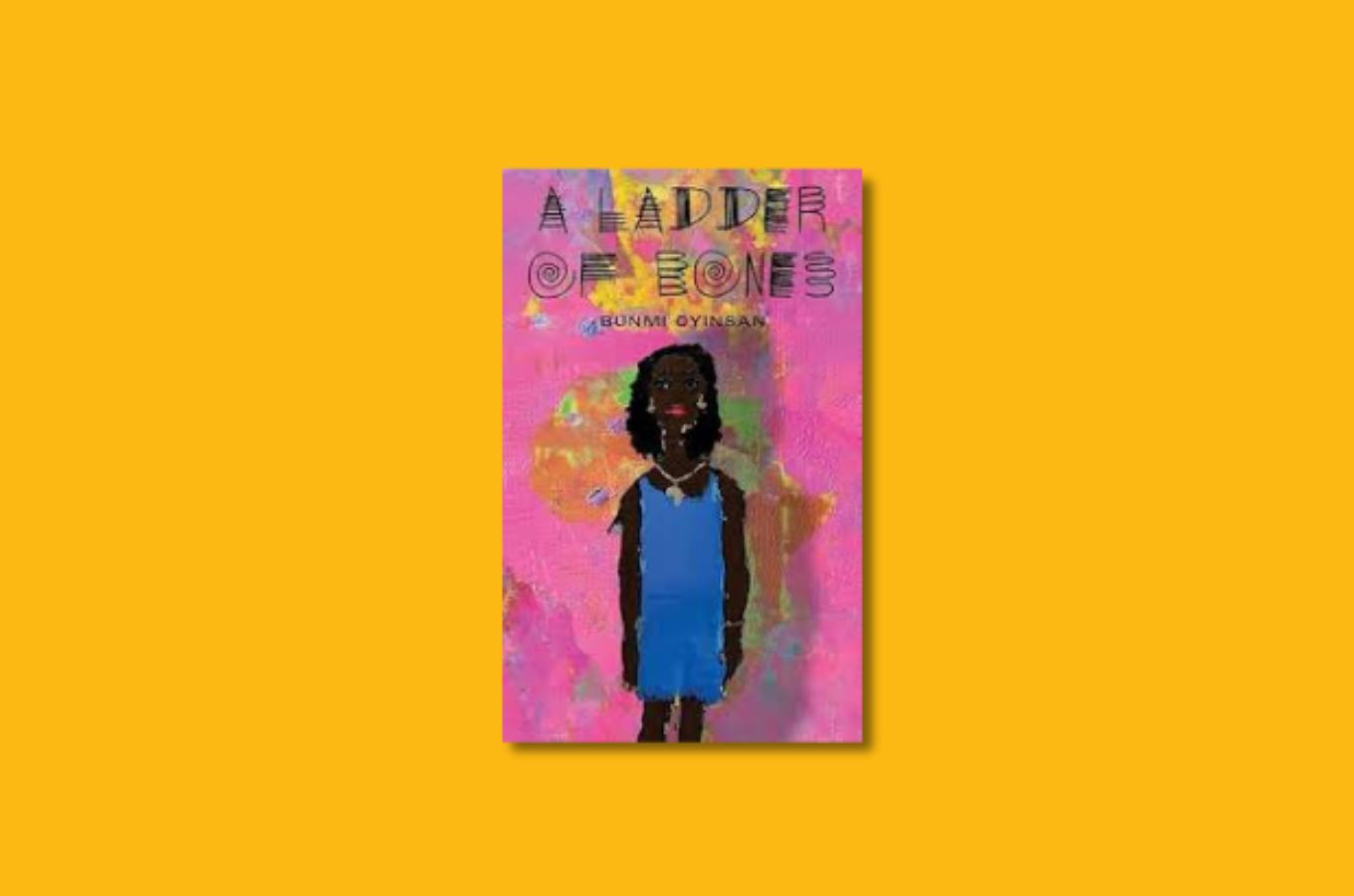
Excerpt from A LADDER OF BONES published by Guernica Editions. Copyright © 2025 by Bunmi Oyinsan.
Grab a copy here!






Comfort October 07, 2025 06:05
Looking forward to a ladder of bones