

 Chapter 1
An Ethiopian Conservative
At the dawn of the twentieth century, men of light and leading both in Europe and in America had not yet made up their minds as to what place to assign to the spiritual aspirations of the black man; and the nations were casting about for an answer to the wail which went up from the heart of the oppressed race for opportunity. And yet it was at best an impotent cry. For there has never lived a people worth writing about who have not shaped out a destiny for themselves, or carved out their own opportunity. Before this time, however, it had been discovered that the black man was not necessarily the missing link between man and ape. It had even been granted that for intellectual endowments he had nothing to be ashamed of in an open competition with the Aryan or any other type. Here was a being anatomically perfect, adaptive and adaptable to any and every sphere of the struggle for life. Sociologically, he had succeeded in recording upon the pages of contemporary history a conception of family life unknown to Western ideas. Moreover, he was the scion of a spiritual sphere peculiar unto himself; for when Western nations would have exhausted their energy in the vain struggle for the things which satisfy not, it was felt that it would be these people to whom the world would turn for inspiration, seeing that in them only would be found those elements which make for pure altruism, the leaven of all human experience. Again, the art of the caricaturist had by now been played out.
It was no longer possible, as far as this race was concerned, to depict the Sultan of Zanzibar, for example, other than as an Ethiopian gentleman, “clothed and in his right mind.” And there were sons of God among them, men whom the Gods visited as of yore; for even now three continents were ringing with the names of men like Du Bois, Booker T. Washington, Blyden, Dunbar, Coleridge Taylor and others—men who had distinguished themselves in the fields of activity and intellectuality—and it was by no means an uncommon thing to meet in the universities of Europe and America the sons of Ethiopia in quest of the golden tree of knowledge.
Here, in London, about the time of which we write, were to be seen two young men, walking arm in arm up Tottenham Court Road, and, ever and anon, stopping to examine old dirty books in some second-class bookstall, or some quaint relics in a curiosity shop. Presently, the twain stopped at a particularly ancient looking bookshop off a by-street leading to Upper Bedford Place. The darker man of the two picked up from the stall outside, a well-thumbed copy of Marcus Aurelius, and began carelessly to turn over the leaves. Suddenly he stopped, and his face grew pensive.
Turning to his friend, he said, “Isn’t it funny, Whitely, the remarkable similarity of thought and almost of expression there is between all the great teachers of the past? Listen to what, for instance, Marcus Aurelius says here,”reading aloud a paragraph from the Meditations, which ran thus: “‘Pray not to save thy child, but that thou mayest not fear to lose him.’ Now, you, a Divinity student, what do you make of that?” And without waiting for an answer, he added, “Does it not read very much like the teaching of the holy Nazarene—‘he that findeth his life shall lose it,’ or words to that effect? Now, what I wish to know is what had Jesus Christ in common with Marcus Aurelius?” “Candidly, Kwamankra,” said Whitely, “I have never given the matter a thought; but since you put the question, and viewing it from a merely debatable standpoint, I am inclined to say that the first question to consider was whether Jesus Christ was man or God.”
Kwamankra raised his eyes in astonishment. “You do surprise me, Whitely; how can you, of all others, have any doubt upon the matter? I thought you were going up for Orders.” Whitely appeared confused, but soon regaining composure, he said to his companion, “Let us move on.” As they sauntered along, Whitely began: “You know, Kwamankra, I can talk better walking, and I will now answer the question you put to me a while ago. At one time I thought of taking Orders, and even now I may do so. But a little evil in the shape of an unanswerable doubt haunts me by day and night, and it is even the self-same question I put to you at the bookshop.” “Well, I hardly know what to say, Whitely. In these matters, I, of course, regard myself as an outsider. You see we pagans come all the way here to sit at the feet of Gamaliel,” he said with a little mischievous laugh, “and it is uncommonly hard upon us for you to entertain doubts upon the broad questions upon which we seek comparison and light. But I can conceive of no such difficulty as you experience in our system. Jesus Christ man or God?” he repeated slowly and musingly unto himself—then turning somewhat suddenly to his friend, he said, “You know, Whitely, since I learned your language, not as a vehicle of thought, but as a means of more intimately studying your philosophy, I have been trying to get at the root idea of the word ‘God’; and so far as my researches have gone, it is an Anglo-Saxon word, the Teutonic form being Gutha, which is said to be quite distinct from ‘good.’ Whence then,one may ask, come your ideas, as associated with the fountain of all good, of omnipresence, omniscience, omnipotence? Of course they are borrowed from the Romans, who were pagans like ourselves, and who, indeed, had much to learn from the Ethiopians through the Greeks.” A turn or two took the young men to Russell Square, and soon they found themselves at Bedford Place. The darker man of the two produced a latch-key, and invited his companion to come in. There was nothing remarkable about the rooms except that they were furnished in the Oriental style. Here and there, at convenient comers, were divans with rich cushions, embroidered in silk, and carpets of leopard skins into which the feet sank as one walked. On the walls were trophies, consisting principally of African weapons. There were to be seen a collection of musical instruments of all descriptions, some so simple as to make one wonder how any symphony could be got out of them. A well-filled shelf, with a plain oak desk, littered with written matter, with some flowers here and there, about completed the outward circumstance of the room into which our visitor was ushered. Pushing well forward the only easy chair in the room, and placing his friend in it with a smile of welcome, he threw himself upon a low seat beside him, touched a bell on a side table, and ordered some refreshment. “I hope you don’t mind my old-world ways,” remarked Kwamankra. “You know, though I have lived in this country fairly long, off and on, I like to sniff a bit of the African air somehow where’er I go.” “That is perfectly natural, at least with a well-balanced mind,” correcting himself, said Whitely; “but what I can’t understand is that you don’t seem a bit Eastern in your methods of work. To judge from that pile yonder,” eyeing the notes mischievously, “one wouldn’t think you were over here for a holiday.” “Oh, that is only a bit of derivative work. You have no idea how interesting it is. Would you like to see what I am doing?” “How good of you! I should be delighted.” “I shall soon be finishing now,” said Kwamankra excitedly. “You see I am at the letter ‘Y.’ And that reminds me: you remember a while ago my taking you to task over the feebleness of the idea of ‘God’ in the Anglo-Saxon language.
I have just got the corresponding word here in Fante. It is a big word, so big
that you can hardly manage it:—
NYIAKROPON.
Does it convey any meaning to you? How can it? And yet, I can assure you, my
friend, it is no mere barbarous jargon. It is the combination of distinct root
ideas in one word. It relates back to the beginning of all things visible, and
links the intelligent part of man with the great Intelligence of the universe.
Breaking up the word into its component parts, as I have done, we have:—
Nyia nuku ara oye pon. That is,
He who alone is great.
“How very suggestive. Who should have thought it?” observed Whitely,
enthusiastically.
“Well, let us take the next word, then,
NYAMI,
which is still more suggestive, and analyze it. Broken up, it stands in bold
relief thus:—
Nyia oye emi. That is,
He who is I am.
Now compare the Hebrew I am hath sent me, and you have it. Nor is this a
fanciful play upon roots, for our people sing unto this day:
‘Wana si onyi Nyami se?’
Dasayi wo ho inde, okina na onyi,
Nyami firi tsitsi kaisi odumankuma.’
meaning:
‘Who says he is equal with God?
Man is to-day, to-morrow he is not,
I am is from eternity to eternity.’
“You can now understand,” continued Kwamankra in a low, sad tone, “why your difficulty surprised me. But now that I come to think of it, it may be due to the limitations of your language.”
“After what you have just shown me, I must confess there is a deal in what you say; and somehow you Orientals manage to keep your hold on the eternal verities, where we flounder and are lost.”
“Pardon me, my good friend, not quite that. As yet you are only drifting, drifting, drifting away from the ancient moorings that you Westerners built in sand. Jesus Christ came from the East. In Bethlehem he was born, and in Egypt was he nurtured; and, yet, you seek to teach Him us. We have caught His Spirit and live; you follow the letter and are tossed hither and thither by every wind. Forgive me when I say that the future of the world is with the East. The nation that can, in the next century, show the greatest output of spiritual strength, that is the nation that shall lead the world, and as Buddha from Africa taught Asia, so may Africa again lead the way.”
“I am not prepared to dispute the matter with you, Kwamankra, and there seems to be a good deal of truth in what you say; but how about the doubt deep down in my own heart? That is a personal affair, you know. In a word, what think you of the Christ?”
“What a clever dialectician you are, Whitely, to be sure? If I did not know you so well, I would hardly think you were serious. You throw back to me the question I put to you a while ago, and you lay upon me the burden of solving my own riddle.”
Whitely’s voice was low and sad with a suspicion of emotion in his whole manner, as he said: “Forgive me, Kwamankra, if I have seemed flippant; I was never more serious in my life. I have arrived at a crisis in my career whichmay mean disaster at any moment; and, what is more, until this day I have never had the courage to speak it out to any of my friends for fear they would mock at my doubts.”
Kwamankra turned upon his friend a look full of penetration and sympathy; and, for the moment, Whitely felt uneasy under the searching glance of the Eastern student. It seemed to him as if in that instant Kwamankra had probed his inner nature and found it shallow.
“According to our ideas, Whitely, one broad divinity runs through humanity, and whether we are gods, or we are men, depends upon how far we have given way to the divine influence operating upon our humanity; and, comparing one system with another, I must confess there was in the man Christ Jesus a greater share of divinity than in any teacher before or after Him, and that was in my mind when I was wondering what Marcus Aurelius had in common with Jesus Christ. “But tell me, Whitely, supposing Jesus Christ had been born of an Ethiopian woman instead of Mary of the line of David, do you think it would have made any difference in the way he influenced mankind?”
“What a strange question,” returned Whitely; “our Lord born of an Ethiopian woman?”—forgetting his doubts for the moment—“Whatever put such an idea into your head? I am sure you are the first man who has given expression to such a thought.”
“Yes, it is strange”—and there was a vibration of the intensest pathos in Kwamankra’s voice—“that an African should venture to think that the Holy One of God might have been born of his race. I can easily interpret your thoughts; but, tell me, what is there extraordinary in the idea?”
“Oh, I don’t know. Habits of thought, convention, and all that sort of thing, I suppose. And yet I am hardly qualified to speak upon these things,” said Whitely, softening.
He rose to go. He was due farther west to see his people. Before leaving, he laid a hand on Kwamankra’s shoulder, and looking gravely into his face, he said: “It is a pity, Kwamankra, I did not meet you a little earlier in my career. But even now, it may not be too late. Good-bye! Mind you meet me at Liverpool Street Station before the hour for the night train up. Good-bye!”
***
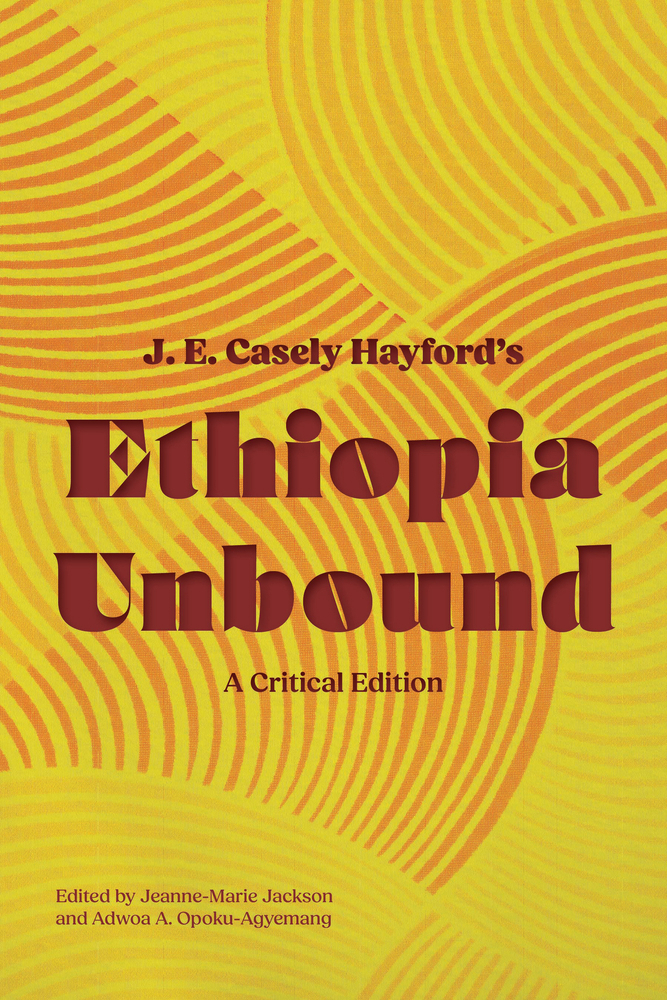
Excerpt from Ethiopia Unbound: A Critical Edition by J. E. Casely Hayford. Edited by Jeanne-Marie Jackson and Adwoa A. Opoku-Agyemang. Published by Michigan State University Press. Copyright © 2024 by Michigan State University.






COMMENTS -
Reader Interactions