
You don’t know what it is that you are looking for. But you can feel its absence when your fingers reach out and come up short. When the knot in the middle of your chest tightens and causes splinters from your frame. How does one miss so badly what one does not know? —Yejide Kilanko, “You Don’t Know” (2021)
“When did you give birth?”
I’m lying on the cracked plastic examination table, my legs hitched up in stirrups, as the white woman who is today’s obstetric-gynecologist at the Memory Store parts the lips of my labia with one finger of her blue-gloved hand. She touches my body with the studied professionalism of someone who’s been trained to do something deeply unpleasant. It reminds me of some of my johns.
I am willing myself to remain still under her hands, so it takes a moment to register her words.
“I don’t have any kids,” I say.
Her face scrunches into something approximating sympathy. But she’s no actress; I can tell she doesn’t care.
“I’m sorry for your loss,” she says automatically and reaches for the speculum.
“No,” I say, rising on my elbows to look directly at the woman bent over between my legs. “You don’t understand, I’ve never had children. I’ve never given birth.”
Her expression hardens, a look I can tell she’s more comfortable with. “You don’t have to talk about it if you don’t want to, but you shouldn’t lie to your doctors.”
“Why would I lie about this?”
“I don’t know, people lie about all kinds of things,” she says primly as she lubes up the tool. We both hear the missing like you in that phrase.
“Honey, I’m a hooker not your priest,” I sass. “I don’t lie unless I’m being paid.”
She looks me in the eye as she jams the cold metal into my vagina and, with no warning, wrenches it open. I grit my teeth and bite back a cry.
“Sorry,” she says with a cold smile. I hold her gaze until she drops hers.
The monthly health examination over, I walk slowly back to my quarters in the refugee zone. The pain between my legs has lessened to a dull throbbing. I want to rage at this latest humiliation, but my anger will not kindle. It’s just one of the many routine degradations I’m expected to gratefully endure for the institutional generosity of my presence in the land of my betters. But if I’m never allowed to forget who I am, then neither should they.
This area used to be rock quarries; it is devoid of the rich greenery that characterizes the rest of the city. Here, the air tastes like grit and dust. My “quarters” are the top of an undersized bunk bed in a two-room microunit, one of hundreds crammed into the five prefab buildings set aside for single and childless refugees. Of my six other roommates, only one is home today, a broad-bodied woman with the nut-brown colouring of one of the drowned Pacific Islands. Though we’ve lived in the same space for nearly a year, she and I have yet to exchange a word. I don’t even know her name. She is sleeping off her long night shift at the elder care facility and will likely still be in bed when I leave for my official work detail at the city’s mail sorting hub in an hour or two. I fetch my bucket and bathing kit from my locker at the foot of the bed and head to the communal bathroom at the end of the hall.
The bathroom is blessedly empty at this time of the day—just after the workers of the morning shifts have left and the long after the night shifts have returned. Today’s waterflow is uncertain but running. There’s even hot water, though it peters out after a few minutes. I bathe vigorously, trying to get the feel of the Memory Store’s clinic off my skin.
This is not the first time I’ve been asked about my birth status. The rich white folk of this country can’t seem to birth babies on their own anymore, so it looks like they’ve kicked up their search for surrogates among us refugees and immigrants. There’s really nothing they won’t buy, is there? These days though, the question snags at something in me. A hole, a vast abyssal emptiness at the core of my being. I want to cry, but I don’t know why. I just can’t shake the feeling that I’ve forgotten something deeply important.
I scoop water out of the bucket with a small plastic bowl and pour it over my body. As I scrub, I run my hands critically over myself. Does the flop of my lower belly indicate a pregnancy? Are my sagging breasts because of breastfeeding? I close my eyes and crook my arms, imagining that I am cradling a baby. The act feels oddly familiar. I open my eyes again and take in the cracked grey tile of the shower stall. I try to picture a child in this bleak space and there my imagination runs aground. This is no place for that kind of innocence.
A white envelope is waiting for me on my bed when I return from the bathroom. It has an official government seal at one corner. My roommate is still sleeping. Whoever dropped the letter off hadn’t woken her. My name is misspelled, as usual, but my status number is correct, which is all that matters. Inside the envelope is a cheque for the largest amount of money I’ve ever seen. It’s backdated to a year ago, which tells me it’s been processing through the system for a while, and has been issued for “services rendered.”
I crosscheck the National Bank stamp at the bottom. I hold the slim sheet of mushroom paper up to the dim lightbulb in the ceiling to illuminate the hidden hologram on the back of the check.
Yep, it’s legit.
I dress quickly and gather my things—including my little good luck pebble, the odd black pyramid I take everywhere with me. I don’t bother returning my bucket to the locker. I head out the door and I don’t look back.
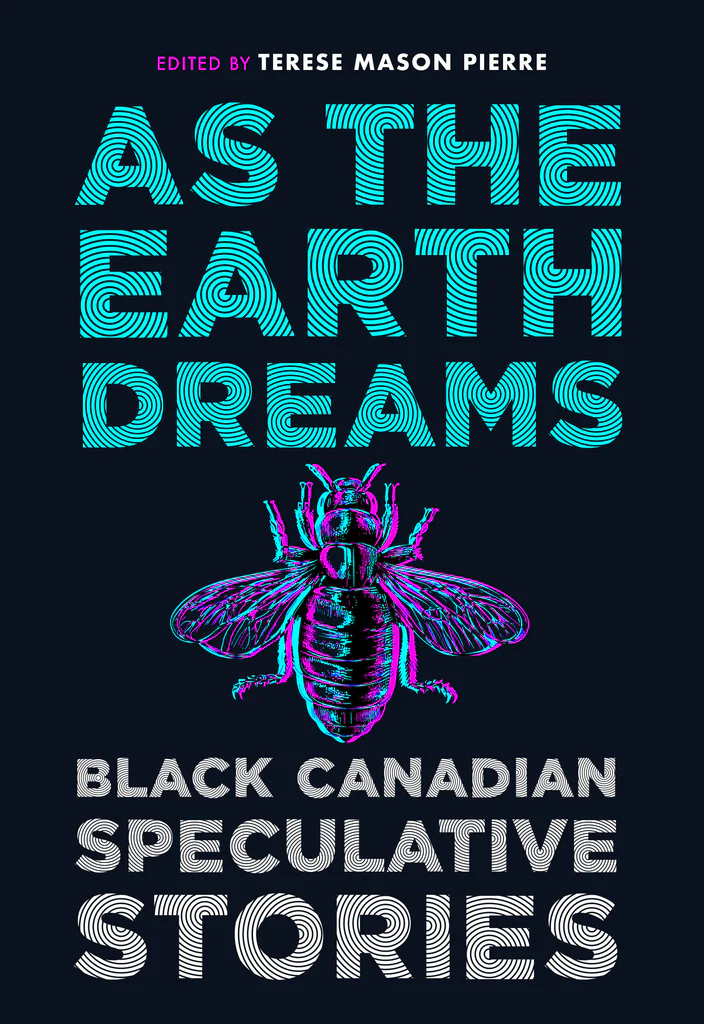
Excerpted from “A Hole in the Middle of the World” by Chinelo Onwalu, in As the Earth Dreams: Black Canadian Speculative Fiction, edited by Terese Mason Pierre. ©2025 Terese Mason Pierre. Published by House of Anansi Press www.houseofanansi.com
Order a copy here

COMMENTS -
Reader Interactions