

(Broken) Tongue
I look up phrases that are used to describe me. I write down words that I cannot pronounce. Speak but don’t speak. Say but can’t articulate. I am coming home to no one.
“Nigerian Pidgin English”: a term for the blending of many Nigerian languages (primarily Igbo, Yoruba, and Hausa) and English. My parents exist on a bridge straddling two countries. They call me and my siblings Americans as a cheeky insult. Many Nigerians of my parents’ generation aren’t sure how to write their own language. This is also true for me.
For you to fully understand my crisis of identity, I must speak with “special intensity given to the expression of feelings and ideas.” I must perform what resembles a poem to tell you the gloomiest story of isolation. Isolation that makes clear the lack of “a place where something flourishes, is most typically found, or from which it originates.” I am without my own definition of home.
I enter the threshold and there I see you, this otherworldly body welcoming me. You’re a manifestation of my dreams-dreams of distant lands. Dreams of me running and searching for home. They say that your dreams reveal your innermost thoughts, tell you of a you that is not given to the world-a you who hides. But here I am, here you are-skin and bone, earthworm and falcon.
I want to tell a story of you. Not about you. Something larger, something grander than saying, “Have you met the Atlantic? She’s great.” I want to tell a story of you. I want to express the relationship between a part and a whole. The sleeve of this coat. The breathing of fresh air. The rays of the sun. The merging of my two selves.
The African Dream
I’m watching TV with my dad. House Hunters is on. We sit together on a tattered leather couch in a four-bedroom house with two and a half baths, eagerly awaiting the reveal of a much larger home with granite countertops and crown molding. Casually my dad tells me about the hut he used to live in while a commercial for Tiny House Nation flashes on- screen. How distant I feel from the life I would’ve had but will never know. A life of electricity that comes and goes, a life of my mother fetching water for her grandmother to take a shower, a life of cars that don’t obey four-way stops, a life of pink doily dresses and braids too tight, done every six weeks or so.
We moved from our small house in a less desirable area of Tucson to a large house outside the city. It was around the time I turned eight years old. The dusty desert air smelled like the early aughts chubby cheeks, skateboards, yellow school buses, Otter Pops. Wood became walls, became bedrooms, became memories, became nightmares. I took pictures with my siblings in front of the structure that would become another salmon-colored adobe house in a sea of salmon-colored adobe houses within a gated community outside Tucson.
I look out the window and see a vision of my mother sitting in her high school dorm room in Nigeria, surrounded by trendy clothing, posters, hair products, and lotions. She sits without smiling, unusual for her then but a habitual pose now. In the evenings, I daydream of another life in Nigeria, picturing every detail. I’m wearing a frilly lace shirt with Ankara fabric, and I can taste the jollof and shea butter and sweat in the air that my dad says engulfs you as you step off the plane.
This period of imaginary Africanization fixes me. It rebuilds me from broken, remolds my tongue, deconstructs the Atlantic. I zigzag against the current of the borderlands, never arriving.
I wrap my hair in a gele with golden aso oke fabric, textured and glossy. I sip on Heineken, hoping the beer will change my voice from meek to boisterous. Hoping it will transform me into someone who likes Heineken.
As a little girl, I stole my dad’s wicker hat and pretended to be on a safari because the American school system told me all about the country of Africa. They shrunk down my continent until I could fit it into my pocket, muddying my white flower dress with its rich pigment, shades of brown like church doors and my father’s suits. I colored the walls with brown Crayola to create mirrors of other selves.
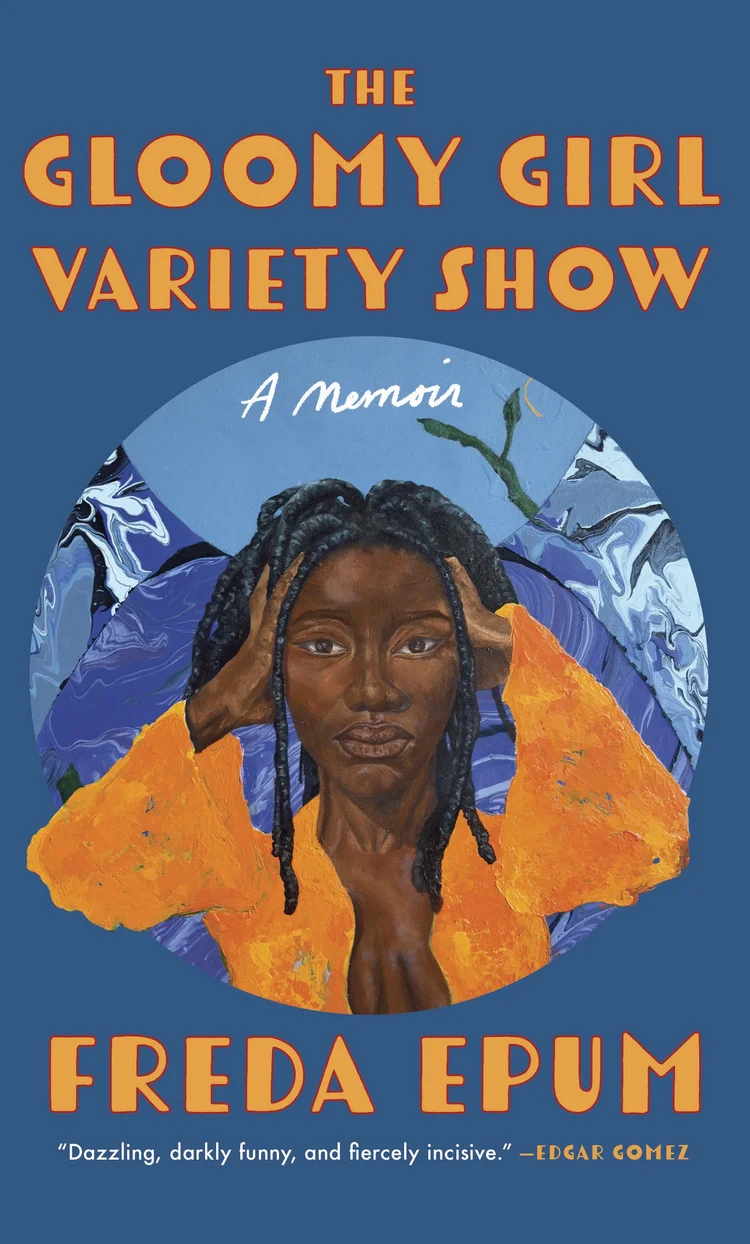
Excerpt from THE GLOOMY GIRL VARIETY SHOW published by Feminist Press at CUNY. Copyright © 2024 by Freda Epum.
Purchase a copy here.



COMMENTS -
Reader Interactions