

Sea Stories
I have no stomach to keep sea stories.
Ten thousand boys are crossing
the black Atlantic without life jackets.
In Thiaroye-sur-Mer, hundreds are wading
through the butane eye of the Mediterranean,
flailing in the brine.
I confess there is no hierarchy
of those rushing out of a country’s flame,
hiding under the tent cities
waiting for the next blue boats
and those making fancy claims
of gratified documents, airborne dreams,
visa tracks against the furls of night,
breakaway planets, rebellious stars,
turbulent clouds, and wayward wind.
Purgation is learning the slant geometry,
the delicate curve of your country,
and demanding holiness from a land
that has always named you a fungible thing.
It is mortal then to dream of return,
to surrender to the blights of the road,
but not to the pyrrhic promise of this land.
A Layover
You are told no wisdom
of handwashing can wash
the illusion of a migrant clean.
No sleek shampoos can wash off
the odour of departures.
So, your first ablution at the layover
must be taken as lathers of shame.
The border man asked you to step aside
from the queue of jetlagged nomads,
where dreams smell like purple onion.
Your second baptism
is not a warm bath, for God’s sake,
but crusted snow shrouding you
inside the scorn of a winter city.
To be diasporic is not always a summer kiss.
Finally, this is the genesis of your curse,
of longings and memories that sit on you
like blisters. No warranty,
you will break; but then pray
you break into a small circle of mercy.
My Country Describes Itself to Me
I am your nemesis, Jídé;
I am your field of grief
where men return
with smeared hands
and hopes are crushed to bone dust
its white powder ferried away
by the rage of harmattan.
I am the rot of memory
that tingles your stomach.
I am the strange affairs of dreams
that purged you of purity in the night.
I am the deep gorges of guilt.
I am the slur of tongues
asking for your righteousness.
I am your love, Jídé.
And no matter how much I torment you
you shall return to me.
***
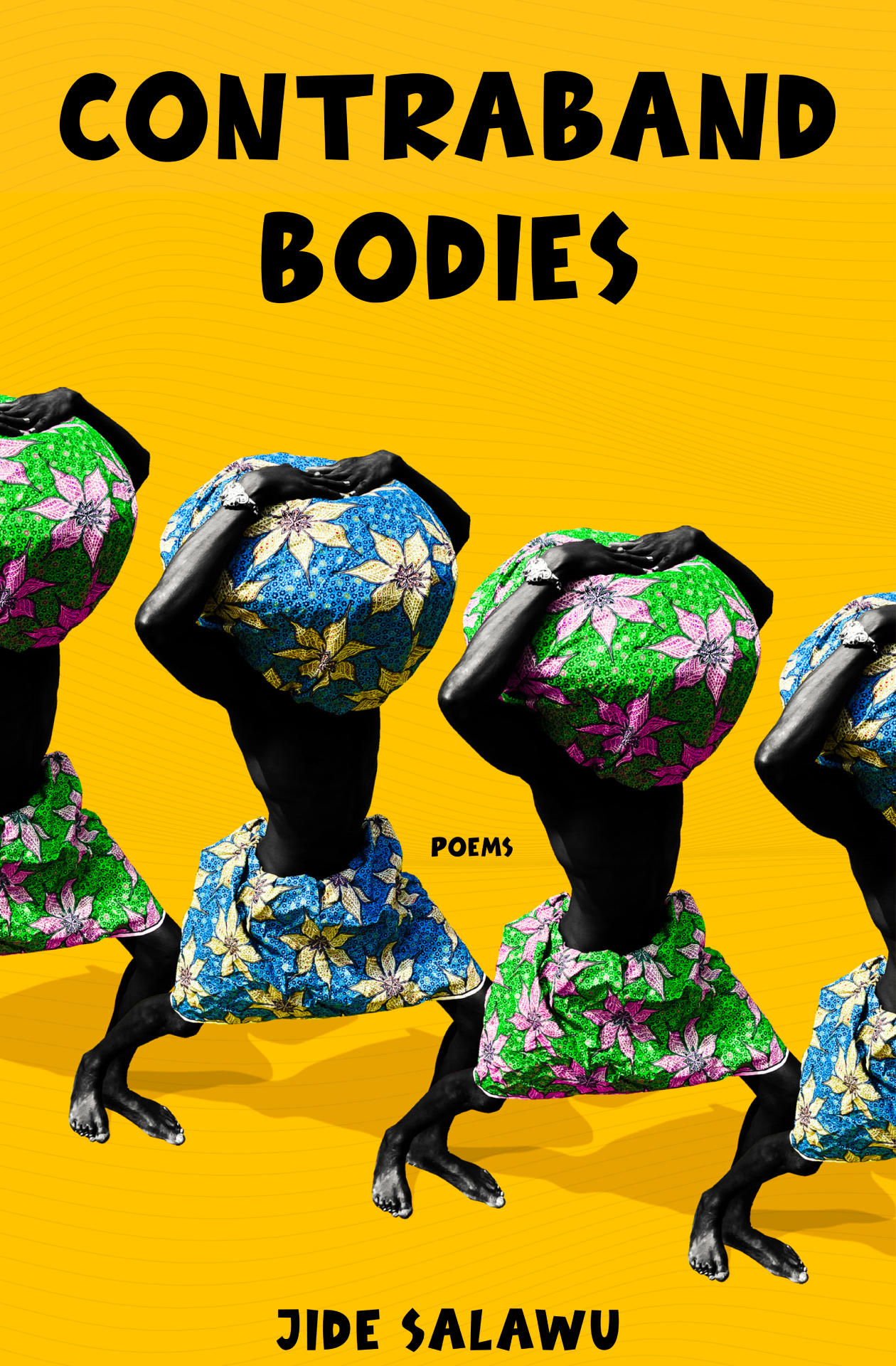
About the book: Contraband Bodies is a meditation debut to be reckoned with. Jide Salawu shines in this personal record of diaspora and a country lost to precarious politics. Mourning home, Salawu deploys gritty language, razor-edge imagery, decolonial poetics, and granular details to highlight the diverse circumstances of being a Black migrant in Africa and beyond.
Salawu meditates on the agony of Atlantic memories and dispersal, confronting new forms of digital kinship. He creates a unique catalogue of images that map the migratory routes from the village to the city, within continental Africa, and across different diasporic landscapes. He builds on a solid canon of migration and mobility in African poetry and brings forward a powerful, new, diasporic poetic voice.
About the author: Jide Salawu is the author of Preface for Leaving Homeland, published under the African Poetry Book Fund, and the co-editor of African Urban Echoes, published by Griots Lounge Canada. His poetry has appeared or is forthcoming in The Fiddlehead, The Walrus, Poetry Pause, Literary Review of Canada, Prairie Schooner, Rattle, and Transition. He was a Yosef Wosk Fellow and the recipient of the James Patrick Folinsbee Award for Creative Writing at the University of Alberta. Salawu grew up in Shao, Nigeria, but currently lives in Edmonton, Canada, where he teaches as an assistant lecturer at the English and Film Studies programme of the University of Alberta. Salawu is also the managing editor of OlongoAfrica. His poetry collection, Contraband Bodies, is published by Narrative Landscape Press (2025).




COMMENTS -
Reader Interactions