

The four of us walked in the dark streets, under the skeletons of lampposts with dead bulbs. Sylvie had joined us—Iman, Alissa, and me. We were going to her uncle’s. I kept my eyes on her so I wouldn’t have to look at Alissa and Iman. They lagged behind and whispered to each other, laughing. Their good mood sent shivers down my spine. I quickened my pace to catch up to Sylvie.
“Why are we going to see your uncle?”
“Because Alissa is batshit crazy.”
She didn’t provide further explanation. I felt so alone. We arrived at the gate of a house that looked like Hadja’s. A common courtyard, a well in its center, individual apartments around it. Sylvie went up to one of the apartment doors and knocked. Seconds later, a man in his forties opened the door. His face lit up when he recognized Sylvie:
“My little niece! Have you brought your friends to visit your uncle? One second, I’ll be right back.”
I peeked inside before he closed the door. It was a single room. Children were playing inside. A woman sat in front of a black-and-white television set. A few moments later, the man came out with stools, which he placed in the yard in front of his door.
“Sit down, children. Sylvie, how is your mother?”
As he talked, he placed a bowl of peanuts in the center of the circle he had formed with the stools. We lounged on them, ravenous, while Sylvie and her uncle caught up. I still wondered why we had come. I watched Alissa out of the corner of my eye. She had spread the peanuts on her lap. Iman dug in, using any opportunity to brush his fingers against her thighs. I ached to leave. I watched as dragonflies flew toward the light above the door. I let myself get carried away by the hum of their wings. Until I heard Alissa’s voice:
“Uncle, I heard that you were in Europe. Would you tell us how it was?”
At that point I understood. Alissa was indeed batshit crazy. As crazy as Iman. They both scared me. The uncle did not respond immediately. He looked up at the moon for a long moment, as if he had memories hidden in one of its craters. Then he sucked the air between his teeth, making a noise that conveyed his bitterness:
“There is nothing there, children. Forget it.”
But Iman’s curiosity was piqued. He leaned forward, determined not to give up on the subject:
“You lived in Europe? But why in the world didn’t you stay there, Uncle?”
All his attention was captured by the uncle’s answer. Beside him, Alissa sat with her back stiff. She looked me straight in the eye. A light flickered in her pupil, but I didn’t understand the message she was trying to send me. The uncle began to speak in a monotonous voice, slowly, pausing regularly to collect his thoughts.
“Those were the worst years of my life, my children. It was fifteen years ago. I left, thinking of reaching the El Dorado. I thought it would change my life. Unfortunately, I didn’t know how right I was.
“I was a little older than you are today, but I was full of dreams. After the mandatory visit to the bokonon to have some lucky charms made for me, I embarked on a fishing boat. At the time, the regulations were much less strict between the borders. Our initial goal was to fish for sardines in Morocco. However, the farther the ship went out to sea, and the smaller the coast of our country became, the more my dreams grew. After a fortnight at sea, I came to the conclusion that I wouldn’t return unless I became very rich. I had this notion that I had to make my life in Morocco. But as we got closer to Arab countries, I talked to my traveling companions. Ousmane, a Senegalese, explained to me that Morocco was not enough. The West, he told me, was where fortunes were made. Maybe it was malnutrition, or weakness from scurvy, but I hallucinated frequently. I saw myself on a paved road, surrounded by white-skinned men who recognized me and greeted me ceremoniously.
“The night we anchored off the coast of Tangiers, while everyone else slept and I struggled to sleep, I saw a shadow moving in our cabin. It approached me and shook me, and I recognized Ousmane. He said, ‘It is now or never. There is an issue at the docks and the authorities are distracted!’ He took me by the arm and we slipped between the bodies lying on the ground, exhausted from the long day of fishing. We went up on deck. I only had my clothes on when I dove into the cold water. We swam for a long time until we reached a deserted cove. Then we walked all night. We could not let ourselves be found in the vicinity of the port because as black fishermen we would automatically be escorted back to the ship. When the sun rose, we hid in the streets and slept. We played this game for several days. Ousmane was Muslim and spoke Arabic. In the evening, he went out to get the news and establish contacts. Our companions had not reported our disappearance to the authorities, undoubtedly for fear of being held responsible and losing their fishing benefits. Nevertheless, we had to avoid discovery for a few weeks until the boat returned to sea. We waited, living at night, sleeping during the day, fighting with alley cats for the leftover meals in restaurants dumpsters. After a few weeks, Ousmane showed up with a surly-looking Moroccan. Ousmane said the man wanted to show us something. We crossed the city, fear in our stomachs, forced to trust this stranger. He took us far away, to the hills overlooking Tangier. Then he turned and, with a gesture, asked us to take a look below our feet, at the Strait of Gibraltar.
“‘Fourteen kilometers,’ he said. ‘Thirty minutes crossing. On the other side is Tarifa, Andalusia, Spain.
“I think the most beautiful word I’d heard in my life was that last one, ‘Spain,’ pronounced with a Moroccan accent. It still sings in my ears. We watched the lights on the coast across the strait sparkle. I felt as though if I stretched my hand forward, I could capture them. They still shine in my mind today.
“‘But you will need to work to pay the passage. Two thousand dirhams. A thousand up front, the rest on the other side of the border,’ he said.
“We had to find work. It took us months to get the money we needed. The first half was used to get us fake passports to make it through the border posts. We were to return them to the smugglers at the destination. Once we had gathered the second half of the money, we were ready to go. We contacted the Moroccan again. I have never been more excited in my life. Ousmane was about ten dirhams short, but we were impatient. If we missed this departure, we would have to wait at least a month before the next one. We couldn’t wait. The Moroccan brought us together one night, along with a group of other frightened men, and we took the road to the forest of Benyounès. From there, he was to take us to the enclave of the Spanish camp of Ceuta. I have never prayed so much as I did that night. At each border post we encountered, I thought my heart would explode in my chest. Yet each time, the customs officer cast a distracted glance at our passports and extended a lazy hand into which we slipped a few hundred dirhams. We passed the first post. Then the second. Then the third. During the trip, I lost track of Ousmane. It was every man for himself, to each his luck. We would meet again, God willing, on the other side. At the fourth and last station, I heard a commotion. It was Ousmane, he was screaming! What was going on? One of my companions explained that my friend was missing a few dirhams. He had tried to negotiate, but the customs officer had refused. A dozen dirhams! Horrified, I watched Ousmane being thrown to the ground. The customs officers shouted while brandishing his passport. It had been reported stolen, they said. I thought about going to my friend’s aid, but someone held me back by the arm. “To each his fate, my brother. Allah has decided …” Ousmane’s fate would land him, as we all knew, in a cell in Tetouan with hundreds of other African immigrants. I would never see him again. Most of us don’t make it through, but I did.
“I made it through, and I found myself alone on an Andalusian road. That’s where my real problems started. That’s when I really started to suffer …”
Sylvie’s uncle stopped talking. He yawned and stretched. He was tired. He scanned his audience, ready to stand. I don’t know what he saw in Iman’s eyes at that point that made him sit back down quickly. As he spoke, he stared at Iman:
“I have got to tell you something. If leaving here was leaving hell, then arriving there was the hell of hell. My children, I do not wish for you to have to lie and steal to feed yourselves. I do not wish for you to call death to deliver you from the cold on winter nights, in the basements of abandoned buildings. I don’t want you to get stabbed for a bowl of broth in a homeless shelter.”
Saying this, he lifted his garment and showed us a large scar under his ribs.
“I was pissing blood when they took me to the hospital, where they asked me for my papers. Nevertheless, I thank heaven that I had this injury, because it allowed the authorities to find me and bring me home. Today, I look at my wife and my children and I tremble at the thought that I almost missed out on this. There was a time in my life when I didn’t even know what it was like to be human anymore. All that for sixty kilometers travelled inside Europe. I’ll leave you with that. God, make tomorrow ours.”
***
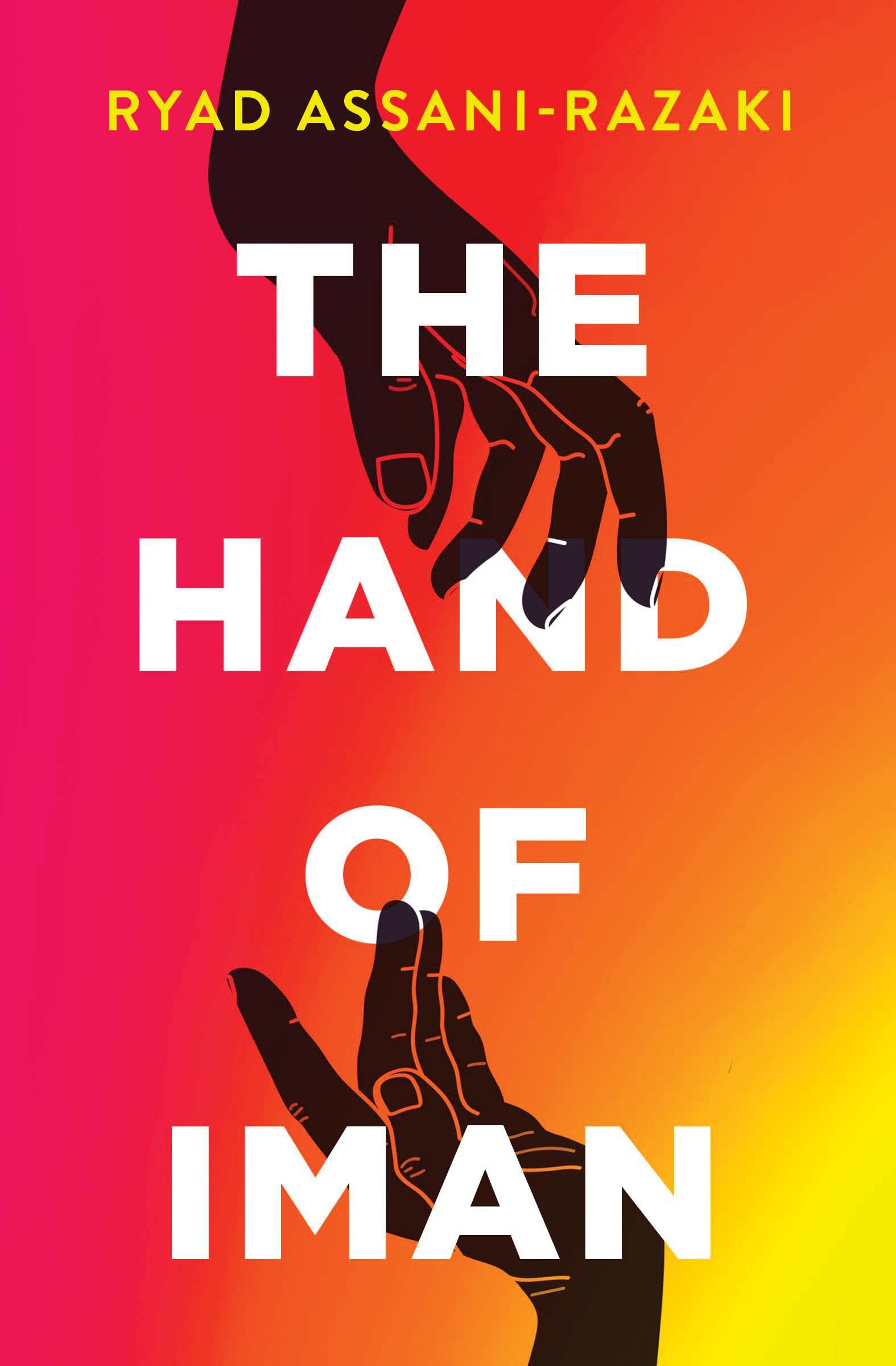
Excerpted from The Hand of Iman by Ryad Assani-Razaki. Used with permission of the publisher, House of Anansi Press. All rights reserved. Copyright © 2025, Ryad Assani-Razaki.
Preorder a copy here.




COMMENTS -
Reader Interactions