

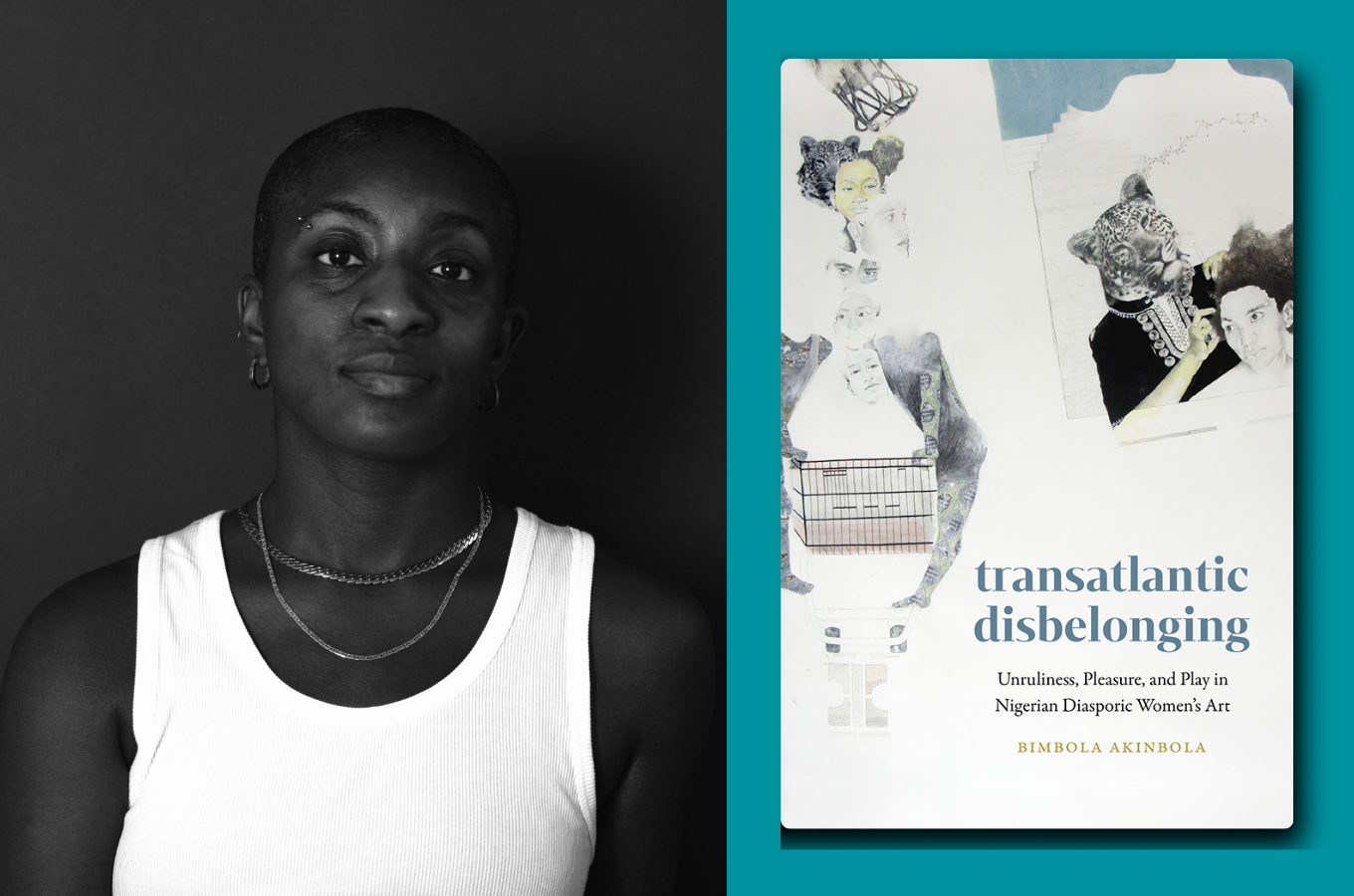
 Bimbola Akinbola’s Transatlantic Disbelonging: Unruliness, Pleasure, and Play in Nigerian Diasporic Women’s Art begins with a feeling many of us know too well — the ache of not quite belonging anywhere. But instead of treating that feeling as loss, she turns it into a kind of freedom. What if not belonging could be its own form of power? Akinbola, who teaches performance studies at Northwestern University, writes with care for the emotional lives of her subjects. She draws from a rich archive of art and feminist theory, but includes her own experiences in the book, as well as interviews with the artists themselves.
Across painting, drawing, performance, video, and digital culture, Akinbola follows Nigerian women artists who transform displacement into creativity. She calls this stance disbelonging — a way of thinking and making that refuses neat categories like “home” and “away.” For her, disbelonging isn’t about exile; it’s about invention.
The artists she studies are as bold as they are diverse. Wura-Natasha Ogunji, known for endurance-based performances like Will I Still Carry Water When I Am a Dead Woman?, uses movement and repetition to ask what it means to carry history in your body. Njideka Akunyili Crosby builds her large, luminous paintings out of family photos and magazine transfers, layering the intimacy of memory into the domestic spaces of diaspora. Zina Saro-Wiwa’s haunting videos, including Sarogua Mourning and Eaten by the Heart, turn grief into connection, showing how vulnerability can build new kinds of community. And in the dreamlike worlds of ruby onyinyechi amanze and Nnedi Okorafor, alienation becomes play — a space for imagining other ways to be.
It’s the chapter on amanze and Okorafor that stayed with me most. Akinbola pushes back against the pressure to be “the right kind” of girl. For her, taking risks is part of growing up free. “Negotiating risk,” she writes, “is a fundamental part of imagining and leisure for African girls.” She reclaims ideas like Black Girl Magic and Carefree Black Girl as more than hashtags. She says they are real ways of thinking and learning, a kind of “careful disbelonging” built around joy, play, and imagination. In Okorafor’s Akata Witch, she finds a heroine who refuses to hide her difference. “Readers,” Akinbola writes, “are asked to look to the figure of the akata girl as the moral compass of the community,” because centering her well-being “offers a truer picture of the moral and ethical future of a community.” Sunny Nwazue, Okorafor’s Nigerian American, albino protagonist, learns that what sets her apart is also what gives her power.
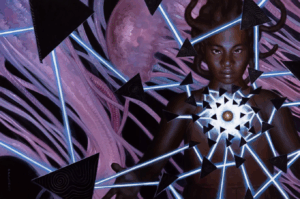
Akinbola pairs Sunny with amanze’s character Ada the Alien, a glowing yellow figure who drifts through the artist’s intricate drawings, both “familiar and strange, humanoid and posthuman.” The connection between them feels electric. Both Sunny and Ada move through worlds that were not built for them, making space through care, friendship, and play. As Akinbola puts it, these artists “reclaim the terms alien and akata,” once used to mark Africans abroad as outsiders, and turn them into creative identities. Their worlds, she argues, are “alternative records of what it has meant to be a Nigerian diasporic girl.”
Akinbola’s larger point in the book is that disbelonging reaches toward freedom, but not in any easy sense. The women in her book don’t deny their displacement or the ache that comes with it. They don’t try to erase the longing to belong — they live with it, work with it, and sometimes even make beauty out of it. What they find is a way of being entangled with their out-of-jointness, where creativity takes root in the tension between wanting to belong and knowing they never fully can.
Transatlantic Disbelonging Akinbola reminds us that we don’t have to romanticize not fitting in to learn how to live fully within that space


COMMENTS -
Reader Interactions