

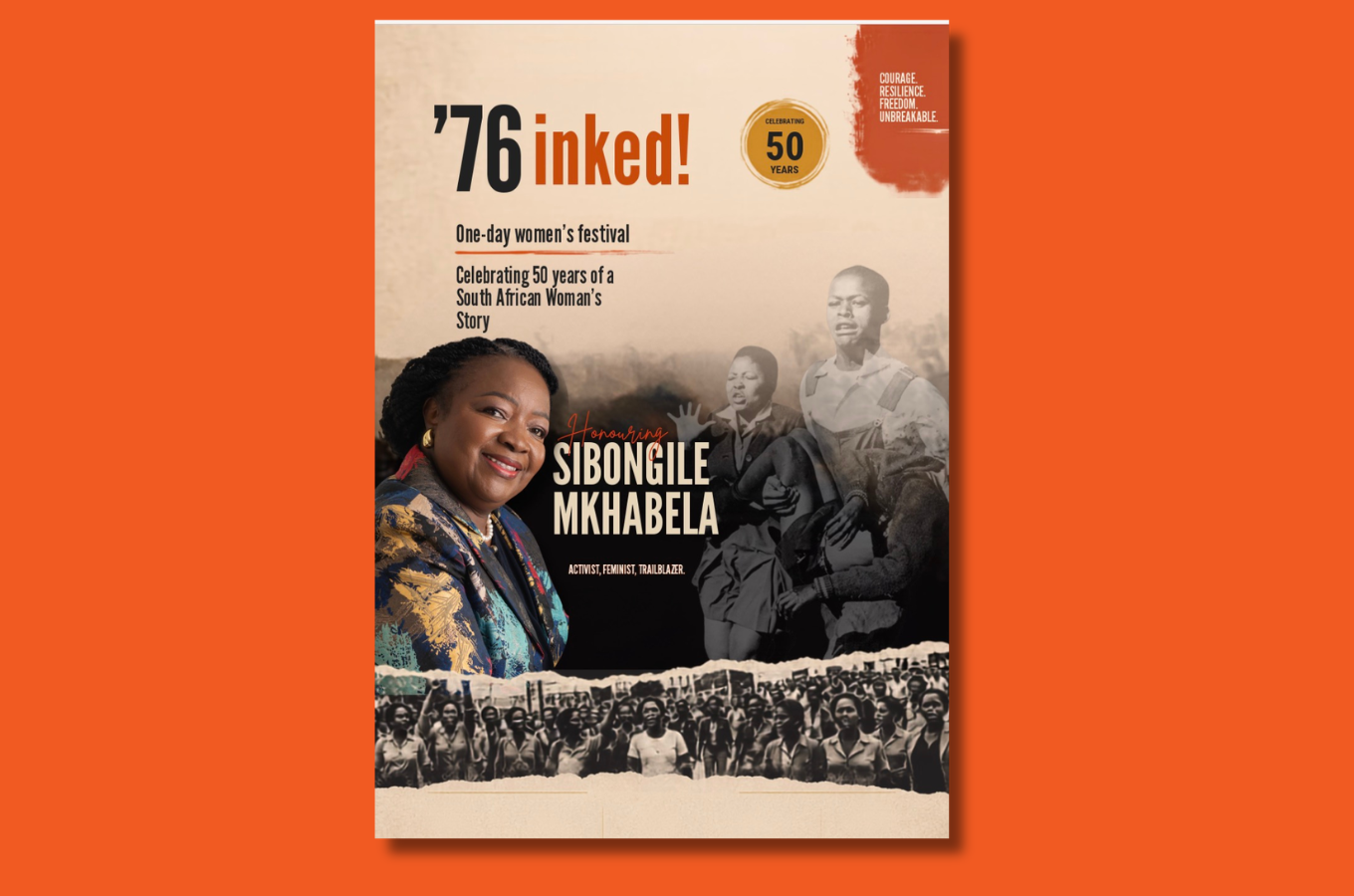
Seventy years ago, on August 9, 1956, thousands of South African women of all races marched on the Union Buildings in Pretoria to protest the extension of pass laws to Black women, a demonstration that would eventually give South Africa its Women’s Day. Nine days before that march, on July 31, 1956, a girl was born in Zola, Soweto, who would grow up to embody the very defiance that day represented. This year, as South Africa observes Women’s Day on its shifted public holiday of Monday, August 10, that girl, Sibongile Mkhabela, turns 70, and a new literary festival, ’76 Inked!, has been built around her life to mark the occasion.
The timing carries a second layer of coincidence. As journalist Unathi Kondile notes in a joint piece for the Mail & Guardian, co-written with author Zukiswa Wanner, the day before Mkhabela’s birthday, July 30, 2026, Wanner herself turned 50, making her, too, a child of 1976. “Two birthdays. Two remarkable women. Two generations,” Kondile writes, setting up a festival that gathers not just Mkhabela’s contemporaries but a cluster of South African women writers who share her birth year.
’76 Inked! is billed as a one-day women’s festival celebrating “50 years of a South African Woman’s Story,” with its list of partners including the Johannesburg Institute for Advanced Study, the University of Johannesburg, Thekgang, Tekano, Pan Macmillan, Penguin Random House South Africa, Book Circle Capital, and the Thabo Mbeki Foundation. 1976 was the year of the Soweto Uprising, when Mkhabela, then a 20-year-old student leader, found herself facing state violence with no birthday cake, no flowers, and no safety, only teargas and the fear of arrest, as Wanner recounts in her section of the Mail & Guardian piece. Mkhabela would go on to become the only woman among the Soweto 11 charged and convicted for her role in the uprising, held at Kroonstad Prison and C Max in Pretoria from 1978 to 1982, followed by a three-year banning order.
The festival’s programme, running from 9am until late, opens with Nozizwe Jele — the Commonwealth Writers’ Prize-winning author of Happiness is a Four-Letter Word — leading “It Starts with a Word,” a practical session on writing, editing, and publishing, in conversation with Sally Ngobeni of the Between the Covers Book Club. It moves through Kagiso Lesego Molope’s “Staged: Mothers of the Nation, Daughters of No-One,” a conversation on identity and inheritance moderated by Gugulethu Lethabo Sihlali; land reform attorney and author Bulelwa Mabasa’s “Black Women and Land: When Do We Get It?”; and Zukiswa Wanner’s own session, “20 Years a Madam / 20 Years a Maid: Laughing so as Not to Cry,” in conversation with Lorraine Sithole. After a lunch break, broadcaster Phemelo Motene takes up “Growing a Sustainable Reading Economy,” addressing what it means to sustain South Africa’s literary culture against streaming platforms and shrinking attention spans, before crime novelist and screenwriter Angela Makholwa closes the panel sessions with “Crimes to Edit, Films to Make.” The day builds to its headline act: “From Student Activist to Giving Heart to Boardrooms — 50 Years of Being Sibongile Mkhabela,” a conversation with human rights lawyer Wendy Isaack.
Notably, several of the featured authors including Jele, Molope, Mabasa, and Makholwa share 1976 as their own birth year alongside Wanner, making them generational contemporaries of the uprising itself, even as their work engages entirely different chapters of South African life. Wanner, for her part, has continued to expand her own footprint since moving back to Johannesburg from Kenya: she co-founded Paivapo Publishers, found herself aboard an international flotilla attempting to break an 18-year blockade of Gaza alongside civilians from 43 other countries, and turned the experience into her latest book, Flotilla: A Journey of Conscience. She was conferred an honorary Doctor of Letters by the University of the Free State this year. Mkhabela’s own trajectory since her imprisonment has been just as expansive: she went on to lead the Nelson Mandela Children’s Fund, helped establish the Nelson Mandela Children’s Hospital, coordinated the legislative process that created South Africa’s National Development Agency under Thabo Mbeki, and now serves as Executive Director of the Barloworld Empowerment Foundation. Her memoir, Open Earth and Black Roses, tells the story of June 16, 1976 through her own experience, and her honours include the National Order of Luthuli (Silver), an honorary doctorate from Nelson Mandela University, and appointment as a Knight of the French National Order of Merit.
The festival takes place at Book Circle Capital in Melville, with free entry and RSVPs required via bookcirclecapital@gmail.com. The first 50 attendees to arrive will receive a copy of Mkhabela’s Open Earth and Black Roses. For a Women’s Month built around a woman who turned imprisonment into a lifetime of institution-building, ’76 Inked! reads less like a single-day event than an invitation to sit, for a few hours, inside the throughline connecting 1956, 1976, and the present and to ask, as Wanner does in her tribute, not just how to celebrate Sibongile Mkhabela, but how to be her.

COMMENTS -
Reader Interactions