

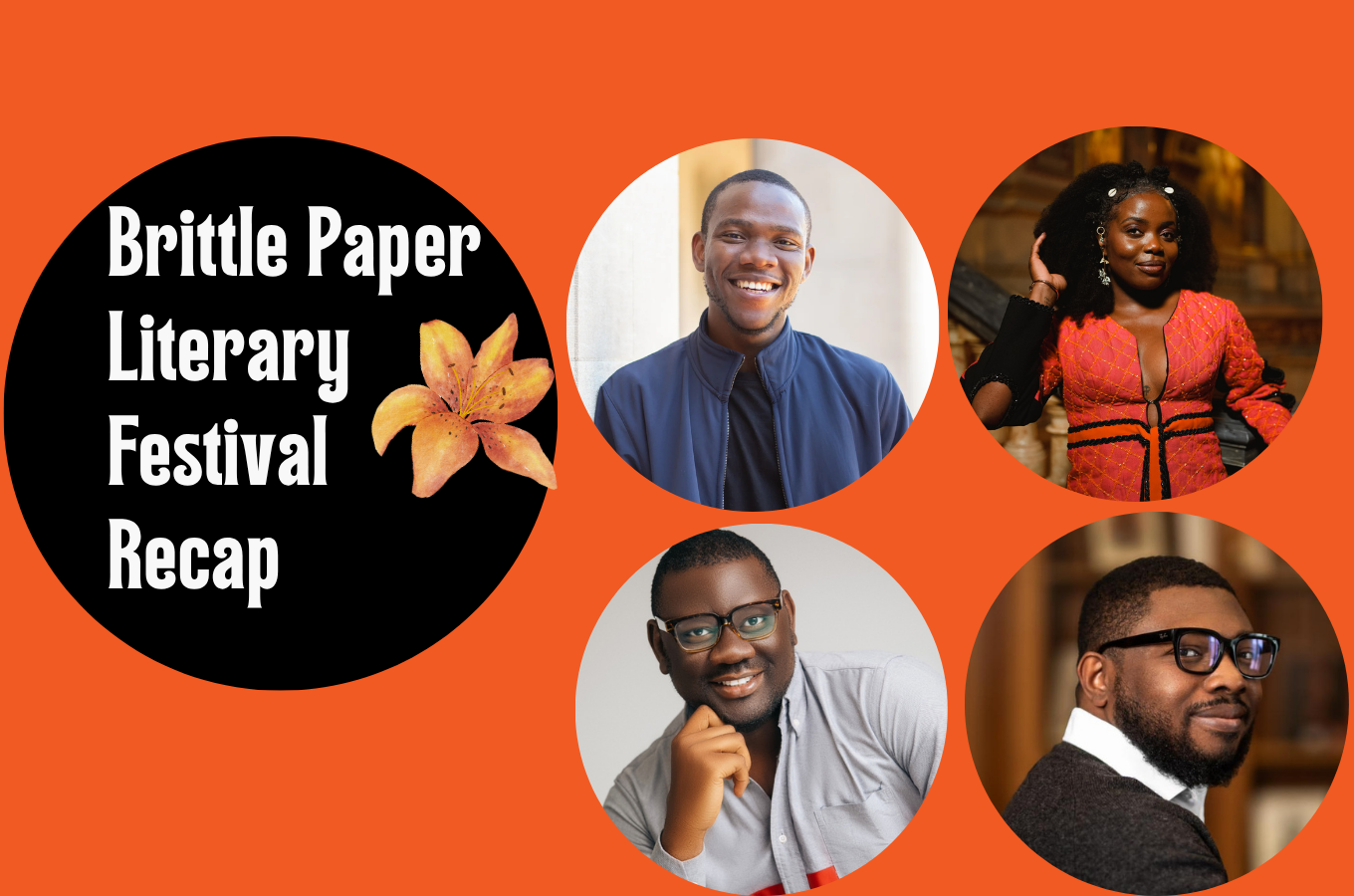
On Saturday, August 29, 2026, Brittle Paper hosted its first-ever Literary Festival, a five-hour virtual gathering built around a question that has quietly shaped the site’s entire mission: what happens when you take the writers still finding their footing and put them at the center of the room, instead of on its edges? Themed around whether the writer still plays a role in society, the festival brought together poets, novelists, publishers, and readers from across the continent and its diaspora for an afternoon that, by the end, felt less like a program and more like proof of concept.
The day opened with Session I: Brittle Paperians, a two-part reading showcasing writers who found their first audience on Brittle Paper’s pages. The poetry hour brought Salama Wainaina, Aanuoluwapo Adesina, Salmah Salam Oiza, Chioniso Tsikisayi, Owen Habel Lwanda, Nabila Ismail, Laurène Southe, and Omobola Osamor to the mic, reading work first published on the site, from Wainaina’s “Inheritance of Rot” to Tsikisayi’s “Cease-Fire,” closing with a special appearance by celebrated Liberian poet Dr. Patricia Jabbeh Wesley. One attendee, Chiamaka Ogiji, wrote afterward that every poem reminded her of the possibilities of form, that each one “sounds like music.” The prose hour followed with readings from Amani Mosi, Mifa Adejumo, Bello Taiwo Victoria, Mercy Eni, Dami Salami, Riley Hlatshwayo, Mwende Makulu, Mali Kambandu, and Marjorie Namara Ruganda, pulling from stories spanning years of the site’s archive. Kambandu, one of the readers herself, said the poetry left her both moved and, in her words, “jealous” of a gift she felt she could never possess.
Session II turned the festival’s underlying question into a live conversation. Novelist Kelechi Okafor joined moderator Nteranya Sanginga for the keynote panel “Does the Writer Still Play a Role in Society?”, wrestling with what it means to write meaningfully in an era shaped by AI, social media, and shrinking attention spans, and how that role has shifted since the generation of Achebe and Ngũgĩ. The conversation clearly landed. One attendee, a Nigerian writer building a life in a place where her culture sits outside the mainstream, wrote that Okafor’s keynote helped her realize the importance of finding creative spaces efficient for her energy, spaces where she isn’t spending herself explaining her cultural lens to others rather than writing. Another commenter, poet and educator Deborah Olatunji, pushed the conversation further in her question to the panel, asking what more African writers and institutions need to do to reduce reliance on Western publishing infrastructure altogether.
The day closed with Session III, a masterclass titled “How to Go From Rejection to Book Deal,” featuring Othuke Ominiabohs, publisher at one of Nigeria’s most successful independent presses, moderated by novelist Ibrahim Babátúndé Ibrahim. The session took direct aim at the practical anxieties every emerging writer carries: how to navigate traditional, digital, and self-publishing routes, and whether a publishing home for African books actually exists on the continent. One attendee flagged Ominiabohs’s distinction between the skill of writing and the skill of storytelling, and his point about using market data rather than guesswork to understand what readers actually want, as one of the day’s most useful practical takeaways. Another reader, Augustina from Nigeria, brought her own hard-won wisdom to the comments section afterward, noting that rejection is often a matter of mismatch rather than a verdict on quality, and that persistence, not perfection, is usually what closes the gap.
The festival’s energy didn’t end when the last panel closed. To mark the occasion, Brittle Paper ran a companion Flash Fiction Competition, inviting writers to imagine, in 22 words or fewer, what the role of the writer might look like in the year 2158, two centuries after Achebe published Things Fall Apart. Over 250 entries came in, and Editor Tahzeeb Akram’s team spent days narrowing the field down to a top ten before settling on a winner. Mary Ipeh Osise took first place with “Know This,” a spare, striking meditation comparing the future writer to the seamstress of a bygone century; McLord Selasi Azalekor and Abimbola Akin rounded out the podium in second and third. The remaining seven finalists, published alongside the winners, ranged from Phiwe Mhlope’s defiant “resistance is freedom” to Ogieva Uyiosa Victory’s image of a storyteller silencing monsters on a distant planet, together offering a moving snapshot of how the Brittle Paper community imagines the writer’s future.
What emerged across the day, panels and prizes alike, wasn’t just a lineup of readings and competitions, it was a room, virtual as it was, that writers kept describing as something they didn’t know they needed. Owen Habel Lwanda, one of the poetry readers, called the day “a beautiful reminder that African literature is reinventing, and becoming,” and said he was grateful simply to be surrounded by people who understand why stories matter. Victoria Nwobodo, joining from Austin, Texas, described the festival as an “inspiring, informative pan-African community celebration of literature,” noting that the panel discussions managed to be both broad and instructive, and that she left the day eager to dig deeper into Brittle Paper’s archive as an engaged member of the community.
That response shows why this festival exists at all. Each year, Brittle Paper receives close to 2,500 submissions, the overwhelming majority from writers based on the continent, and publishes roughly 150 of them on the site and another 50 across seasonal anthologies. For many contributors, that’s their first-ever publication, often shepherded through the process by Editor Tahzeeb Akram before they go on to build careers well beyond Brittle Paper’s pages. The festival was built explicitly to honor that pipeline, to insist that “aspiring” writers, the ones publishing rarely notices until they’ve already arrived, are in fact the foundation the entire literary ecosystem stands on.
If the comments left behind after the festival are any indication, that message reached exactly the people it was meant for. Writers wrote in asking for the festival to become an annual fixture, praying, in Chiamaka Ogiji’s words, that it happens every year. Others left contact information hoping to connect with fellow attendees, or expressed regret at having only just discovered the space. Look out for the Brittle Paper Literary Festival 002!


COMMENTS -
Reader Interactions