

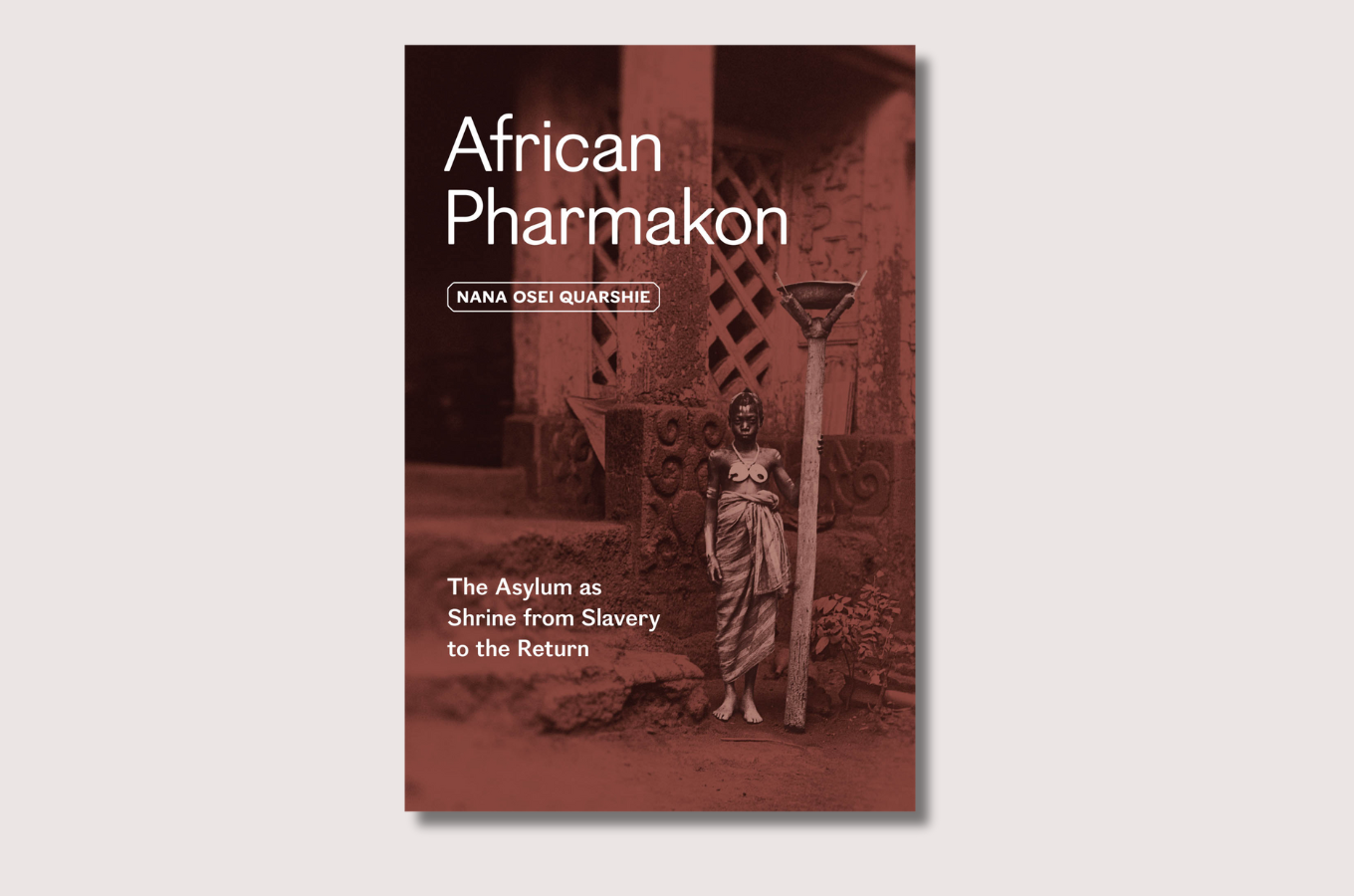
Yale historian Nana Osei Quarshie’s debut monograph, African Pharmakon: The Asylum as Shrine from Slavery to the Return, arrives from the University of Chicago Press in 2025 with a bold thesis: European psychiatric institutions in West Africa didn’t simply displace African therapeutic traditions, they built upon them.
For centuries, mental distress in West Africa has been subject to what Quarshie describes as a mix of healing, harming, ritual, and regulation. His book questions conventional narratives about colonial psychiatry by demonstrating how European psychiatric institutions adapted long-standing techniques of social control and healing already present in West African societies. The book’s central concept draws from Plato’s Phaedrus, where Socrates describes the pharmakon as a substance that can be both palliative and poisonous. Quarshie applies this framework to West African psychotherapeutic practices, arguing that they function as ambivalent mechanisms for mental healing and harming.
Combining extensive archival research with ethnographic fieldwork, including the first scholarly examination of patient records from the Accra Psychiatric Hospital, Quarshie identifies five techniques that have shaped the treatment of mental distress across centuries: spiritual pawning, logging, manhunting, mass expulsion, and pharmacotherapy. The book traces these practices from the Atlantic slave trade era through colonial rule to independent Ghana, examining how Ga shrine priests in eighteenth and nineteenth-century Gold Coast treated mentally distressed individuals who had lost exchange value as labor capital on the Atlantic slave market. His 2023 article “Spiritual Pawning: ‘Mad Slaves’ and Mental Healing in Atlantic-Era West Africa” won the 2024 Jack Goody Award for best article and received an honorable mention for the 2024 James L. Clifford Prize.
What makes African Pharmakon particularly compelling is its rejection of simplistic binaries. Rather than positioning Indigenous healing practices in opposition to colonial oppression, Quarshie offers a nuanced account of how psychiatric care became simultaneously a tool of empowerment and exclusion. West Africans, he argues, were never passive victims of European-imposed psychiatric concepts. Instead, they “enchanted” the British colonial asylum in Accra by engaging with European psychiatric practices through the lens of African ritual and political concerns. Early endorsements suggest the book’s significance extends beyond African history, with scholars praising Quarshie’s “mind politic” analytic as “an absolutely precious gift” that greatly expands the field of the history of madness by making it diasporic and crossing historical time periods.
Nana Osei Quarshie is Assistant Professor in the Program in the History of Science and Medicine at Yale University, with affiliations in the departments of anthropology and religious studies and the Yale School of Medicine. His research, supported by prestigious fellowships including the Chateaubriand Fellowship and the Social Science Research Council’s International Dissertation Research Fellowship, has appeared in Comparative Studies in Society and History, Bulletin of the History of Medicine, History and Anthropology, and other leading journals. African Pharmakon represents a pioneering reframing of how we understand psychiatry and mental health governance in West Africa, challenging us to reconsider histories of confinement, capture, and care on the continent.






COMMENTS -
Reader Interactions