

Part One
When their parents died within six months of each other, twenty-year-old Gift inherited a six-roomed-house on Zvimba Street in Glen Norah, and three younger brothers who looked to him for their daily bread.
They let out four rooms to tenants, but the income melted into mealie meal, bread and cooking oil long before month end. School fees for the twelve-year-old twins, Tendai and Tatenda, became a debate postponed from one term to the next. Gift learned the humiliation of rehearsing apologies to the headmaster, and the quiet trick of leaving his own plate half empty so the boys could eat.
Every afternoon, he sat under the asbestos roof of a disused market stall with other unemployed men. They called the place The Shade. It should have been called The Shade of Despair, for it sheltered no one from anything that mattered. It was there that Peter, freshly back from Johannesburg to bury an uncle, found them.
“It isn’t chaos, the way you boys imagine it,” Peter said, leaning forward on an upturned crate. “There is a whole system. The omalayitshas, the cross-border drivers, know how to move you and your bags if you can pay enough for the bribes along the way. And then there are the amaguma-gumas, who walk you across on foot through the bush.”
“Why not cross at the proper gates?” someone asked.
Peter spat into the dirt. “You need documents, money and time. Men like us have none of those.”
“Does the South African government not try to stop it?”
“They know it happens. The police at that border know it happens. Some of them take the bribes themselves. You cannot fence the whole of Limpopo province. And as long as there is nothing here, no jobs, no sadza on the table, people will keep crossing. The omalayitshas know it. The amaguma-gumas know it. The soldiers know it.”
The talk drifted to football and girls, but Gift stayed quiet.
That night he lay awake listening to his eighteen-year-old brother, Alvin, breathe in the dark.
“What if we go?” Gift whispered. “To Joburg?”
Alvin shifted on his thin mattress. “I’m afraid.”
“So am I,” Gift said. “But the twins need fees. We need food. I can’t keep pretending things will get better on their own.”
A week later they stood at Roadport with a single canvas bag between them. Gift told the twins they were going to find work and would send money soon. He hated himself for not knowing whether it was a promise or a prayer.
Part Two
The tar gave way to red dust at Beitbridge. They spent the night in an abandoned warehouse among thirty strangers. At dusk, a guide named Tom gathered them, his voice flat with practice. Tom collected the cash first, working the notes into a pouch zipped tight against his waist.
“No torches. No phones. If you hear soldiers, drop and stay down. Do not wait for anyone.”
They walked into the bush as the light failed. Thorns tore at their clothes and dust choked their throats. Gift’s cheap shoes split early, and the raw skin at his heels wept into his socks, but he kept pace and said nothing. Behind him, Alvin’s breathing grew heavier with every kilometre, though he did not complain once.
By the second night, they reached Limpopo. In the dry season, the great river had shrunk to channels of cold water threading through banks of pale sand.
“Walk where I walk,” Tom said, stepping into the current.
Gift lifted the canvas bag onto his head and followed. The water climbed to his thighs, cold enough to numb his blistered feet. Beside him, Alvin’s knees buckled against the drag of the current, and Gift caught his arm and hauled him toward the far bank.
When they scrambled onto South African soil, two men stepped out of the reeds carrying heavy sticks. Gift froze, but Tom calmly handed over a bundle of rand notes. The men counted the cash and melted back into the bush.
For two more nights they hid beneath thorn scrub by day and walked by night, avoiding the roads, until they reached Musina. There they packed into an overcrowded minibus heading south. At every roadblock, the driver climbed out, shook an officer’s hand and returned without a word. Nobody asked them anything.
When Johannesburg finally rose out of the morning haze, Alvin pressed his forehead to the cracked window.
“So, this is where our future begins,” he said quietly.
Gift wanted to believe him. But looking out at the endless grey of the city, he felt only how small the two of them were inside it.
Part Three
They joined the ranks of the undocumented, a population nobody counted and nobody wanted to. Formal work was closed to them under the Immigration Act, so they learned the bitter routine of the day labourer. Every morning, at five, they stood on a concrete traffic island on the edge of Sandton, and homeowners and contractors drove past slowly, choosing cheap muscle for the day, the way one chooses fruit at a stall.
Gift learned to mix plaster and paint walls. Alvin, unafraid of heights, found steadier work on the scaffolding gangs. Together they earned less than half the legal minimum wage for twelve hour days of hard labour. At night, they returned to a damp room in Jeppestown, shared with eight other Zimbabwean men. Four foam mattresses covered the floor, shared on a strict rotation. If you worked the night shift, someone else slept on your foam by day.
They adapted to survive. They bought clothes that matched the downtown youth, learned the hand signals of the minibus taxis, and practised their click consonants in the dark. They joined WhatsApp groups that served as an early warning system, quiet messages passed from phone to phone about police vans, immigration raids, and the mood turning in this street or that one. There were rumours, too, of vigilantes standing outside clinics in Hillbrow, turning away anyone who could not produce an identity document, even a woman in labour. Gift did not know if it was true. He only knew that he now walked past every clinic without looking at it, the way one avoids the eyes of a growling dog.
There were lighter hours still. Sundays brought football on a dusty pitch behind the railway line, and for an hour or two, they were simply brothers again, rather than orphans carrying a household on their backs.
There was also Nandi Khumalo, who ran a small takeaway container near Gift’s paint supplier. The first time he ordered, he chose the cheapest thing on the board, a plain vetkoek. She handed him a paper bag heavier than it should have been. Outside, he opened it to find a kota and a piece of fried chicken. He walked back in.
“Sisi, there’s a mistake here.”
Nandi looked at him, and something in her eyes softened. “Just take it, bhuti. You have a long afternoon of painting ahead of you.”
Over the following months, their brief exchanges became the anchor of his week. She began teaching him isiZulu phrases in the quiet hours between customers.
“No, no,” she laughed one afternoon. “Your tongue is too lazy for the click.”
“My tongue is the heavy Bantu kind,” he said. “It was not built for your language.”
She folded her arms and tilted her head. “Oh? Then what was it built for?” There was a mischievous sparkle in her eyes.
Gift grinned and raised both hands in surrender. “That sounds like a trap.”
“It isn’t.”
“It definitely is.”
“So, you won’t answer?”
“Come on, Nandilicious!”
She burst into laughter, and he joined in, relieved he had escaped whatever answer she had been hoping to coax from him.
One Sunday he found the courage to ask her to walk with him in Joubert Park. They sat near a dry fountain, pigeons scattering at their feet.
“Not every South African is against you guys,” Nandi said quietly. “We are the same, really. Same hunger, same government that forgets us.”
Gift smiled without much humour. “When you are hiding from a mob, or running from the metro police, it is easy to forget that.”
“And not every Zimbabwean should think we are all cruel.”
It was a fragile happiness. Walking back towards the taxi rank, two men outside a spaza shop stared openly at them.
“Why is she walking with a kwerekwere?” one called out. “Are there no Zulu men left? We will deal with him.”
Nandi gripped Gift’s arm tighter, her face burning, and said nothing until they were three streets away.
Part Four
Every month, Gift sent money home through a friend’s bank account, or EcoCash, or a crowded transfer booth on Bree Street. He punched the codes into his cracked phone and waited for the confirmation message to arrive like a held breath finally released. Three meals a day for the twins. School fees paid before the deadline. Each transfer felt like a small fist raised against the poverty that had orphaned them twice, once by death and once by circumstance.
“The twins sent a voice note,” Alvin said one evening, exhaustion shadowing his eyes. “They had chicken for dinner.”
“Then it is worth it,” Gift said, though two years of hiding, of working to the bone, of pretending in every voice note that everything was fine, had begun to show on both of them.
“Gift,” Alvin whispered later, so the sleeping men around them would not hear. “I heard something at the site today. There is talk of a group calling itself March and March. They are saying all makwerekwere abahambe, all foreigners, must be gone by the end of the month. Packed and out, or face consequences. Operation Dudula is already going door to door in some blocks, checking papers.”
“People talk like that every few months,” Gift said, keeping his face flat.
“It isn’t only talk this time.” Alvin sat up, fear open on his face. “They burned shacks down at the coast last month. People died there, Mozambicans, they said on the radio. If a thing like that comes here, we have nothing standing between us and them.”
“Panicking will not help us,” Gift said, and then softened his voice. “We avoid the main roads. We look like we belong. We have survived two years, munin’ina.” He did not tell Alvin that he had heard the same warning that morning, from a different mouth, in a different street.
The trouble came on a dry Friday evening. Walking back from a job, they turned the last corner towards Jeppestown, and stopped. A crowd filled the street, voices raised in a chant that needed no translation. The contents of their neighbours’ lives lay scattered on the tarmac: clothes, a slashed mattress, a child’s blue school jersey trodden into the dirt. The glass front of the Nigerian shop on the corner had been put through, loaves of bread crushed underfoot among the shards. In the centre of a ring of onlookers filming on their phones, a man was being beaten. It was Pedro, a quiet Mozambican carpenter who had once fixed their door for nothing. His face was already a mask of blood, his cries lost beneath the thud of boots and wood.
Alvin grabbed Gift’s arm. “We have to go. Now.”
“Hey! Wena! Where do you two think you’re going?”
Three men closed the distance. One carried a rusted iron pipe. Another, in Zulu attire, held a short spear. The third wore a strange, hungry smile and nothing else on top.
Gift raised his hands, palms open. “We are not looking for trouble, brother. We are only passing through.”
“Passing through?” The man with the pipe spat near Gift’s foot. “You have been passing through for years. Taking our jobs. You think we don’t see you? Makwerekwere abahambe.”
“We are not doing anything wrong. All we want is to work,” Gift said, his voice steady despite the fear climbing his throat.
“Go and work in your own country.”
The pipe swung in a vicious arc. Gift threw up his left arm to protect his head, and the impact was sickening, a crack that seemed to come from somewhere outside his own body. He stumbled backwards and dropped to his knees, retching.
“Gift!” Alvin threw himself forward.
After that, the world came apart, fragment by fragment. A boot in the ribs. Rough hands tearing at his pockets for the week’s cash. His phone gone, his shoes pulled from his feet. Somewhere close, Alvin was screaming, and through the blur, Gift saw his brother pinned to the ground, his jacket torn away, boots driving into his stomach.
“Abahambe! Go back to your own poverty!”
A heavy boot slammed into Gift’s thigh and he curled into himself. In the strange clarity that sometimes visits real pain, he thought of the twins waiting for a confirmation code that would not come this month. He thought of his parents beneath the dry grass of KuMbudzi Cemetery, and hoped, absurdly, that they could not see this.
A sharp cry cut through the noise. The man with the spear had lunged, opening a gash across Alvin’s forehead.
“Enough!” a woman’s voice rang out, furious and unafraid. “Enough! You have taken everything already. Leave these boys!”
The blows stopped. Gift opened one eye. An older South African woman was marching down the street, a small crowd of neighbours gathering behind her. The attackers hesitated, laughed to cover their retreat, and scattered into the alleyway with their loot. The onlookers drifted away too, leaving the street to its wreckage.
“Alvin.” Gift dragged himself across the tarmac on his elbows, his broken arm hanging wrong at his side. “Alvin, look at me.”
Alvin’s eyes would not settle. “Gift. My head. I can’t see properly.”
“Get up, munin’ina. We have to move before they come back.”
They staggered upright together, Gift’s good arm around his brother, Alvin’s weight sagging against Gift’s fractured side. They held each other exactly as they had over their parents’ graves in Harare, two boys learning again how little separates standing from falling.
A few metres away, the woman was pressing a cloth to Pedro’s bleeding head. “Don’t go back to your room,” she said without looking up. “Walk to the Methodist church on Jeppe Street. The pastor opens the hall when this happens. They don’t ask for papers there. Go now, before the patrol comes back round.”
Part Five
The Methodist church stood on a dark corner, its stone walls offering a fragile kind of sanctuary against a city that had turned its face away. By the time the brothers stumbled through the heavy wooden doors, the parish hall was already filling with the displaced.
Zimbabweans, Malawians, Congolese and Mozambicans sat pressed together on borrowed blankets. Women wept quietly in the corners. Children were held too tightly against chests that had nothing else left to hold onto. Others simply stared up at the high rafters, stunned past speech by the sudden loss of everything they had built.
A young volunteer cleaned and bound the gash on Alvin’s forehead, then splinted Gift’s arm with two lengths of scrap wood and a torn sheet, apologising for the pain with every knot she tied.
They sat with their backs against the cold stone, the church settling into its long night of other people’s grief.
“Gift,” Alvin whispered, his voice small beneath the white bandage. “Is this going to happen to us again?”
“I don’t know, Alvin. I don’t know, munin’ina.”
He thought of Nandi, who had gone to Soweto for the weekend and did not yet know that Jeppestown was burning. He wondered whether her family would warn her away from him for good now, whether the fires in this street would reach all the way to her door in the shape of a decision she had not yet made. A tear traced a clean line through the dust on his cheek.
Something about the church made him think of The Shade back home, and for a moment his mind wandered loose from the pain. Soon they would move on again, from this hall to the Zimbabwean consulate, from one point to the next, always forward and never home. If they ever went back to where they started, that would make a triangle. A triangle of despair, pointless by definition, since every point on it led only to another. He almost laughed, but the sound cracked into something else in his throat.
They had not come to South Africa to grow rich or to take anything from anyone. They had come to mix cement, wash clothes, sweep floors, sell vegetables, guard buildings through the cold hours of the night, and send something small back home every month. Their dreams had never reached further than a decent meal for four boys in Glen Norah and the chance, one day, to return home with their dignity still intact.
They had worked the hours that many locals refused, paid rent on time, queued for taxis in the rain, and tried above all to remain invisible. But to the mob in the street that evening, they had not been fathers, sons, brothers, or grieving orphans keeping a house together with EcoCash and prayer. They had been only amakwerekwere, outsiders blamed for a poverty that had taken root in the country long before they crossed the river.
Now they sat beneath a stranger’s roof, stripped of almost everything they had carried with them, and Gift drew his brother in against his side with his one good arm and held him there until the sirens outside grew fainter, and then further still, and then, near morning, stopped.
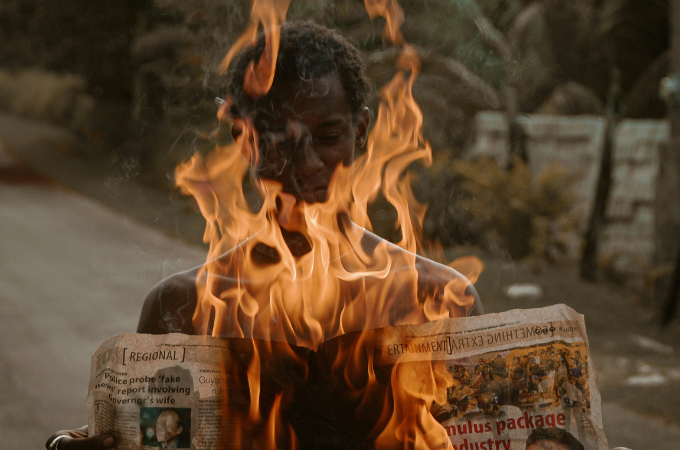
Photo by Shaquiel McKenzie on Unsplash







COMMENTS -
Reader Interactions