

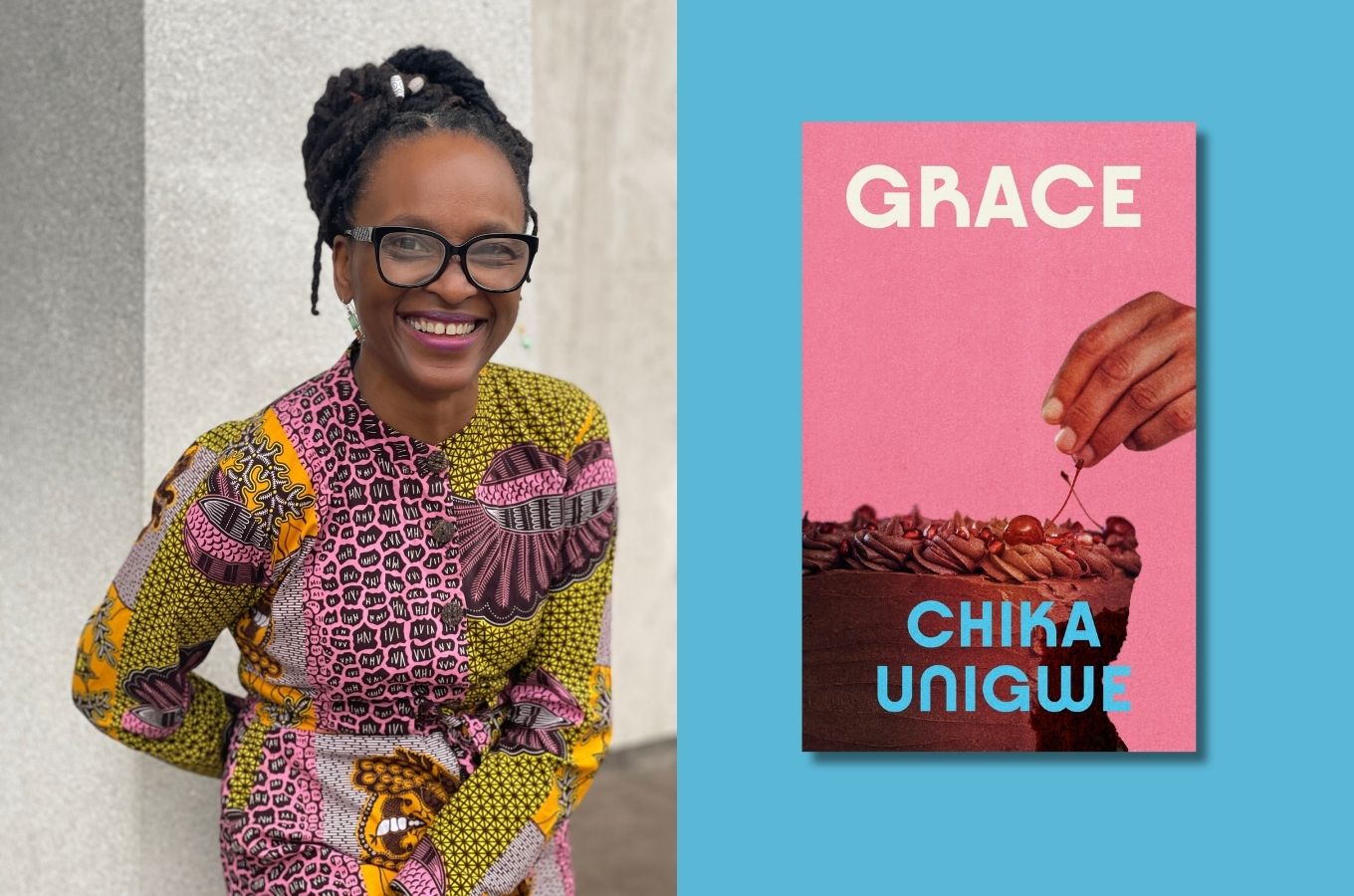
Chika Unigwe’s novel titled Grace is about a midwife named Grace. And yes, her name hovers uncomfortably close to the word disgrace because the novel is about how easily grace slips into disgrace when women are judged by impossible standards. Maybe because I am mother as well, this book spoke to me as a direct form of address. And all I could see as I read are the many mothers crowding its pages, all trying to survive a system that makes mothering into a life goal that women are set up to botch.
Published by Canongate just days ago, the novel is set in 2020, at the height of COVID. It opens in Enugu, one of southeastern Nigeria’s major cities, with Grace, who appears on the outside to be a successful midwife. She runs a maternity home, she is married, and respected in church and society. But Unigwe slowly pulls back the curtain on what lies behind that success. At fifteen, Grace became pregnant by her sixteen-year-old boyfriend, Ben. When the pregnancy is discovered, Ben slips out of the complications that arise with astonishing ease, while Grace is left to bear the full weight of teenage pregnancy. She is verbally assaulted by Ben’s mother and ultimately led by her own mother to abandon her baby by the roadside. That decision is the novel’s moral and emotional center.
Years later, when Grace runs a clinic that helps desperate young pregnant girls relinquish their babies to wealthier, childless couples, she is asking the same question about what “choice” really amounts to when every available option leads to ruin. In spite of doing such an ethically questionable service, Grace does not see herself as a bad person. Officially, her clinic offers birthing services like any maternity clinic, with nurses and doctors. Unofficially, she helps teenage girls and young women who are pregnant, poor, and have no support. Most of them cannot keep their pregnancies without their lives falling apart. Their families would reject them, they would be forced out of school, or they would be stuck raising a child without money or help. When these girls come to Grace, she gives them a place to stay and medical care during the pregnancy. After the baby is born, the baby is given to a childless couple who want a child and can afford to pay. Almost all the money goes to the girl who carried the pregnancy, so she can start over: go back to school, move away, or survive without being tied permanently to the pregnancy. Part of this story is how Grace is able to justify the ethical grey area of what she is doing and differentiate herself from the notorious baby factories found in Nigeria.
Making sense of this ethical tightrope is the foundation of Grace’s connection with the reader, what Grace has to think through and unknot for herself as the novel progresses. Grace has had to live with the aftermath deciding to let go of a child, when it felt that that was the only card she had left to play, so while her work is driven by compassion, she is haunted by her unresolved grief and guilt for a child she abandons. Unigwe handles the ambiguity well, never being pushy about how we should feel about Grace’s clinic.
One thing I truly loved about this book is that it makes it almost impossible to judge mothers. It resists the usual moral frameworks we bring to stories about women. Unigwe does this deliberately, by inundation. There are simply too many mothers here, operating under too many pressures, for any single one to absorb all the blame. And because I am, in fact, a literary scholar, and because literary scholars are constitutionally incapable of resisting the urge to catalogue, I want to pause and map the many ways Grace defines motherhood. Indulge me.
There is Grace herself a mother. She has two daughters she loves, but she is also the mother of a child she abandoned and has never been able to grieve publicly. Then there are the pregnant girls who come to her. Society treats them as mothers only in the biological sense. Pregnancy places them in an extremely vulnerable position. They are expected to carry a child but not allowed to claim it without punishment. Their motherhood is a mark of shame, something they have to give up in order to have a future at all. On the other side are the wealthy women who come to collect the babies, mothers-in-waiting and socially protected. They come to Grace with stories about the woes of childlessness, with the knowledge that their desire for a child is considered by the world around them to be legitimate and urgent. They are not shamed for infertility in the same way teenage pregnancy is punished, but they are still constrained by family expectations. Other mothers in the story are harder to rationalize. Ben’s mother represents motherhood as a defense of male privilege. When she insults Grace and calls her a prostitute, she is being mean, but what is even more disturbing is that she knows that the world is on her side. She knows society will agree with her: that a pregnant girl is a disgrace, that a boy’s future must be protected at whatever cost, that blame should land squarely on the female body. Grace’s own mother embodies a more devastating form of maternal failure. Even though she does everything in her power to help her daughter, she still succumbs to the fear of social judgment, fear of what her daughter’s pregnancy will do to the family. When she leads Grace to abandon the baby, she is acting out of desperation rather than malice.
When you only look at a single mother in a story, it’s easy to ask whether she did the right or wrong thing. But when the novel shows us many mothers, all operating under very different pressures, that kind of judgment starts to fall apart. All of these women are flawed because they are trying to survive in a world that, as Grace puts it, “did not forgive women it found wanting.”
In terms of style, Grace is spare. Unigwe strips the novel down to what needs to be said. It’s also a short book, the kind you think will last longer than it does, so it’s worth taking your time with the book. I was not as discerning and inhaled in a one slow Sunday morning over coffee and pastry. Her style reminds me of Chinua Achebe’s famous economical writing — that kind of writing that can do a lot with very little, writing that can conjure entire emotional and social worlds with just a few well-chosen details. Unigwe doesn’t explain everything or lean heavily on dialogue. She lets tightly orchestrated scenes and vivid images do most of the emotional work.



COMMENTS -
Reader Interactions