

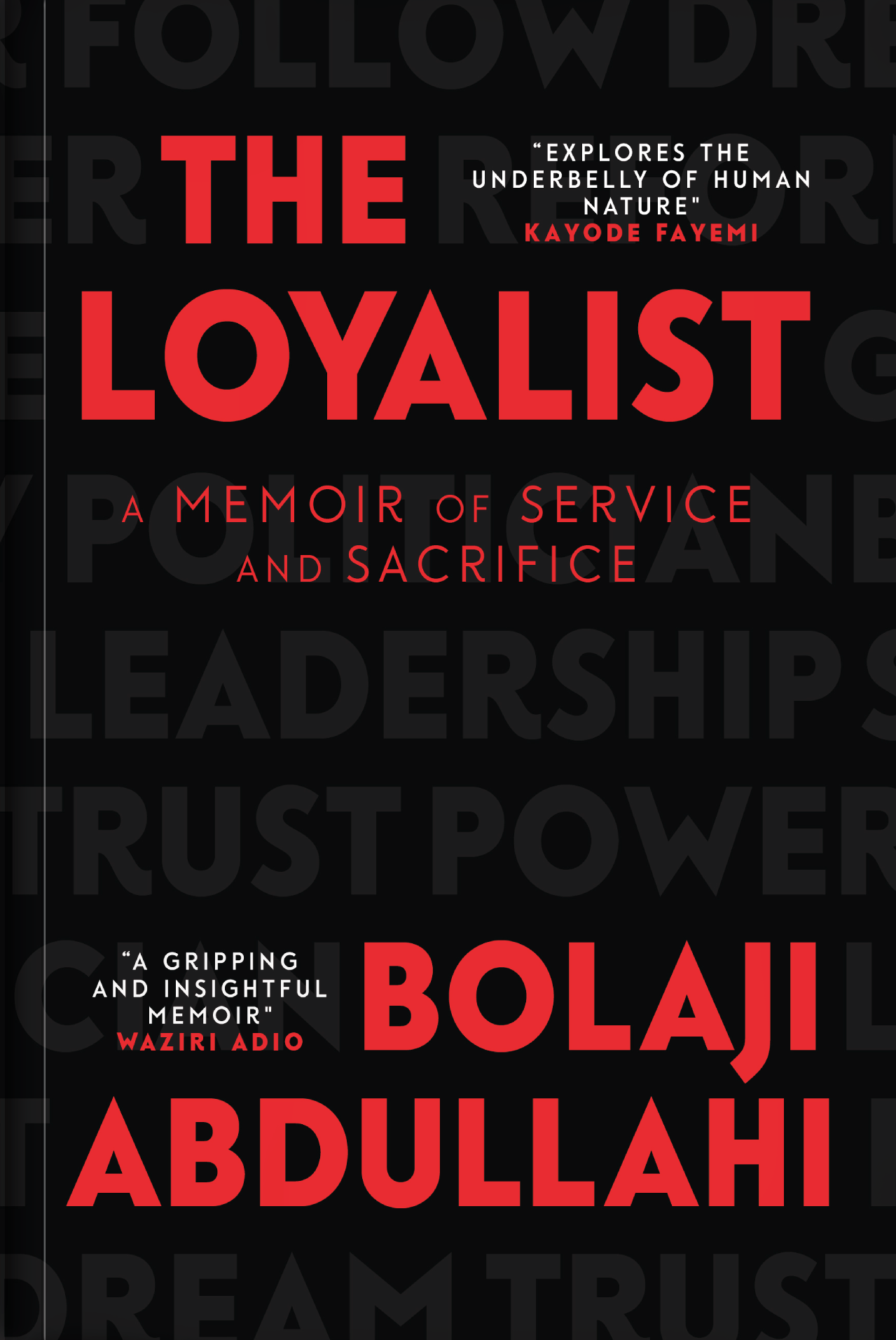
 EXCERPT TAKEN FROM CHAPTER ELEVEN
THE DREAMS WE CARRY
My first personal contact with Oshiomhole was when, as governor of Edo State, he organised the 10km Okpekpe Road Race in May 2013. Through Mike Itemuagbor, he invited me to the inaugural edition. He was particularly impressed that even though I was a minister in the PDP government, I could attend an event organised by an opposition party.[1] This notion of party difference did not even occur to me. The marathon was a brilliant sporting event that I was happy to support as the minister of sports. More importantly, after what he did for me in South Africa, I could not possibly refuse an invitation from Mike.
The same day that the state executive of the party loyal to Saraki was dissolved, Senator Saraki called and told me to resign before Friday.
“So our people don’t start to say you did not follow us back to PDP,” he said.
This directive made it clear he had decided I would be the party’s governorship candidate in 2019. While I felt this was a good deal, I also knew that if I stayed in the NWC, the party might have been equally happy to offer me the governorship ticket, if only to spite him. However, such a move would have meant ending my relationship with him.
The following day, I met with the National Organising Secretary, Osita Izunaso, whose political experience I had relied on many times before.
“It’s good that you’ve built your reputation as a loyal person. I’m also happy for you that Oloye has decided to reward your loyalty. It’s good for him too. But you need to find your own reason for leaving the party,” he said.
“What do you mean? I don’t understand,” I replied.
“You know, people are beginning to say that if you give Bolaji any assignment, he’ll do it well. But the moment you have a problem with Saraki, he’ll abandon the job and follow him. People appreciate that you are loyal, but that’s not good for you,” he explained.
The following day, 31 July, Senator Saraki finally announced his decision to leave the ruling APC. In his statement, he said he had arrived at the “difficult decision” in the interest of his people and associates, who in the past three years had “suffered alienation and been treated as outsiders in their own party.” He also reiterated his earlier assertion that there was a “government within the government,” which had made genuine reconciliation impossible. “This was why my people, like all self-respecting people would do, decided to seek accommodation elsewhere.”
On 1 August, I also handed in my resignation letter, citing the unilateral dissolution of the party executive in Kwara State as my main grievance. That same day, I resigned as Chairman of the Nigeria Sugar Development Council, a position I had been appointed to in December 2017. No one asked me to do this, but I felt it would be hypocritical to resign my membership of the party while holding onto a position I had obtained solely due tothat membership.
Reflecting on why Senator Saraki felt the need to promise me the governorship ticket, I concluded that there were three possibilities. One, my governorship aspiration aligned with his plans for 2019, and he would have supported me regardless of whether we were leaving the party or not. Two, he did not want me to lose another high-profile position due to his politics without compensating me. Afterall, as Solonius said in Spartacus, “Loyalty can be a crushing weight, if not braced by proper support.” The third reason was that, despite my antecedents, he simply did not trust that I would follow him without an incentive. It could also have been a combination of all the three.
My view of politics and power had been shaped by my years as a journalist. I saw political power not as the Golden Fleece atop a dragon-guarded mountain but as something residing in the sordid underworld, beneath the level of human dignity. Anyone who desired it had to crawl through sewers to reach it, emerging on the other side too corrupted to do anything good with it. This was even before I heard Ragnar Lothbrok, hero of the Netflix series Vikings, say that he never sought power because “[It] is only given to those who are prepared to lower themselves to pick it up.”
However, my time as a policy adviser and later as Commissioner for Education opened my eyes to what could be achieved with political power in competent and courageous hands. Conversely, my experience as a federal minister, especially in my time in youth development, taught me that grand ideas could remain just that if one does not have real politcal power.
An ethical politician might sound like an oxymoron, but I had met politicians driven by a desire to serve the public good. While they might have crawled through sewers and might have even been tarnished by compromises they had to make, they never lost sight of their higher objectives. For them, the suffering was necessary, and even tolerable, for the sake of the purpose they had to serve, which was greater than themselves.
Around April 2018, I set about the task of developing a plan that would make it clear to everyone why I wanted to be governor. My aim was to show, early on, that I was the most prepared of anyone else who might be vying for the same position.
In his own quest to become president of the country, Senator Saraki had consistently campaigned on his competence and courage. He argued that Nigeria would only make real progress if we put our best foot forward. He could say this with confidence because he considered himself to be one of the best,—a claim that would be difficult to contest. Even his worst detractors could not deny his competence and ability to get things done.
By drawing up a plan, I wanted to demonstrate to him that if he backed me to be governor, he would not just be compensating me for the ministerial position I lost or the other sacrifices I might have made, but he would also be putting his best foot forward, just as he had advocated. After all, he could not champion the idea that only the best was good enough for the country while lowering the standard for our state.
Apart from holding an advanced degree in governance, I believed my strongest credential was my knowledge of specific policies, the general principles that inspired them, and their political contexts. This expertise had been built over eight years of working with him, first as an aide and later as a commissioner. My background as a child of poor parents also gave me an intuitive understanding of the living conditions of the majority of our people. For me, poverty was not just something that I had only studied in IDS.[2] Poverty and I attended the same schools; we sat in the same seats and slept in the same dormitories. This, I believed, was the lived reality of the majority of the people I planned to govern. I could relate to their stories because I was one of them.
I consulted with experts in public health, finance, asset management, mining, and agriculture. I held brainstorming sessions and focus group discussions, as I was taught in development school. During these sessions, I met many talented young people, as well as older and more knowledgeable individuals from our state who worked in diverse sectors across the country and the wider world. I began to form an idea of which individuals could play which roles. I intended to take full advantage of their talents and experience in building a truly efficient government.
In one survey that we commissioned, we found that health was the biggest issue for most people, followed by youth unemployment and then education. We also discovered that the majority of our people spent the bulk of their incomes on food, hospitals, and private primary education. Among those earning their incomes in the state, about 40% earned less than ₦18,000 a month, while another 48% earned between ₦18,000 and ₦30,000 monthly. Going by the 2017 World Bank-adjusted definition of extreme poverty as earning below $1.90 per day, it was highly likely that up to 86% of our people fell within the extreme poverty zone. With this picture in mind, our priorities could not have been clearer.
In the end, we produced a beautifully packaged handbook titled Kwara 2019: Agenda for Youth Development and Investment in People. The general principle of our plan was to put people at the centre of the government’s development agenda. We believed that if the government made the right investments in people through health, education, and skills development, it would empower them to take charge of their lives and become productive actors in growth and development.
Although we created these plans to demonstrate original ideas and solutions to the problems in our state, we also considered it strategic to emphasise that these ideas were expressions of Senator Saraki’s grand vision for the state and a continuation of the work he started in 2003. Yet again, as Robert Greene admonished, never outshine the master.
When I gave him a copy of the document, he flipped through it and only asked me where I had it printed. Whether he took the time to read it afterwards, I do not know. On Wednesday, 12 September, I formally announced my plan to run for governor at a colourful event in Ilorin and presented the plan to party bigwigs across the state.
Soon after, I commenced a tour of the local government areas. Kwara State has 16 local government areas,and during my work as Commissioner for Education, I had become familiar with most of them. In all the places we visited, many recalled my time as commissioner with nostalgia and expressed excitement about the possibility of my returning as the state’s chief executive. “If nothing else, I know our children will get a good education,” one traditional ruler remarked when we visited his palace.
As the days for the primary election drew closer, I noticed that the number of aspirants had swelled to six or seven. This was quite unusual in a state known for selecting candidates through consensus. Even the national secretariat of the PDP had started to wonder what was happening in Kwara State. Meanwhile, the leader himself continued to insist that he would not ask anybody not to contest.
I believed that each of the aspirants sought his consent before proceeding to obtain the nomination form. Although I was confident I already had the ticket in the bag, I worried that too many people would be left embittered in the end, making it difficult to rally their support for the general election. When I brought this concern to the leader’s attention, he said he was reluctant to tell anyone not to contest because he did not want to lose more followers. He cited examples of people who had left because he had asked them not to contest in past elections. I agreed with him but suspected there was more to it. By allowing everyone who so desired to contest and by insisting that he would not interfere, he was probably sending a message to the party at the national level. He planned to contest in the upcoming presidential primary election, and I suspected this liberal posturing might have something to do with that.
A few days before the primaries, some people visited my house. According to them, they liked me and would like me to become governor. However, they strongly thought that I should start to think of a “Plan B,” in case Oga did not give me the ticket.
“We heard Oga has promised you. But, hmmm,” one of them said, shaking his head.
“Honourable Minister, you should understand what we are saying,” another added.
I did not understand what they were talking about, and I had to do my best not to insult them. I even wondered if they had been sent to test me. In all the years I had known Senator Saraki, I could not recall an instance where he had said one thing and done another. When people asked if they could trust him, I assured them with the conviction of a devotee that if my Oga did not want to do something, he would rather keep quiet or avoid the issue altogether. However, once he gave you his word, you could bank on it. Despite my indignation, I thanked them and assured them that everything was in God’s hands.
I believe in God. But despite my faith, I felt a certain chill down my spine when I considered that everything I had done—the money I had spent, the travelling, my great ideas and plans—depended on me securing the backing of just one man. It was enough for me that he had given me his word, but I still wondered if these people, who were asking me to consider an alternative plan, knew something I did not.
On Saturday, 29 September, I woke up from a midday nap to find a missed call from the leader himself. When I returned the call, he asked me to meet him at his guesthouse, which was only a few minutes’ drive from my house. The following day was the primary election, which I believed would be a mere formality. I had returned from Baruten Local Government that morning, concluding my statewide consultation visits. Feelinglike the candidate designate, I was the only aspirant who had toured all 16 local governments. My strategy was to ensure that by the time the general election campaigns began, I would not be visiting those places for the first time.
As I was about to step out of the house, I remembered the dream I had during that short nap. As I recalledit, the dream felt somewhat strange and even a little disturbing. In the dream, I was walking down an alley, and although it was dark, I could see everything as if it were daylight. I turned a bend and came upon a large swimming pool. I was wearing only a pair of white boxer shorts. A couple of young men were sitting around the pool. If they noticed me, they did not show it, and I did not speak to them either.
I dived into the pool, only to find that the water was dirty and smelly, as though the pool had been long abandoned. As I gathered myself to climb out, the youths started to laugh in jest. My white boxers had turned brown. I then found myself in a different place, resembling a market. There was a sizeable crowd of people all around. I was not bothered that I was walking around almost naked but was instead concerned that people might notice I smelled bad. To my relief, they did not seem to see me, even as I walked through them.
Then I found myself walking down a dark hallway. I saw light at the far end, so I quickened my steps. Justas I was about to reach the light, a wall suddenly rose in front of me. An iron sheet, like roll-up security shutters, dropped and sealed off the wall. I rushed forward and managed to tear off the iron sheet with my bare hands. I began punching the wall and was able to make a small hole. As I continued punching, I woke up.
[1] He was elected on the platform of Action Congress of Nigeria, ACN.
[2] Institute of Development Studies of the University of Sussex
—
Excerpted from THE LOYALIST: A Memoir of Service and Sacrifice. Copyright © 2026 Bolaji Abdullahi. Published with permission from Masobe Books.
Preorder a copy here.



COMMENTS -
Reader Interactions