

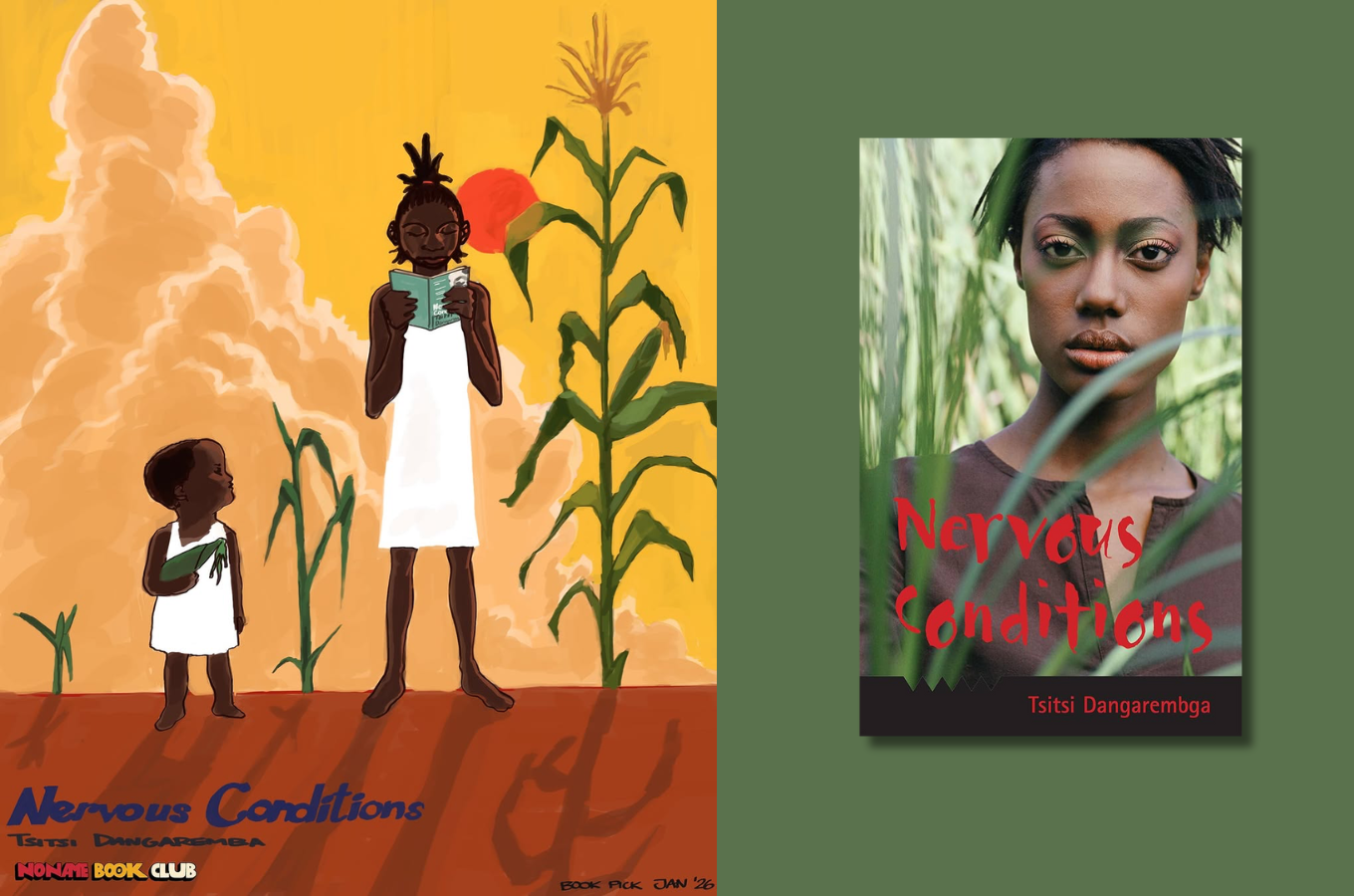
Noname Book Club begins the year with Tsitsi Dangarembga’s groundbreaking 1988 novel Nervous Conditions, a work that has shaped generations of readers’ understanding of colonialism, gender, and education in postcolonial Zimbabwe, and Africa at large. The selection continues the club’s commitment to centering works by Black authors that interrogate systems of power and oppression across the African diaspora.
Nervous Conditions tells the story of Tambu, a young Shona girl navigating the complexities of colonial education, patriarchy, and family obligation in 1960s Rhodesia. The novel’s famous opening line, “I was not sorry when my brother died”, immediately positions readers within a narrative that refuses sentimentality about the costs of survival under intersecting oppressions. Dangarembga’s exploration of how colonial education estranges Africans from their own communities while promising liberation remains urgently relevant.
Since its publication, the novel has become essential reading in postcolonial studies and African literature courses worldwide. It was the first book published in English by a Black Zimbabwean woman, breaking ground in an industry that had largely excluded African women’s voices. The book’s examination of how women navigate limited choices within patriarchal and colonial structures influenced subsequent generations of African women writers exploring similar terrain.
Noname Book Club’s selection of Nervous Conditions aligns with their reading trajectory spanning radical Black thought and literature. Past selections have included Octavia Butler’s Parable of the Sower, Aime Cesaire’s Discourse on Colonialism, Angela Davis’s Freedom Is a Constant Struggle, Toni Morrison’s The Bluest Eye, Chinua Achebe’s Things Fall Apart, James Baldwin’s The Fire Next Time, and Audre Lorde’s Sister Outsider. The club has also featured contemporary works like Brit Bennett’s The Vanishing Half, Kiese Laymon’s Heavy, and Jesmyn Ward’s Sing, Unburied, Sing, alongside political texts such as Michelle Alexander’s The New Jim Crow and Roxane Dunbar-Ortiz’s An Indigenous Peoples’ History of the United States. These selections consistently encourage readers to examine structural inequalities while imagining transformative possibilities.




COMMENTS -
Reader Interactions